  1. Home
  2. Emerging Tech
  3. News

Artificial intelligence can now identify a bird just by looking at a photo

Add as a preferred source on Google
Image used with permission by copyright holder

Artificial intelligence technology has proven itself useful in many different areas, and now birdwatching has gotten the A.I. treatment. A new A.I. tool can identify up to 200 different species of birds just by looking at one photo. 

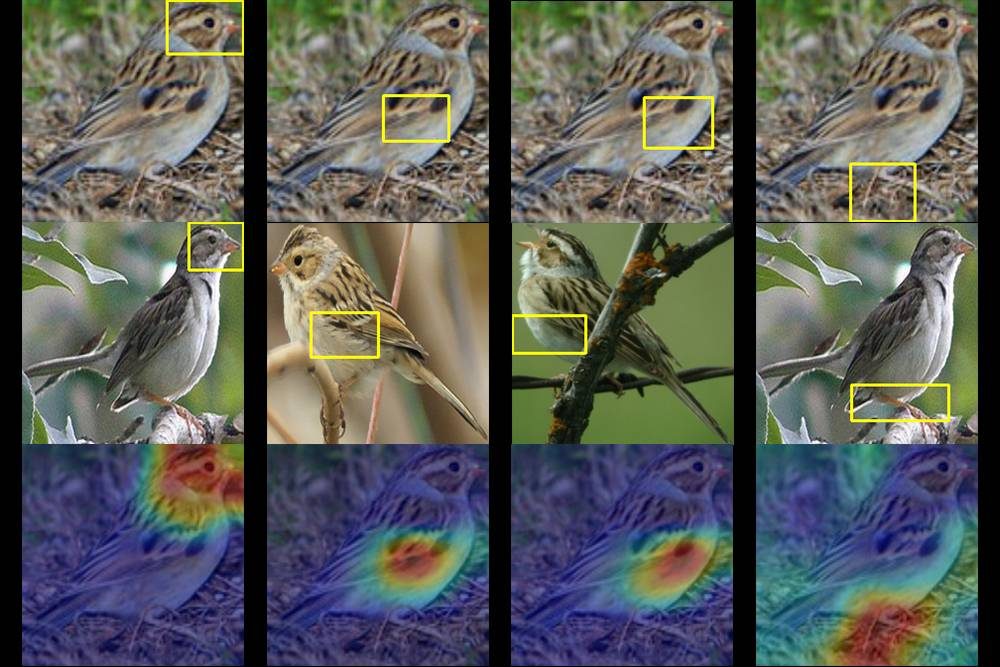
The technology comes from a team at Duke University that used over 11,000 photos of 200 bird species to teach a machine to differentiate them. The tool was shown birds from ducks to hummingbirds and was able to pick out specific patterns that match a particular species of bird. 

Recommended Videos

“Along the way, it spits out a series of heat maps that essentially say: ‘This isn’t just any warbler. It’s a hooded warbler, and here are the features — like its masked head and yellow belly — that give it away,’” wrote Robin Smith, senior science writer in Duke’s communications department, in a blog post about the new technology. 

The researchers included Duke computer science Ph.D. student Chaofan Chen, Duke undergraduate Oscar Li, team members from the Prediction Analysis Lab, and Duke professor Cynthia Rudin. The team found that the machine learning correctly identified bird species 84% of the time. 

Essentially, the technology is similar to facial-recognition software, which remembers faces on social media sites to suggest tags or to identify people in surveillance videos. Unlike other controversial facial-recognition software, however, the technology from Duke is meant to be transparent in how the machine learns identifiable features. 

“[Rudin] and her lab are designing deep learning models that explain the reasoning behind their predictions, making it clear exactly why and how they came up with their answers. When such a model makes a mistake, its built-in transparency makes it possible to see why,” the blog post reads. 

The hope is to take this technology to another level so it can be used to classify areas in medical images, such as identifying a lump in a mammogram. 

“It’s case-based reasoning,” Rudin said. “We’re hoping we can better explain to physicians or patients why their image was classified by the network as either malignant or benign.”

Digital Trends reached out to Duke University to find out what other ways the new tool can be used for, but we haven’t heard back. 

Allison Matyus
Former Digital Trends Contributor
Allison Matyus is a general news reporter at Digital Trends. She covers any and all tech news, including issues around social…
Claude Code can now browse the web without opening Chrome
The desktop app now includes an in-app browser that can read websites, click links, and interact with web apps.
Claude Code Featured

Developers spend a surprising amount of time bouncing between their code editor, browser tabs, API documentation, GitHub issues, and design files. Anthropic thinks Claude Code should simply do all of that without constantly asking users to switch windows. The company has announced a new in-app browser for Claude Code on desktop, allowing its AI coding assistant to open websites, read documentation, inspect designs, and interact with web pages directly from within the application.

A browser built into Claude Code

Read more
Apple is suing OpenAI over theft of trade secrets in blockbuster lawsuit
The lawsuit claims OpenAI recruited Apple employees and obtained confidential information about unreleased products.
Apple store Apple Building Apple Logo

For the past two years, Apple and OpenAI have been presented as close AI partners. ChatGPT powers key Apple Intelligence features, Siri can hand complex queries over to OpenAI, and together the two companies helped bring generative AI to millions of Apple devices. Now, that partnership has taken a dramatic turn.

What is Apple accusing OpenAI of?

Read more
Home robots can already walk. The hard part is stopping them from crushing your glassware
1X’s NEO uses tactile sensing and force control to handle fragile objects, aiming at the kind of household work humanoids still struggle to do.
Baby, Person, Electronics

A robot can look convincing while walking across a stage and still be useless in a kitchen. Picking up a wet glass demands precision, quick corrections, and enough restraint to avoid squeezing too hard. 1X is tackling that problem with new tendon-driven hands for NEO, its humanoid home robot.

1X says each hand has 25 degrees of freedom, with 22 across the fingers and palm and another three in the wrist. Its joints can yield when pushed instead of staying rigid, giving NEO a better chance of handling household objects without treating every collision like a wrestling match.

Read more