1. Home
  2. Emerging Tech
  3. News

Bouncing robot reaches new heights, artfully dodges moving obstacles

Add as a preferred source on Google
SALTO - Teaching an old robot new tricks

Meet Salto, a tiny and adorable bouncing robot developed at UC Berkeley. The bot weighs just 100 grams (3.5 ounces) and is about a foot long, and it can move through an environment by bouncing and jumping.

Recommended Videos

Salto was first developed in 2016, and back then could only jump off the ground once then bounce off wall. The latest version of the robot has learned lots of new tricks, and now it can do hundreds of jumps in a 10-minute period, can jump up to 4 feet high, and can travel forward at eight to 10 miles per hour. It is more intelligent too, and can dodge obstacles, even moving targets.

Ph.D. candidate Justin Yim spent four years working on the bot, and it’s now sophisticated enough that he can take it for short walks around the university campus.

“Small robots are really great for a lot of things, like running around in places where larger robots or humans can’t fit,” Yim explained in a statement. “For example, in a disaster scenario, where people might be trapped under rubble, robots might be really useful at finding the people in a way that is not dangerous to rescuers and might even be faster than rescuers could have done unaided. We wanted Salto to not only be small, but also able to jump really high and really quickly so that it could navigate these difficult places.”
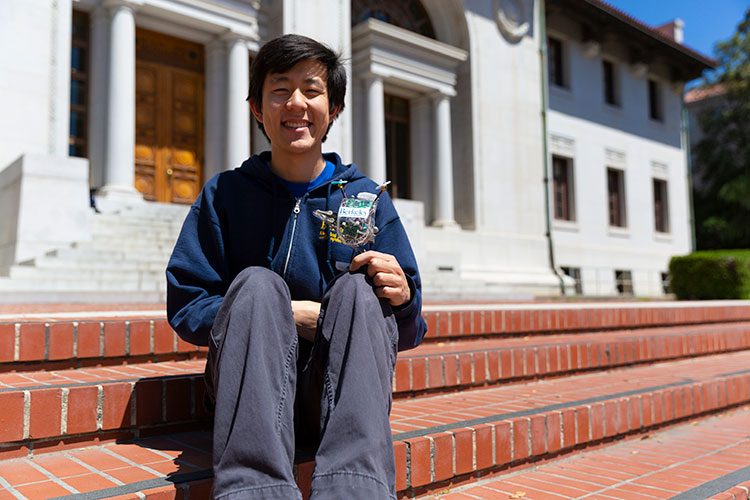
Robotics graduate student Justin Yim led the effort to program Salto with sophisticated control software that lets the robot master complex maneuvers. UC Berkeley photo by Stephen McNally

The bot was developed using motion capture technology to test its capabilities. The information about how the robot should move is calculated on a laptop and sent wirelessly via radio to a control board inside the robot. This means that Salto can hit a particular spot on a surface very accurately, which enables it to perform complex jump maneuvers.

“It’s worked better than any other of our other robots we’ve had so far,” Professor Ron Fearing of the UC Berkeley Department of Electrical Engineering and Computer Science said in a statement. “These fast accelerations let us move on surfaces where a conventional robot would just fall right off.”

The next challenge for the team is to get Salto to work on uneven or complex surfaces like grass or gravel. They are also considering adding an arm to the bot to let it interact more with the environment, such as grabbing onto branches and swinging upward.

Georgina Torbet
Georgina has been the space writer at Digital Trends space writer for six years, covering human space exploration, planetary…
Remember Samsung’s Ballie home robot? It may finally be inching closer to reality
Leaked app wireframes give the strongest hint yet that Samsung's Ballie home robot, first shown at CES 2020, might still be headed toward an actual release.
Samsung Ballie robot in a room next to a dog feeder.

Samsung's rolling home robot has been the industry's longest-running "will it ever actually ship" joke, and I'll admit I'd mostly given up on it. Now, there's finally a glimmer of hope.

Samsung first unveiled Ballie as a concept at CES 2020. Then, it showed it as a significantly upgraded version four years later. However, the company never confirmed a release date or committed to releasing it at all. 

Read more
Polar is yet another AI browser, but it goes beyond just automating the mundane web chores
Polar wants to turn your browser into an AI-powered productivity tool
Polar AI browser

The AI browser race is entering a new phase. After spending much of 2025 trying to reinvent web search with built-in chatbots, startups are increasingly shifting their attention toward browser agents that can automate repetitive work instead of simply answering questions. The latest company to embrace that transition is Polar, a startup founded by former Perplexity engineer Kevin Zhang, which has raised $5.7 million in seed funding led by Madrona.

Unlike the first generation of AI browsers that targeted everyday consumers, Polar is designed specifically for knowledge workers. Its premise is straightforward: instead of replacing Google Search, the browser aims to eliminate repetitive tasks that professionals perform across dozens of browser tabs every day.

Read more
I use ChatGPT Pro everyday, and these 3 features keep me subscribed
ChatGPT on iPhone

I've used ChatGPT for years, but for the longest time, I never felt the need to pay for it. Instead, I subscribed to Claude Pro because it fit my workflow better. Between regular chat and Cowork, it gave me everything I needed in one place, so paying for another AI subscription didn't make sense.

That changed when OpenAI introduced ChatGPT Work. I was curious enough to give ChatGPT Pro a proper shot, expecting to test one new feature and move on. Instead, I ended up using it far more than I expected. The more I relied on it in my day-to-day work, the more I realized it offered a few things I didn't want to give up. Those are the three features that have kept me happily subscribed ever since.

Read more