  1. Home
  2. Emerging Tech
  3. News

The connected cow business is about to jump over the moo-n

Add as a preferred source on Google

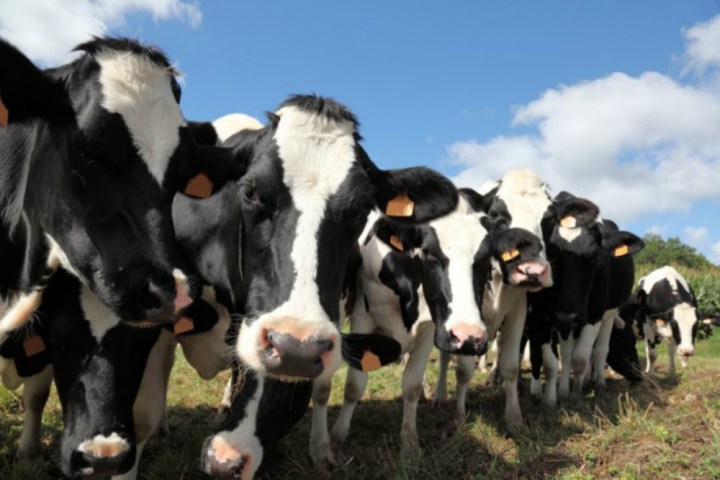
Connected cows are already a thing, but recently the intersection of barnyards and bits has been breeding a whole herd of applications. The current $1.27 billion “Connected Cow and Farm” business is slated to grow eight-fold to $10.75 billion by 2021, says research firm Arclusteras reported in The Register.

Arun Nirmal is Arcluster’s research director. Nirmal says cows are going to be the greatest factor in the coming connected farming boom. “The intersection of highly sophisticated automation and M2M [machine to machine] technologies combined with the application of industrial internet of things in this space is set to disrupt the industry over the next decade.”

Recommended Videos

Connected cow applications include automated milking and feeding, health monitoring, herd management, comfort and cleaning, and mating management.

Let’s go through that list. As The Register points out, milking and feeding are already automated in most developed countries. Health management with bovine wearables to monitor vital signs just involves larger wristbands.

Herd management used to be done with cowbells, but GPS locator chips on collars or ear tags can handle it on the connected farm. (Perhaps there will be a side business supplying excess cowbells to garage bands.)

Comfort and cleaning as a category brings up images of shovels and hoses, for anyone who has ever lived or worked on a farm, but in time there may be robots to handle those chores.

Mating management is where the topic gets interesting. Fujitsu has already developed a wearable and an app for that. According to The Register, cows “commence oestrus at night and a day or two beforehand become rather more mobile.” So tracking bovine friskiness will be the key to lining up pasture booty calls more efficiently.

As explained by The Register, when the data is right “farmers know when it’s time to get some sperm out of the deep freeze and open that big new packet of rubber gloves.”

Microsoft has separately been involved in a project that monitors amorous bovine behavior. We’re not going to milk this story beyond mentioning that, in order for cows to be optimal milk producers, they have to be in a continuous cycle of pregnancy and calving. The internet of cows will help with this, keeping cows healthy and ensuring that the milk keeps flowing.


Bruce Brown
Bruce Brown Contributing Editor   As a Contributing Editor to the Auto teams at Digital Trends and TheManual.com, Bruce…
Students who use AI every day may be falling behind, while moderate users pull ahead
New global testing data suggests more AI in the classroom isn't automatically better.
Logo, Text

I assumed more AI access might help students learn faster. However, a new OECD study dispels that misconception for me and everyone else who gave their children a paid version of AI chatbots, thinking it would help them through their educational journey. 

According to PISA 2025 data from 760,000 students in 91 countries, students who use AI daily score meaningfully worse on standardized tests than their peers. The full picture is more complicated than a simple ban would fix.

Read more
XPENG just put its humanoid robot on the production line, and it walked itself out
IRON clocks in for its first shift
XPENG Iron

XPENG’s humanoid robot has officially joined the workforce, and it even got an employee badge. The Chinese automaker announced on September 8 that its next-generation IRON had completed assembly and autonomously walked off its newly commissioned humanoid robot production line in Guangzhou.

CEO He Xiaopeng then pinned a staff badge onto the robot, symbolically welcoming it to the XPENG team. It is a charming little ceremony for a machine that the company hopes will eventually become a regular part of everyday life. XPENG is moving IRON beyond R&D prototypes toward production-line manufacturing, applying the quality-control systems and manufacturing experience it has developed through its electric vehicle business.

Read more
An AI-designed drug might help slow aging, but we’re not there yet
The results hint at a possible anti-aging effect, but there’s still a long way to go before we know what it means.
medical test tubes

Rentosertib, a drug Insilico Medicine designed almost entirely using AI, was created to treat idiopathic pulmonary fibrosis, a disease that scars and stiffens the lungs over time. But fighting lung disease was only half the plan from the start.

According to a new study published in Nature Biotechnology, the drug's target was chosen specifically because it overlaps heavily with the biology of aging, and the whole trial was designed to test whether treating the lungs could also mean turning back the body's biological clock.

Read more