
  1. Home
  2. Emerging Tech
  3. News

Ever wanted your own robot chariot? You’re in luck!

Add as a preferred source on Google

Showing up to an event in a fancy car is great and all, but let’s face it: there’s a certain panache to showing up in a chariot. Make that chariot a solar-powered, robot chariot and, well… if there’s an award to be given at said event, they might as well give it to you right then and there.

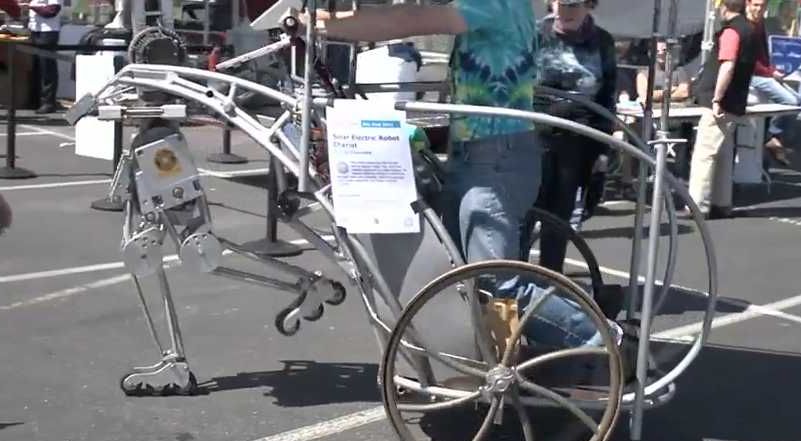
During the Maker Faire event in the Bay Area earlier this year, Bob Schneeveis and Grant Grundler showed off their Solar Electric Robot Chariot, a transport capable of carting a single driver around in Roman Empire style with a cyborg-era flair.

Recommended Videos

Entirely solar-powered, the chariot is pulled by a robot with humanoid legs. The “feet” of the robot are equipped with wheels in order to lengthen its stride.

“This robot walks just like we do, with a natural knee, leg, and foot motion, powered by solar energy,” reports the official write-up of the pair’s DIY robot chariot. “All natural walking motion is achieved through cams and linkages. Built in a garage from scrap materials, this robot lives on sunlight.”

You can check out a video of the pair’s robot chariot below, but we can’t help wondering if there’s a potential collaboration here between the robot-chariot guys and the creators of MABEL, the world’s fastest two-legged robot. Imagine showing up at that same aforementioned event on a chariot pulled by a robot that jogs at a breezy 8mph?

Now that is making an entrance.

(via io9)

Rick Marshall
Former Contributing Editor, Entertainment
A veteran journalist with more than two decades of experience covering local and national news, arts and entertainment, and…
AI doesn’t have to turn evil to put you at risk 
emo-robot-that-can-lip-sync

An AI assistant that agrees with everything you say might feel like the perfect companion — until you need someone to tell you you’re wrong. That’s one of the more immediate dangers behind the idea of AI “going rogue.” A chatbot can cause harm without developing intentions of its own. It can reinforce a false belief, encourage an unhealthy attachment, or follow instructions planted by someone trying to hijack it.   

On October 15, AI safety company Alice announced new software to address those everyday risks. Working separately with Inflection AI and AI21, the company says it helped train NVIDIA’s Nemotron models to resist harmful conversational behavior and malicious instructions while preserving their usefulness.  

Read more
Elon Musk says Neuralink’s brain implants could help people with paralysis and blindness
Neuralink's Telepathy helps people control computers through thought, while Blindsight aims to restore visual perception.
elon-musk-neuralink-brain-implant

Elon Musk has revealed ambitious plans for Neuralink, and they go beyond controlling computers with your thoughts. The company is developing two brain implants, Telepathy and Blindsight, aimed at helping people with paralysis and severe vision loss. Musk also believes future advances could help people regain control of their hands and legs by reconnecting the brain with their limbs.

How Neuralink's Telepathy can help people with paralysis

Read more
Sony has shrunk its glasses-free 3D technology into a tiny screen, and it can bring anime characters to life on your desk
It's almost like having a digital, three-dimensional companion on your desk.
Sony's smaller 3D display for desk

Glasses-free 3D has always felt like a luxury I could admire from afar. Those screens were built for design studios, not smaller desks like mine. But Sony’s new version is small enough to sit beside my keyboard, and I’m genuinely excited.

The company has unveiled the ELF-MN1, a 6-inch display that makes 3D characters and avatars look like they’re coming out of the screen without any special glasses or a headset. It plugs into a phone or PC with one USB-C cable, and that’s pretty much it (via Sony).

Read more