
  1. Home
  2. Emerging Tech
  3. Audio / Video
  4. Legacy Archives

Homemade gizmo lets users censor annoying TV content

Add as a preferred source on Google
enough-already
Image used with permission by copyright holder

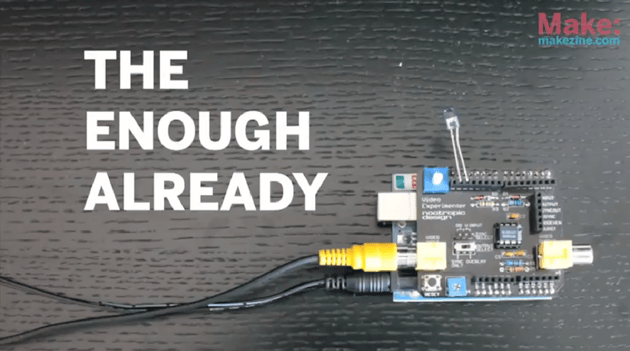
Frustrated by the saturation of mindless celebrity news on television, electronics hobbyist and MAKE Magazine blogger Matt Richardson decided to find a way to cut out television content that he has no desire to subject himself to, like, say, reports about Kim Kardashian’s new haircut, or other such drivel.

To accomplish this goal, Richardson created the Arduino Enough Already!. Based on the open-source electronics and programming platform Adruino, this tiny gizmo connects to the television, and is able to automatically mute the sound when pre-established keywords are mentioned.

Recommended Videos

The Enough Already! achieves this auto-censoring by decoding the closed caption data, which is broadcast through the NTSC picture signal. Richardson coded the device to pick up on certain words (he chose names like Sarah Palin, Donald Trump and Charlie Sheen, but you could choose literally anything).

When a designated keyword comes through the closed caption, a modified LED on the Enough Already! acts like the TV’s remote, and commands the television to mute for 30 seconds. (Mute duration can be increased or decreased depending on user preference.) If the keyword comes through again, the clock resets, and keeps the sound off.

Because the Enough Already! is based entirely on an open-source platform, users can tweak the device to match their specifications — or to do something else altogether. Richardson suggests some mods to his creation, like adding a flashing light that illuminates when a word you do want to hear about is mentioned, or as a signal for a drinking game.

The downside to the Enough Already! is that one must possess a higher-than-average tech savvy in order to make the thing work. It’s possible to buy the various components for the contraption already assembled, but it takes some programming know-how and other tinkering skills to get the thing going.

Watch a video about the Enough Already! below:

Andrew Couts
Features Editor for Digital Trends, Andrew Couts covers a wide swath of consumer technology topics, with particular focus on…
Elon Musk says Neuralink’s brain implants could help people with paralysis and blindness
Neuralink's Telepathy helps people control computers through thought, while Blindsight aims to restore visual perception.
elon-musk-neuralink-brain-implant

Elon Musk has revealed ambitious plans for Neuralink, and they go beyond controlling computers with your thoughts. The company is developing two brain implants, Telepathy and Blindsight, aimed at helping people with paralysis and severe vision loss. Musk also believes future advances could help people regain control of their hands and legs by reconnecting the brain with their limbs.

How Neuralink's Telepathy can help people with paralysis

Read more
Sony has shrunk its glasses-free 3D technology into a tiny screen, and it can bring anime characters to life on your desk
It's almost like having a digital, three-dimensional companion on your desk.
Sony's smaller 3D display for desk

Glasses-free 3D has always felt like a luxury I could admire from afar. Those screens were built for design studios, not smaller desks like mine. But Sony’s new version is small enough to sit beside my keyboard, and I’m genuinely excited.

The company has unveiled the ELF-MN1, a 6-inch display that makes 3D characters and avatars look like they’re coming out of the screen without any special glasses or a headset. It plugs into a phone or PC with one USB-C cable, and that’s pretty much it (via Sony).

Read more
3D-printed ghost guns are a notorious blind spot. Scientists may have finally cracked the traceability problem
The plastic used to make these weapons could hold clues that conventional forensic methods often miss.
3D printed Gun replica

Most conventional firearms come with serial numbers and leave unique microscopic markings on bullets and cartridge cases when fired. Investigators can use these clues to trace weapons or connect them to crimes. However, 3D-printed firearms, commonly called ghost guns, present a different challenge. They can be manufactured without serial numbers, and their unconventional construction can make traditional forensic analysis more difficult.

Now, researchers in Australia may have found another way to trace these weapons, using clues hidden in the plastic they're made from.

Read more