
  1. Home
  2. Emerging Tech
  3. Web
  4. Legacy Archives

Honda demonstrates new version of its ASIMO humanoid robot

Add as a preferred source on Google

A few years ago Honda’s ASIMO robot humiliated the Japanese car company when it demonstrated how well it could tumble down stairs, when it was supposed to walk up them.

Whether the engineers that made that ASIMO ended up on the scrapheap along with their failed invention isn’t known, but what is clear is that ASIMO is back.

Recommended Videos

At a press conference held in Tokyo on Tuesday, Honda unveiled an all new ASIMO robot – one that can run, walk across bumpy surfaces, hop, and even pour a coffee. There was no sign of those stairs though.
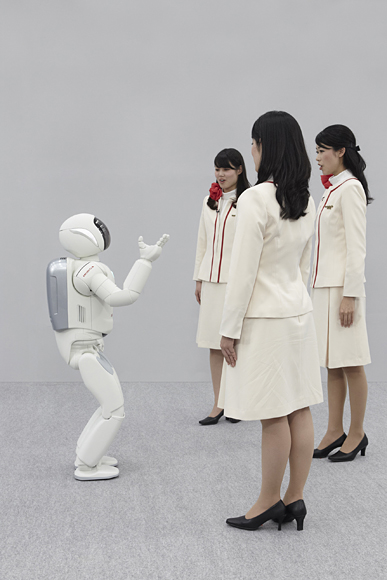
The original ASIMO promised much when it was first unveiled back in 2000 but ended up being looked upon as a rather novel high-tech toy, offering little in the way of practical use.

However, according to the Washington Post, Honda researchers have been hard at work with the astronaut-looking ASIMO, determined to prove its worth. On Tuesday Honda president Takanobu Ito told a gathering of journalists that technology associated with ASIMO has been developed to make a robotic arm which can be used, for example, to open and close valves at the stricken nuclear power plant in Fukushima.

The original idea had been to send ASIMO itself into the damaged plant, but engineers quickly realized that the robot – even the new version – wouldn’t be able to navigate the rubble. Stairs, maybe. Rubble, definitely not. So the company developed the robotic arm instead.

ASIMO’s running speed has also improved, increasing from 3.7 mph in 2005 to 5.6 mph today. According to the Post, its running style was a lot smoother than before, too.

It could even identify different voices speaking at the same time and respond to different instructions from each one. And if all that wasn’t enough to demonstrate that ASIMO had made some significant improvements, it even engaged in a spot of sign language. “My name is ASIMO,” it said with its fingers.

Honda’s president said he knew that much more time would be required to make robots into a practical business, telling reporters, “Maybe at the start this was a dream of engineers to make a machine that was close to a human being, like Astro Boy,” adding “We think ASIMO is good.”

Comparing the stairs video to a news piece broadcast in Japan on Tuesday, the humanoid robot has certainly come a long way. But you really would’ve expected the car company to have sent ASIMO up the biggest staircase ever, just to prove a point.

Old ASIMO:

New, improved ASIMO:

Trevor Mogg
Contributing Editor
Not so many moons ago, Trevor moved from one tea-loving island nation that drives on the left (Britain) to another (Japan)…
Google is making Gemini and Search work better with the apps you love
Gemini's guest list is growing, and your favorite apps are invited.
Gemini AI on a phone.

Google has been finding more ways to make Gemini a part of your daily routine, from putting together playlists to ordering groceries through your favorite apps. Now it's expanding those capabilities to more services, with Google Search joining in, too.

The company has announced a new Connected Apps Platform that makes it easier for developers to bring their services to both Gemini and Search. Alongside this, Google is adding new partners to its growing lineup, bringing more of the apps people already use into its AI ecosystem.

Read more
AI bots are now trying to sabotage public health policies, like banning disposable vapes
Thousands of AI bots voted in a public health poll to block sales restriction on disposable vapes. It's like Big Tobacco is back from the dead.
Woman smoking a vape.

In the broad context of AI and its perceived harms, health and medical risks often pop up in the conversation. The warnings even come from frontier AI labs, such as ChatGPT-maker OpenAI and Anthropic, both of which have warned about misusing AI to cook up bioweapons. Security experts have already spotted a few such incidents in the wild, especially with the usage of AI models without any solid guardrails. 

Well, it appears that the risks run deeper. As per an analysis appearing in the British Medical Journal (BMJ), AI bots are now being deployed to influence public policies governing health risks to citizens. In this instance, an attempt was made using AI bots to thwart regulations that aim to restrict the sale of disposable vapes, all while disguising the manipulation efforts as a response from real humans. 

Read more
A tiny smartphone gadget can detect some of the nastiest chemicals in your water
Scientists built a tiny smartphone gadget that can spot toxic 'forever chemicals'
Smartphone-connected drinking water safety sensor Featured

What if checking your drinking water for dangerous chemicals were as simple as plugging a tiny gadget into your smartphone? Researchers in Japan have developed a compact sensor that could make that possible, potentially bringing sophisticated water contamination testing out of expensive laboratories and into people's hands.

Scientists at the Okinawa Institute of Science and Technology (OIST) have created a portable device capable of detecting extremely low concentrations of PFAS, commonly known as "forever chemicals." The findings were published in the journal Biosensors and Bioelectronics, which demonstrate how an inexpensive sensor and a smartphone could make identifying potentially harmful chemicals in water a lot easier.

Read more