1. Home
  2. Emerging Tech
  3. Legacy Archives

Kobo eReaders get Wi-Fi

Add as a preferred source on Google

The ereader market continues to heat up as we approach the end-of-year holiday season, with Kobo announced a new wireless edition of its Kobo eReader. The new units are available in three colors (black, silver, and lilac) and sport a sharper screen, improved battery life and performance, and integrated Wi-Fi that enables users to shop from more than 2.2 million titles just by touching a “Shop” button—users can also receive wireless delivery of newspapers.
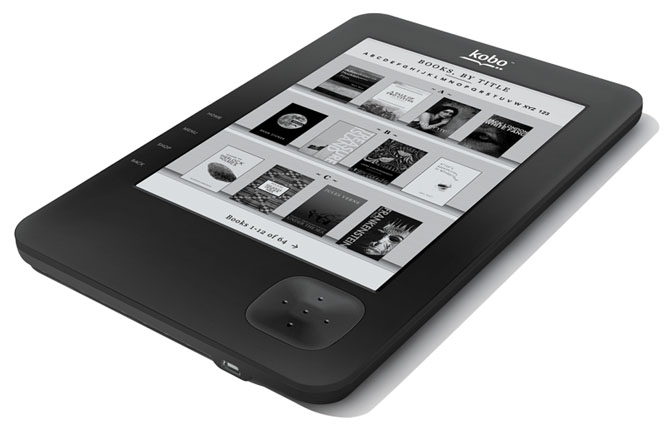
Image used with permission by copyright holder

“We introduced the Kobo eReader to make ereading more affordable and accessible for consumers. It worked, making the Kobo eReader a bestseller, and the industry followed,” said Kobo CEO Michael Serbinis, in a statement. “The market for ereading continues to grow at an unparalleled pace, and Kobo is advancing even faster.”

Recommended Videos

The Kobo eReader sports a 6-inch EInk display that supports 16 levels of greyscale, an SD card slot for removable storage (Kobo says that’s enough to handle about 8,000 ebooks), and a battery the should keep its charge for up to 2 weeks or through 10,000 page loads. As with the previous model, the Kobo eReader uses a D-pad controller for navigation, supports ePub and PDF documents, and has a unique quilted back for comfortable reading.

The new Kobo eReaders are priced at $139.99, and will be available from Kobobooks.com as well as retailers like Borders (in the U.S.) and Indigo Books & Music, and Wal-Mart in Canada. Online orders are available today, with units expected to start shipping in October—the units ship with 100 free “literary masterpieces” pre-installed, and customers who pre-order will be eligible for two free eBooks from Random House of Canada. In the U.S., Kobo readers debuted at $150; the original models are now selling for $129.

Kobo has recently announced updates to its Kobo reader apps for iPhone and Android, as well as what it terms the “first social reading application” for BlackBerry—the Kobo reader app will also come pre-installed on Samsung Galaxy Android-based smartphones.

Geoff Duncan
Former Contributor
Geoff Duncan writes, programs, edits, plays music, and delights in making software misbehave. He's probably the only member…
This tiny MacBook accessory adds customizable shortcuts for meetings and productivity
Finally, a button that saves you from awkward "You're on mute" moments
Dune

A new hardware accessory is looking to simplify one of the more frustrating aspects of using a MacBook: juggling different keyboard shortcuts across video calls, productivity apps, and development tools.

A startup Project Mirage has launched Dune, a compact USB-C accessory that adds three programmable buttons to compatible MacBooks. The device automatically changes its functions depending on the application currently in use, allowing users to perform common actions with a single press instead of memorising different keyboard shortcuts.

Read more
Robots can now ‘see’ touch thanks to a new color-changing tactile sensor
Researchers have developed a color-changing tactile sensor that turns pressure into visible information.
Robot Touch Human Finger

Most robots are pretty good at seeing, but touching? That's been a much tougher problem. While humans instinctively know how hard they're gripping a coffee mug or pressing a button, robots have traditionally relied on complex arrays of tiny sensors to estimate the same thing. Now, researchers at Queen Mary University of London believe they've found a much simpler solution: make touch visible.

A sensor that turns touch into color

Read more
Chrome is getting better at understanding the breaks and punctations you never say out loud
Voice typing in Chrome is about to feel much more natural
Google Chrome on Android Featured

Google is quietly making voice dictation in Chrome feel a lot more natural. With the latest Chrome 151 Beta, the company is introducing a new capability that allows the browser's speech recognition engine to automatically infer punctuation based on the way people speak, eliminating the need to explicitly say commands like "comma" or "full stop."

The update may sound minor at first glance, but it addresses one of the biggest frustrations with voice typing: speaking naturally often produces text that lacks punctuation unless users consciously dictate every punctuation mark. By teaching Chrome to understand pauses, rhythm, and speech patterns, Google is taking another step toward making conversations with computers feel more human.

Read more