  1. Home
  2. Space
  3. Emerging Tech
  4. News

NASA’s Mars 2020 rover practices its crucial descent separation

Add as a preferred source on Google

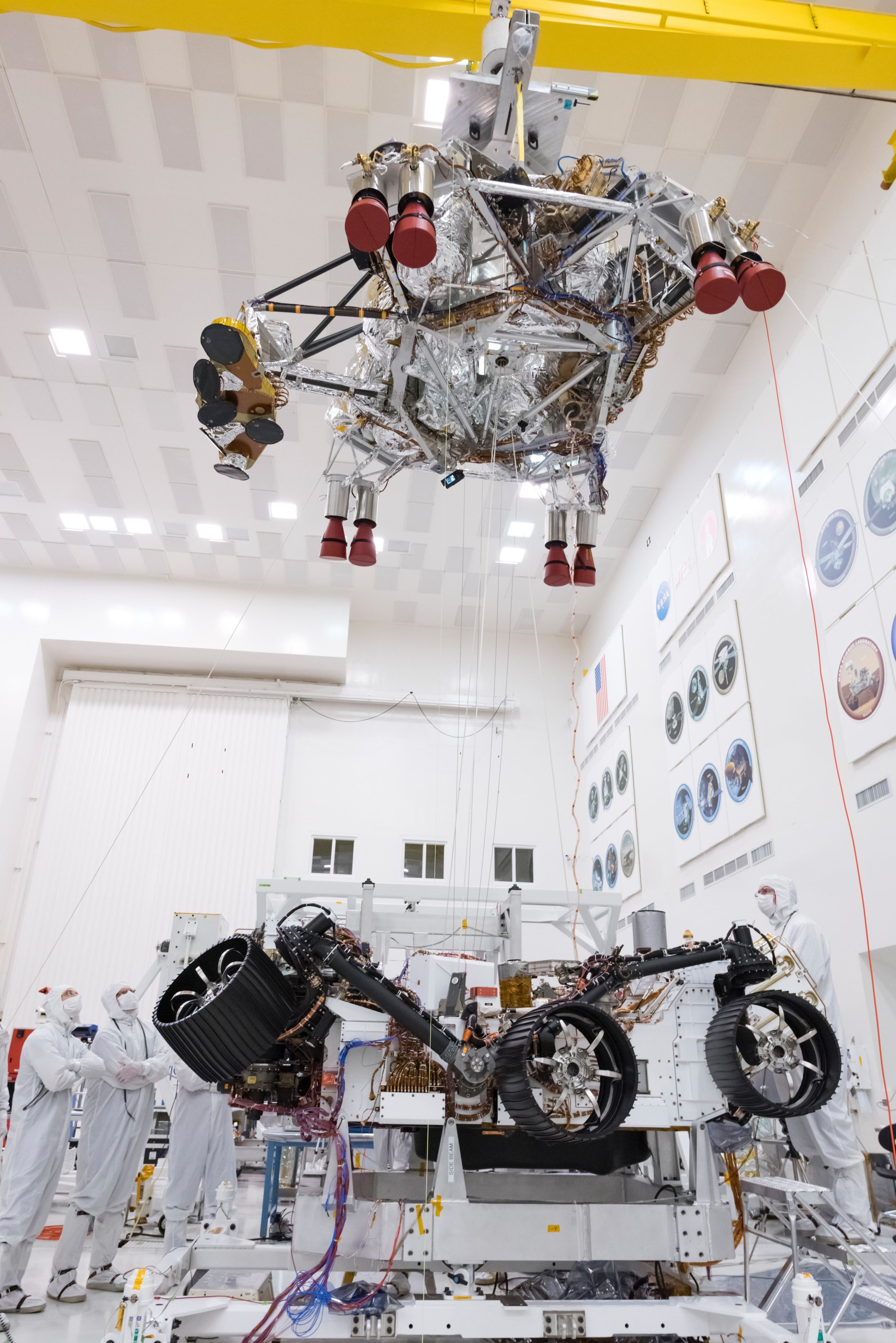
In this picture from September 28, 2019, engineers and technicians working on the Mars 2020 spacecraft at NASA’s Jet Propulsion Laboratory in Pasadena, California, look on as a crane lifts the rocket-powered descent stage away from the rover after a test. NASA/JPL-Caltech

When the Mars 2020 spacecraft enters the Martian atmosphere in two years’ time and prepares to land, the rover will need to detach from the rocket-powered descent stage so it is free to explore the Jezero Crater. This delicate operation was recently practiced here on Earth, with engineers at NASA performing a successful separation test using a large crane to ensure the rover and descent stage can separate cleanly.

Recommended Videos

“Firing the pyrotechnic devices that held the rover and descent stage together and then doing the post-test inspection of the two vehicles was an all-day affair,” Ryan van Schilifgaarde, a support engineer for Mars 2020 assembly at NASA’s Jet Propulsion Laboratory, said in a statement. “With this test behind us, the rover and descent stage go their separate ways for a while. Next time they are attached will be at the Cape next spring during final assembly.”

Now in its final year of engineering before launching in July 2020, the rover will be put through a range of tests to ensure it is ready for whatever its long space journey and the red planet can throw at it. In addition to the separation test, it has already completed tests of its high definition cameras which will capture images of the surface of Mars and a series of tests of its launch, navigation, and landing systems.

The next benchmarks for the rover will be evaluations of how its computers and mechanical systems fair in the cold temperatures and low atmospheric pressures it will experience on Mars. The Surface Thermal Test will recreate the conditions on Mars to see if they cause any electrical or other issues.

Once all the testing is completed and the engineers have declared the rover ready for its expedition, it will be launched on 17 July 2020 from Cape Canaveral, carried aboard a United Launch Alliance Atlas 5 rocket. It will take seven months for the craft to reach Mars, with a landing scheduled for February 18, 2021.

Georgina Torbet
Georgina has been the space writer at Digital Trends space writer for six years, covering human space exploration, planetary…
China’s answer to SpaceX’s reusable rockets literally catches boosters in a net
SpaceX catches boosters on legs. China just used a net.
Ammunition, Missile, Weapon

SpaceX's playbook for recovering a rocket booster generally involves legs, a precisely controlled vertical landing, and either a concrete pad or a drone ship. 

China just managed to pull off something similar, but in a slightly different way, and on July 10, it tested the method as well.

Read more
Dimming the sun sounds unhinged, but this new study on El Niño makes a surprisingly good case for it
A natural test case, Australia's worst-ever wildfire season, suggests the idea deserves serious consideration.
Nature, Outdoors, Sky

When I first saw "scientists propose dimming the sun," I rolled my eyes. It sounds like a science fiction movie cooked up after watching many climate documentaries. But a new study, published on July 8, 2026, in the journal Science Advances, seems to have a genuinely compelling argument.

A Super El Niño is currently forming in the Pacific, feared to be the most intense in decades. It could escalate floods, wildfires, and extreme heat events worldwide. However, Researchers at UC San Diego's Scripps Institution of Oceanography, led by climate scientists Kate Ricke and Jessica Wan, are now proposing one of the most interesting solutions I’ve come across.

Read more
You can now walk through space and gaze into a black hole at this VR exhibit
Smithsonian Starstruck lets you drift past dying stars and see the origin point of the universe for as little as $18 a person.
Smithsonian Starstruck featured

Most planetarium shows ask you to sit still and look up. The Smithsonian's new VR exhibit takes a different approach, letting visitors walk through the vast expanse of the universe, drifting past stars, planets, and a black hole to get a physical sense of its true scale.

A $29 ticket to the edge of the galaxy

Read more