  1. Home
  2. Emerging Tech
  3. News

3D-printed metamaterial ‘machines’ are greater than the sum of their parts

Add as a preferred source on Google

Metamaterials can appear to defy the laws of nature. By bending lightwaves, they may form the fabric of invisibility cloaks. By manipulating sound waves, they may support completely sound-proof rooms. These tiny, artificial structures have a sum greater than their parts, giving them smart properties based on their shape, size, and arrangement, rather than the materials they’re made from.

A team of researchers from the Hasso Plattner Institute in Potsdam, Germany has taken the concept of metamaterials in another direction, developing what they call “metamaterial mechanisms,” objects with seemingly simple internal microstructures that enable some rather complex functions given that they consist of a single piece of 3D-printed material.

Recommended Videos

“The goal of this work was to explore how we can create materials that are machines at the same time.”

To develop their mechanisms, the designers and engineers began by examining an everyday object: rotary door knobs. They used firm cells to act as the handle and anchor blocks, and used “shear” cells to enable movement of the parts. They quickly realized that, if they could implement rotation, they could connect the handle to a hinge and have a fully-functional door latch.

“The goal of this work was to explore how we can create materials that are machines at the same time,” lead researcher and PhD student, Alexandra Ion, told Digital Trends. “Usually, materials are designed for some deformation behavior, but not to transform forces to implement mechanical functions. Our approach allows us to achieve a deeper integration between the structural and the mechanical functions of materials.”
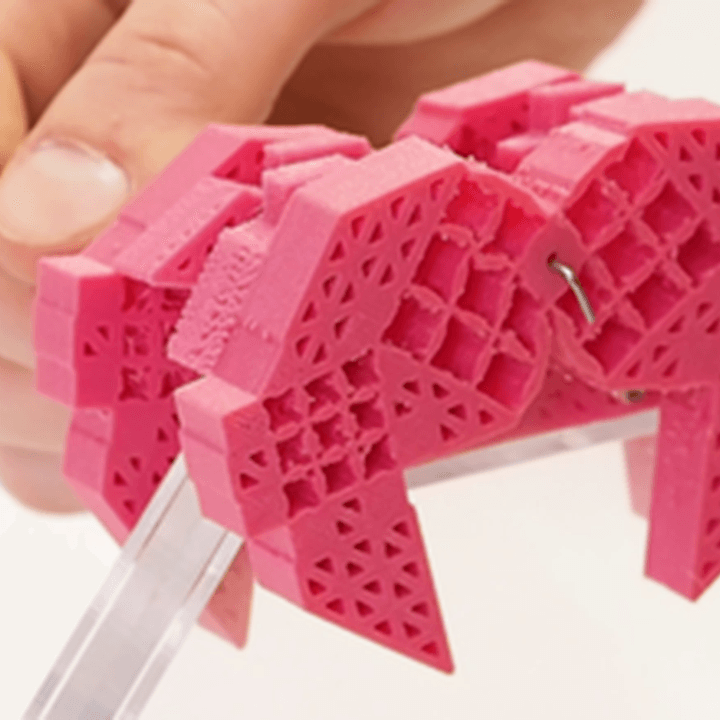
Materails
Metamaterial Jansen walker, consisting of a single block of cells. Image used with permission by copyright holder

After developing their working door latch, Ion and her team began creating other mechanical machines, such as a Jensen walker, pantograph, and pliers.

“These types of machines are very simple to fabricate, compared to the conventional manufacturing process of, for example, a door-latch mechanism, which consists of many parts and requires assembly,” Ion said. “[With this method] we envision that doors can be 3D printed with the door latch mechanism already in place, in one single fabrication step.”

In order to test their machines, the researchers created an editor that lets them experiment and verify designs before sending the objects to the printer. The team is now planning to release the source code of their 3D editor for others to experiment with. However, there might be a learning curve for amateur engineers who just want to toy around.

“While the tool we implemented so far is an expert tool, we plan to implement our learnings about the mechanics of metamaterial mechanisms from this project into software to help novice users to create and 3D print mechanisms,” Ion said.

Dyllan Furness
Former Contributor
Dyllan Furness is a freelance writer from Florida. He covers strange science and emerging tech for Digital Trends, focusing…
Chinese startup claims its brain implant takes just 10 minutes to place, no skull surgery required
StairMed Technology's vein-based BCI could beat Neuralink's roughly two-hour surgery on speed, but the device still hasn't undergone human trials.
Art, Plate, Crystal

Brain implants, like the ones made by Elon Musk's Neuralink, typically involve open-skull surgery. But a Chinese startup says it can skip that step entirely, threading its device into the brain through a vein in a procedure that reportedly takes as little as ten minutes. According to the South China Morning Post, Shanghai-based StairMed Technology is one of several companies pursuing this approach, as the country pushes to expand its homegrown brain-computer interface (BCI) industry.

Faster than Neuralink, on paper

Read more
This bizarre email flaw is leaking corporate secrets to anyone who buys the right domain
Security researchers discovered companies are accidentally sending sensitive emails to domains that outsiders can register.
Maill app icon notifications

You don't always need to hack into a company's systems to get its secrets. Sometimes, the company will simply email them to you. A new report by WIRED's Matt Burgess has uncovered a bizarre email security problem in which companies are inadvertently sending sensitive information to domains that can be registered and controlled by outsiders. Security researchers Cory Solovevich and Mike Sheward discovered that seemingly harmless addresses such as noreply and deleteduser can become unexpected gateways to corporate information when the domains behind them aren't properly controlled.

The "hack" is buying the right domain

Read more
I found 3 ChatGPT features that turned out to be way more useful than I expected
ChatGPT on iPhone

I use ChatGPT pretty much every day, but somewhere along the way, I’ve also developed a habit of poking around and looking for features I haven’t tried yet. Some discoveries are genuinely useful, while others are the kind I’ll probably remember once every six months.

Every once in a while, though, I stumble across something that actually changes how I use ChatGPT. That happened recently with three features I’d somehow been overlooking. I’ve started using all three regularly now, and if you spend a lot of time in ChatGPT too, I think you’re missing out by not giving them a shot.

Read more