1. Home
  2. Emerging Tech
  3. News

This bird-inspired morphing drone can slim down to fit through tight spaces

Add as a preferred source on Google
 

The big tradeoff with quadcopter drones is that in order to make them as stable as possible, their fixed design makes it difficult for them to fit through tight spaces. This doesn’t matter so much when they’re out in the open. However, if quadcopters are going to be relied on for inspection tasks in cluttered indoor environments or used for search and rescue missions that is a pretty big compromise to make.

Recommended Videos

That is where a new drone designed by researchers at France’s Étienne Jules Marey Institute of Movement Sciences comes into play. Their Quad-Morphing drone is able to rotate its arms to allow it to reduce its wingspan by 48 percent, and fly through some impressively small gaps as a result. To do so, it borrows from a movement more often seen in the bird world.

“Our inspiration comes from studies on budgerigar and also from a BBC movie on birds of prey able to morph their wings,” Stéphane Viollet, France’s National Center for Scientific Research research director and head of the Biorobotics research group, told Digital Trends.
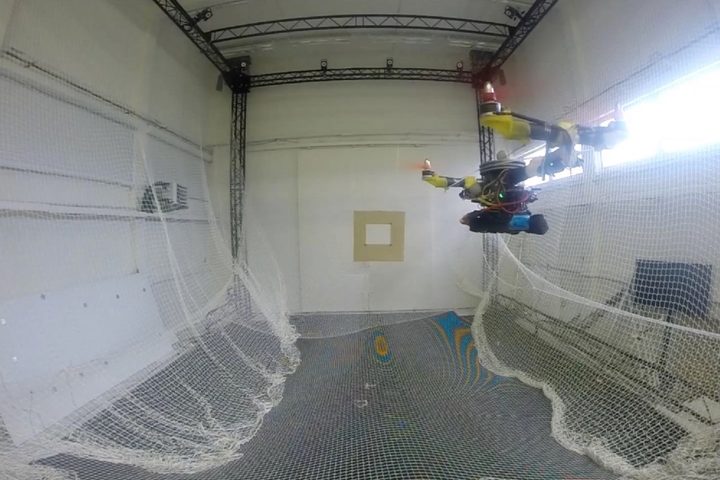
CNRS

Using this model, the team set about developing its innovative drone. During normal flight, the drone’s two horizontal arms, with upward-facing propellers at each end, sits perpendicular to the drone’s central axis. That is the basic form of a typical quadcopter. However, in the event that the drone needs to maneuver through a tight gap a series of wires rotate the arms so that they are instead parallel to the drone’s central axis.

In order to work out when this action should be performed, the drone relies on cameras to determine how large a gap is and whether the drone will need to rotate its arms to travel through it. At present, it uses an array of 17 stationary cameras and an onboard high-speed camera, although this setup would not necessarily work outside of test conditions due to the challenge of installing the stationary cameras.

Nonetheless, if the researchers are able to further develop this project so that it can do all of this using onboard cameras we can totally see how this would be an impressive addition to a quadcopter drone’s everyday capabilities.

A paper describing the work, “Agile Robotic Fliers: A Morphing-Based Approach,” was recently published in the journal Soft Robotics.

Luke Dormehl
I'm a UK-based tech writer covering Cool Tech at Digital Trends. I've also written for Fast Company, Wired, the Guardian…
The Apple Car may be dead, but it became the foundation of Apple Intelligence
A decade of work on a canceled car project reportedly laid the groundwork for Apple Intelligence.
Apple Intelligence in Apple Car

The Apple Car may have never left the garage, but it apparently gave birth to Apple's AI ambitions. According to Bloomberg's Mark Gurman, Apple's canceled autonomous vehicle project, one that consumed more than a decade of work and over $10 billion before being scrapped in 2024, ended up laying the technological foundation for Apple Intelligence. In a rather ironic twist, one of Apple's most expensive failures may also become one of its most important long-term investments.

The Apple Car forced Apple to think like an AI company

Read more
Researchers hid a prompt injection inside a PNG, and AI fell for it
Hacker

AI coding assistants like Claude are becoming every developer's favorite coworker. They can review code, explain confusing functions, and even write entire features with a single prompt. But new research suggests that this growing trust could also become their biggest weakness.

A team of security researchers (professor Sudipta Chattopadhyay and researcher Murali Ediga) has demonstrated an unusual attack that doesn't target the AI model directly. Instead, it targets what the AI doesn't pay enough attention to during code reviews. Rather than hiding malicious instructions in lines of code, the researchers tucked them inside an image file. Since many AI review tools treat images as decorative assets rather than as something worth inspecting, the pull request can appear perfectly harmless and sail through the review.

Read more
AI has already fallen into the wrong hands and they’re using it to make bombs
Logo, Text

Artificial intelligence has quickly become the go-to tool for everything from writing emails and summarizing meetings to helping students study or developers debug code. But the same technology that saves people time can also be misused, and a new report suggests that terrorist organizations are finding ways to do exactly that.

According to a research paper shared with The New York Times ahead of its publication, researchers found evidence that members of Boko Haram have been using popular AI chatbots to support both day-to-day activities and combat-related tasks. Interviews with 27 former members conducted in Nigeria over the past two years suggest that tools such as ChatGPT, Gemini, Claude, Grok, Meta AI, and DeepSeek were used to gather technical information, troubleshoot weapons, and even assist with planning attacks.

Read more