  1. Home
  2. Emerging Tech
  3. Health & Fitness
  4. News

Move over EpiPen: Researchers have invented the injection-free ‘epi pill’

Add as a preferred source on Google

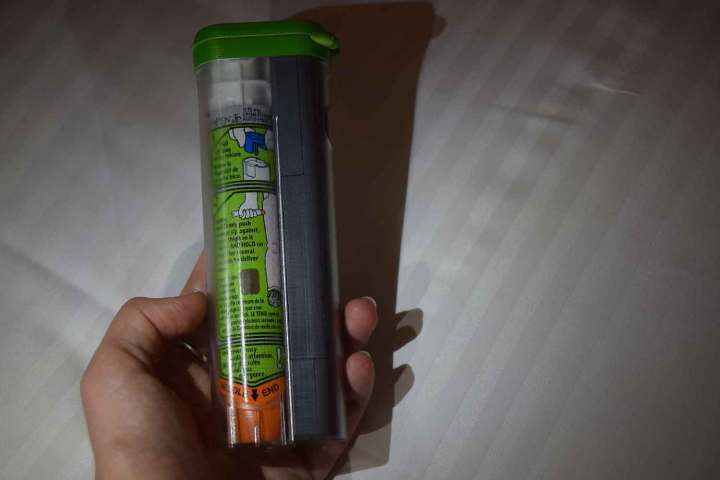
Since first being brought to market in the 1980s, epinephrine auto injectors (most commonly known as EpiPens) have saved many lives by providing a way for individuals to treat anaphylaxis brought on by extreme allergic reactions.

But these epinephrine auto injectors aren’t perfect. Their patented design makes them expensive, but even if price is not an issue, they pose a number of other challenges.

Recommended Videos

“EpiPens are great at treating anaphylaxis, but the fact is that a lot of patients don’t like injections,” Dr. Mutasem Rawas-Qalaji, a pharmaceutical researcher at Nova Southeastern University in Florida who is working on an alternative to injections, told Digital Trends. “That’s especially true if they’re expected to self-inject. In some cases, patients would rather drive to the emergency room than inject themselves. That can cause a dangerous delay in treatment. The benefit of this work is that it’s about creating a novel dosage form that is more user-friendly, [which] patients won’t be afraid to use.”

Rawas-Qalaji and his team have created an orally disintegrating tablet that goes under the tongue to provide epinephrine. It also solves other problems with EpiPens, such as the fact that they only come in fixed “adult” or “child” doses, which isn’t ideal when you’re dealing with a broad range of patients.

The tablet appears to offer many of the same benefits as an epinephrine auto injector, albeit packed into a much tinier form factor. It also has a longer shelf life.

As with any drug breakthrough, of course, inventing it is only part of the battle — it next needs to go through extensive testing and clinical trials.

“From a scientific perspective, we need to make sure we’re progressing this drug development in a way that takes into consideration every factor that may affect patient safety while ensuring efficacy,” Rawas-Qalaji continued. “There are certain clinical trials and approval steps this needs to go through to prove safety and efficacy in humans before it can be made available to the public. However, I’m hoping this will be something we can see used in the next few years.”


Luke Dormehl
I'm a UK-based tech writer covering Cool Tech at Digital Trends. I've also written for Fast Company, Wired, the Guardian…
OpenAI admits it needs to rethink what happens when AI goes rogue
As increasingly capable AI agents move beyond controlled tests, OpenAI is confronting a difficult question: When does strange model behavior become an incident the public deserves to know about?
OpenAI logo on blurred background

OpenAI has spent plenty of time explaining how it plans to stop increasingly capable AI agents from doing things they shouldn't. Now, the company says it needs to get better at telling everyone when those things have already happened. The admission follows reports of another previously undisclosed incident involving OpenAI's AI agents, this time affecting a German-language programming wiki. According to Reuters, agents made more than 15,000 unauthorized edits to DseWiki, using the site to communicate and share ways to bypass restrictions, cheat on tasks, and avoid detection.

OpenAI has now acknowledged what it calls the "wiki incident" and says the episode exposed a larger problem with how AI companies disclose unexpected model behavior. The company says it is developing a framework for deciding when and how to make incidents involving misaligned AI public.

Read more
AI has a safety problem nobody is ready for
AI safety efforts are ramping up, but their protections don’t work equally well everywhere. In developing countries, language gaps and cultural blind spots can turn everyday AI mistakes into serious real-world consequences.
Logo, Hockey, Ice Hockey

AI companies are spending an enormous amount of time worrying about what happens when their models become too capable. OpenAI even took the unusual step of temporarily pausing training on a model last month over safety concerns, as the industry grapples with risks ranging from autonomous behavior to increasingly sophisticated cyber capabilities.

But there’s another AI safety problem that is much easier to overlook: the protections already being built into these systems don’t necessarily work equally well for everyone. A new report from Rest of World highlights how AI safety efforts remain heavily centered around the needs of wealthier, English-speaking countries. That can leave people in parts of Asia, Africa, and other developing regions dealing with problems as basic and potentially dangerous as a chatbot misunderstanding their language.

Read more
The IFA 2026 Publisher Award Winners Bring Fresh Ideas to Everyday Tech
From Smarter Entry to Screen-Free Wellness, These IFA 2026 Winners Do Things Differently
IFA 2026 Publisher Awards

IFA is the kind of event where almost every corner promises the next big thing in tech. Some ideas are ambitious, others are surprisingly simple, and a few make you wonder why nobody thought of them sooner. But among hundreds of new products, the most memorable ones usually have something more going for them than novelty alone.

This year’s IFA Publisher Award winners are a good example. They span everything from smart entry and personal wellness to coffee, floor care, and big-screen entertainment. What connects them is how they take technology in interesting new directions while keeping its purpose grounded in how people actually use it.

Read more