1. Home
  2. Emerging Tech
  3. News

See the strange and beautifully layered terrain of Mars’ Juventae Chasma

Add as a preferred source on Google

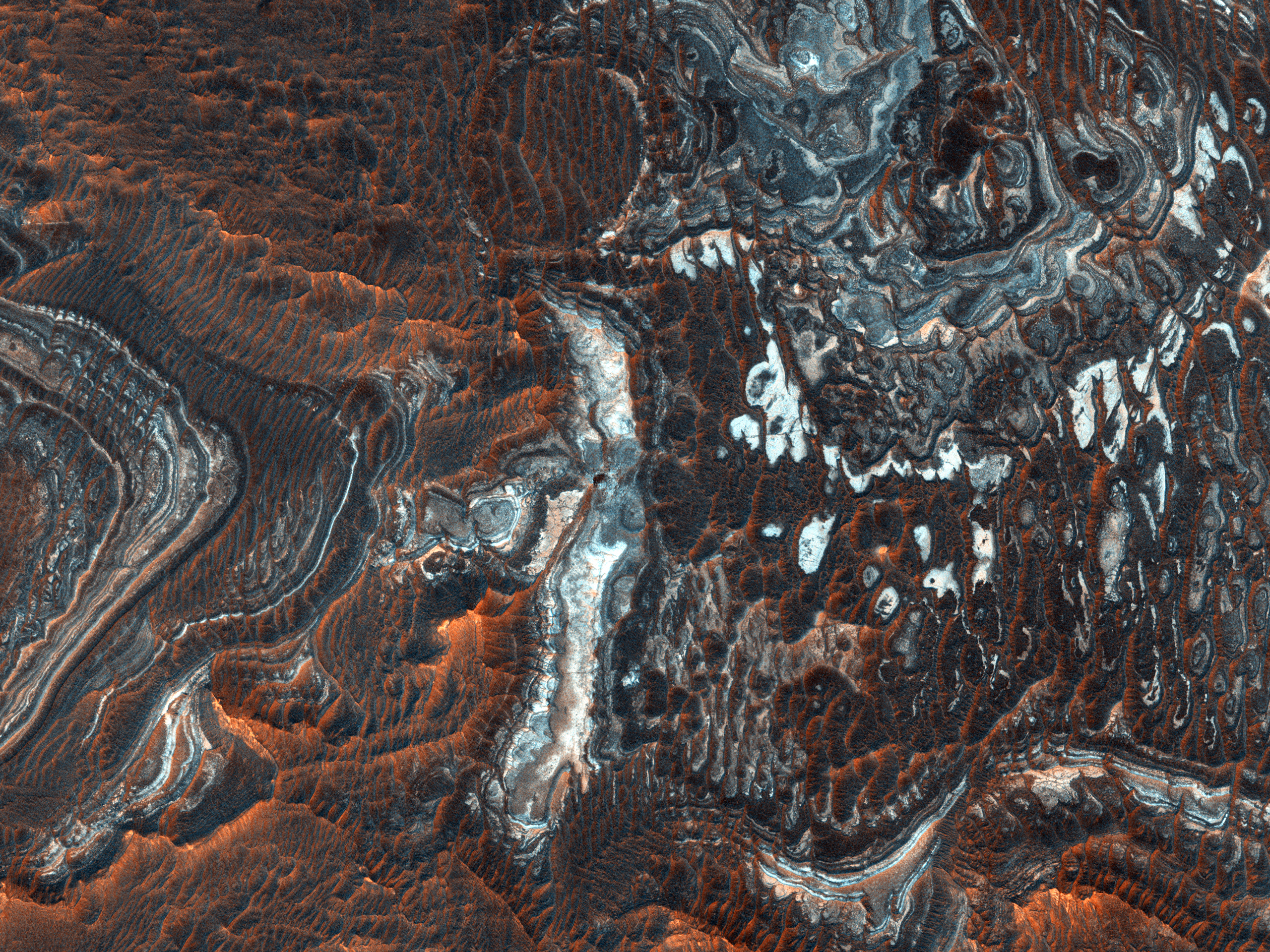
While life is rapidly changing all over the globe right now, the rest of the solar system is going about business as usual. And that includes our planetary neighbor Mars, where NASA’s Mars Reconnaissance Orbiter has captured a particularly stunning image of the strange ridges and channels formed on the planet’s surface by erosion.

This area of Mars is called the Juventae Chasma, a huge canyon that stretches over 150 miles wide and which is named after the mythical fountain of youth. On the floor of the canyon, you’ll find sand dunes and a mountain of sulfate deposits which is one and a half miles high. This region has many areas of striking layers, in which different sediments have been deposited on top of one another and eroded to form elaborate patterns that can be seen from orbit.

This image shows plains North of the Southwestern Juventae Chasma, a canyon part of the gigantic Valles Marineris system.
This image shows plains North of the Southwestern Juventae Chasma, a canyon part of the gigantic Valles Marineris system. NASA/JPL/UArizona

You can see a large, high-resolution version of the image here to appreciate all the beautiful details of this literally unearthly scene.

Recommended Videos

“There are three distinct terrains in this image, plains with possible inverted channels, plains with exposed layers, and layers on a wall of Juventae Chasma,” the HiRISE researchers explained in a post. “Layers are common in the Martian canyons, but it is unknown what process formed them. The layers in the plains here are likely made of the same material as the layer in the canyons.”

This particular image was captured with an instrument called the High-resolution Imaging Experiment (HiRISE) camera on board the Mars Reconnaissance Orbiter (MRO). The MRO has been an essential NASA tool for observing Mars since it entered orbit around the planet in 2006. As well as cameras, the MRO also carries scientific instruments including spectrometers and radar, which can be used in combination to study the geography and weather of Mars.

HiRISE has captured plenty of stunning images of Mars in its career, including snapping photos of both of NASA’s explorers, Curiosity and InSight, on the surface of the planet. But perhaps its most famous finding was something even more out of this world, when last year it captured an image of a martian lava formation that looked strikingly like the Star Trek logo.

Georgina Torbet
Georgina has been the space writer at Digital Trends space writer for six years, covering human space exploration, planetary…
Researchers hid a prompt injection inside a PNG, and AI fell for it
Hacker

AI coding assistants like Claude are becoming every developer's favorite coworker. They can review code, explain confusing functions, and even write entire features with a single prompt. But new research suggests that this growing trust could also become their biggest weakness.

A team of security researchers (professor Sudipta Chattopadhyay and researcher Murali Ediga) has demonstrated an unusual attack that doesn't target the AI model directly. Instead, it targets what the AI doesn't pay enough attention to during code reviews. Rather than hiding malicious instructions in lines of code, the researchers tucked them inside an image file. Since many AI review tools treat images as decorative assets rather than as something worth inspecting, the pull request can appear perfectly harmless and sail through the review.

Read more
AI has already fallen into the wrong hands and they’re using it to make bombs
Logo, Text

Artificial intelligence has quickly become the go-to tool for everything from writing emails and summarizing meetings to helping students study or developers debug code. But the same technology that saves people time can also be misused, and a new report suggests that terrorist organizations are finding ways to do exactly that.

According to a research paper shared with The New York Times ahead of its publication, researchers found evidence that members of Boko Haram have been using popular AI chatbots to support both day-to-day activities and combat-related tasks. Interviews with 27 former members conducted in Nigeria over the past two years suggest that tools such as ChatGPT, Gemini, Claude, Grok, Meta AI, and DeepSeek were used to gather technical information, troubleshoot weapons, and even assist with planning attacks.

Read more
Claude Code can now browse the web without opening Chrome
The desktop app now includes an in-app browser that can read websites, click links, and interact with web apps.
Claude Code Featured

Developers spend a surprising amount of time bouncing between their code editor, browser tabs, API documentation, GitHub issues, and design files. Anthropic thinks Claude Code should simply do all of that without constantly asking users to switch windows. The company has announced a new in-app browser for Claude Code on desktop, allowing its AI coding assistant to open websites, read documentation, inspect designs, and interact with web pages directly from within the application.

A browser built into Claude Code

Read more