
  1. Home
  2. Emerging Tech
  3. Legacy Archives

Plastic Logic Que proReader Gets Its Format Debut

Add as a preferred source on Google

As promised, Plastic Logic has formally unveiled its Que proReader at this week’s Consumer Electronics Show in Las Vegas. The Que proReader is a sleek 8.5 by 11-inch electronic reader designed to provide a “premium reading experience” along with on-demand content access. The device measures only about one-third of an inch thick, but features a 10.7-inch shatterproof plastic display—which would make it the largest ereader display available if it were shipping today. The Que proReader gets it screen size from a a unique plastic display technology that has been in development for about a decade since researcher spun it out of Cavendish Labs, and combined it with E Ink’s Vizplex technology. The idea is to emulate a crisp sheet of paper, but with the flexibility of digital, on-demand content.
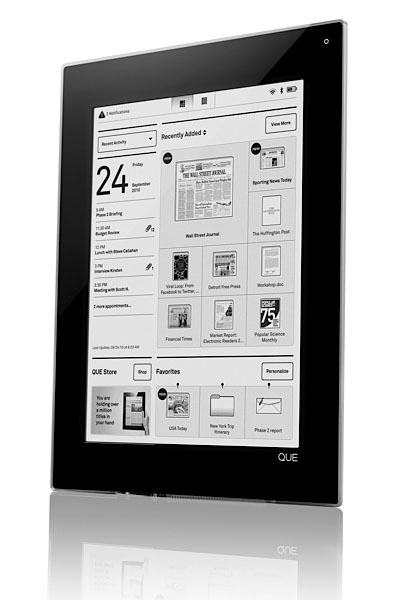
Plastic Logic Que proReader (CES 2010)
Image used with permission by copyright holder

“Today we are introducing two major advancements: the birth of a new market category, the proReader, and a milestone in the evolution of plastic electronics,” said Plastic Logic CEO Richard Archuleta, in a statement. “The Que proReader was built from the ground up for people who need to read. Starting today, mobile professionals can look forward to a paperless briefcase, a lighter load, and a better way to work.”

Recommended Videos

Unlike the Amazon Kindle, Sony Reader, and simulate products aimed at consumers, the Que proReader is aimed at business professionals, with a “home view” that not only features the day’s news and information, but also highlights a user’s appointments and calendar. Of course, the Que Store (powered by Barnes & Noble) will be just one step away (via AT&T’s 3G wireless network, although the proReader also packs Wi-Fi and Bluetooth), and users can easily transfer content from PCs, Macs, and BlackBerry devices. A Barnes & Noble will initially offer business-oriented magazines, newspapers, books, and publications, and Plastic Logic has also set up relationships with leading business and financial journals for one-time and ongoing subscriptions. In addition, Plastic Logic is working with Olive Software to provide a Que-optimized content management and reading experience.

The Que proReader also supports a new “truVue” document format deevloped in conjunction with Adobe that is designed to preserve a good deal of the visual style and appearance of print publications—something near and dear to outlets like the Wall Street Journal.

The Que proReader is available for pre-order now, and Plastic Logic says the devices will ship in April of 2010 and be available from Barnes & Noble later in 2010. The proReader will be available in two capacities—4 GB and 8 GB—at a very pricey $649 and $799 respectively.
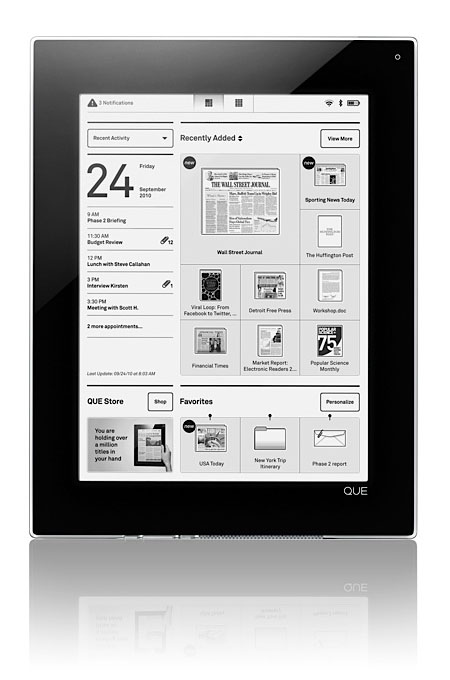
Plastic Logic Que proReader (CES 2010)
Image used with permission by copyright holder
Geoff Duncan
Former Contributor
Geoff Duncan writes, programs, edits, plays music, and delights in making software misbehave. He's probably the only member…
Starlink V5 is here, and it’s lighter, smarter, and far more efficient
The next-generation satellite internet kit promises improved efficiency while maintaining high-speed connectivity.
Starlink V4 vs V5

Not every hardware upgrade needs to be about speed. With Starlink V5, SpaceX is betting that a lighter design and lower power consumption matter just as much. The company has officially introduced its next-generation Starlink V5 kit, featuring a smaller and lighter design with significantly improved power efficiency.

Smaller, lighter, and far more efficient

Read more
Frontier joins the Starlink club with high-speed in-flight internet
The carrier plans to roll out SpaceX's satellite-powered Wi-Fi across its fleet starting in 2027.
Frontier Starlink partnership featured

If there's one thing budget airlines aren't exactly known for, it's great onboard Wi-Fi. In Frontier Airlines' case, it hasn't offered in-flight internet at all. That's about to change. Frontier Airlines has announced a partnership with SpaceX's Starlink to bring high-speed, low-latency internet across its fleet. Installations will begin in early 2027, making Frontier the first ultra-low-cost carrier in the United States to adopt Starlink's satellite-powered connectivity.

Streaming, browsing, and even gaming at 35,000 feet

Read more
OpenAI’s first hardware product sounds more like a companion than a speaker
The AI company is reportedly building a mobile home device that understands context and proactively helps users.
OpenAI press image

For months, rumors have suggested that OpenAI's first hardware product could be a wearable AI device, or perhaps even the beginning of its long-term smartphone ambitions. As it turns out, the company's first gadget may be something far simpler, yet arguably far more ambitious. It will help control smart-home appliances, play media, answer questions, respond to messages, and tap into the range of capabilities offered by OpenAI's ChatGPT, according to people familiar with the matter.

OpenAI's first AI device could end up being a speaker, following plenty of hype that the company is actually working on a wearable AI device and might even launch a smartphone down the road. According to a Bloomberg report, the speaker will serve as a human-like AI companion that will integrate directly with the smart home ecosystem.

Read more