  1. Home
  2. Emerging Tech
  3. Photography
  4. Legacy Archives

Quadcopter with GoPro camera captures stunning views of Niagara Falls

Add as a preferred source on Google

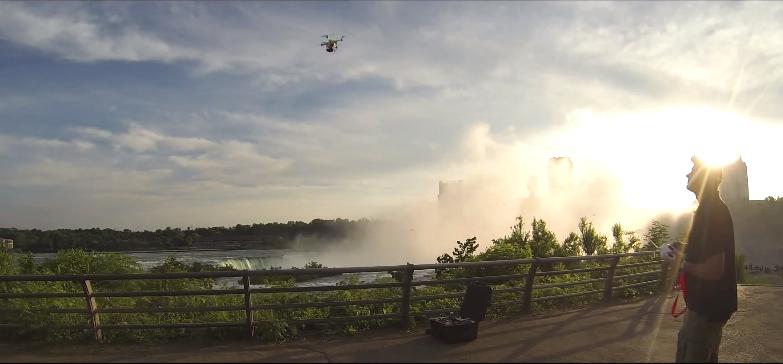
quadcopter niagaraFor his entry into a quadcopter video contest, YouTube user Questpact had the idea to strap a GoPro Hero 3 camera to his DJI Phantom flyer and send it high, and not so high, above Niagara Falls.

With most tourists opting for a good soaking via the Maid in the Mist boat ride instead of a helicopter experience over the falls, Questpact’s video goes some way to showing what the natural wonder looks like from an elevated position, as well as what you can do with a video camera and quadcopter when you put your mind to it – and yes, the results are pretty stunning.

quadcopter niagara falls
Image used with permission by copyright holder

Though they’re not the highest in the world, Niagara Falls – comprising the Horseshoe Falls, American Falls and Bridal Veil Falls – does hold the record for the highest flow rate of any falls on the planet, with Questpact’s video managing to capture some of the incredible energy and power generated by the surging water.

Recommended Videos

Strapping a Fat Shark radio-controlled first-person-view system to his head so he could see exactly what footage he was capturing, Questpact sent his quadcopter over the falls, shooting for 20 minutes in total.

The final video (check it out below), backed with a soothing soundtrack by San Diego band A New Normal, has been edited down to five minutes, and provides some spectacular imagery of this world famous landmark. 

[via Cnet]

Trevor Mogg
Contributing Editor
Not so many moons ago, Trevor moved from one tea-loving island nation that drives on the left (Britain) to another (Japan)…
Anti-surveillance clothing is getting cheaper, but don’t expect an invisibility cloak
Affordable shirts now claim to confuse facial recognition, although their protection depends heavily on the camera and software watching you
Chart, Plot, Adult

Anti-surveillance clothing is starting to look less like an art-school experiment and more like something you could actually wear outside. Shirts designed to confuse facial recognition systems now cost about as much as ordinary streetwear, although buying one won’t make you disappear.

The Guardian reports that designers are using face-like prints, unusual cuts and infrared lights to interfere with computer vision. These techniques target specific weaknesses, so their success depends on what happens to be watching you.

Read more
This spinning drone hides in plain sight using a visual illusion
This drone doesn't turn invisible. It tricks your brain into thinking it has.
Phantom Twist

For decades, engineers have chased the dream of an invisible drone. The usual approaches have involved transparent materials, camouflage coatings, or complex optical systems that bend light around an object. Researchers at Northwestern University decided to take a completely different route. Instead of hiding the drone itself, they chose to fool the human eye.

The result is Phantom Twist, an experimental drone that spins so rapidly it almost disappears into the background. It's not technically invisible, but to anyone watching, it looks more like a faint blur than a flying machine.

Read more
This smart knitted fabric can flip switches, count your steps, and even change shape
Grandma's knitting just entered its Iron Man era
Representative Image

For most of us, knitting brings to mind sweaters, scarves, and perhaps an ambitious grandmother determined to make winter more fashionable. Researchers at Harvard University, however, have a far more futuristic vision. They've transformed ordinary knitted fabric into a programmable material capable of changing shape, acting as an electrical switch, sensing movement, and potentially forming the foundation of tomorrow's wearable technology.

The research, published in Advanced Functional Materials by scientists at the Harvard John A. Paulson School of Engineering and Applied Sciences (SEAS), demonstrates how machine-knitted textiles can "snap" between multiple stable shapes without relying on motors or rigid mechanical parts.

Read more