  1. Home
  2. Emerging Tech
  3. Mobile
  4. Legacy Archives

Researchers aim to power smartphones through walking

Add as a preferred source on Google

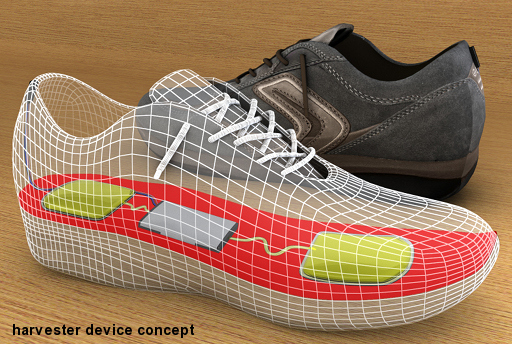
device via instepnanopower.comA new energy harvesting method developed by researchers Tom Krupenkin and J. Ashley Taylor at the University of Wisconsin-Madison promises a practical way to power smartphones and other portable electronics simply by walking down the street.

Though energy-harvesting technology isn’t new as the two engineering researchers point out in a recent Nature Communications article, their new energy-harvesting technology aims to provide for a market not being represented by current energy harvesting methods.

Recommended Videos

“What has been lacking is a mechanical-to-electrical energy conversion technology that would work well for this type of application [mobile electronic devices],” said Krupenkin.

The new method Krupenkin and Taylor have created is a process called reverse electrowetting which converts energy from moving liquid. Their device is made up of thousands of microscopic liquid droplets—they use a liquid metal alloy used in thermometers—which interacts with a nano structured substrate.

The researchers say that humans produce a lot of energy; we can produce as much as a kilowatt of power by sprinting, and only a fraction of that energy is needed to power devices . There have have been previous attempts to harvest power from human locomotion like the 2008 knee brace but they were impractical.

The Wisconsin-Madison Researchers believe that by inserting their device into a pair of shoes, a person could generate up to 20 watts of electrical energy. That energy could then be used to charge devices by plugging in to a small USB port into the shoes. Another method would be to create a tiny Wi-Fi hotspot in the shoe device which would take the load off a phone’s battery. Krupenkin says that this could extend battery life to a month rather than just a day or two.

The device could be very practical in impoverished countries with poor access to electricity, or for military personnel. The product isn’t available yet, but the two are looking to commercialize through their Instep Nanopower company.

 Via MSNBC

Jeff Hughes
Former Digital Trends Contributor
I'm a SF Bay Area-based writer/ninja that loves anything geek, tech, comic, social media or gaming-related.
Anti-surveillance clothing is getting cheaper, but don’t expect an invisibility cloak
Affordable shirts now claim to confuse facial recognition, although their protection depends heavily on the camera and software watching you
Chart, Plot, Adult

Anti-surveillance clothing is starting to look less like an art-school experiment and more like something you could actually wear outside. Shirts designed to confuse facial recognition systems now cost about as much as ordinary streetwear, although buying one won’t make you disappear.

The Guardian reports that designers are using face-like prints, unusual cuts and infrared lights to interfere with computer vision. These techniques target specific weaknesses, so their success depends on what happens to be watching you.

Read more
This spinning drone hides in plain sight using a visual illusion
This drone doesn't turn invisible. It tricks your brain into thinking it has.
Phantom Twist

For decades, engineers have chased the dream of an invisible drone. The usual approaches have involved transparent materials, camouflage coatings, or complex optical systems that bend light around an object. Researchers at Northwestern University decided to take a completely different route. Instead of hiding the drone itself, they chose to fool the human eye.

The result is Phantom Twist, an experimental drone that spins so rapidly it almost disappears into the background. It's not technically invisible, but to anyone watching, it looks more like a faint blur than a flying machine.

Read more
This smart knitted fabric can flip switches, count your steps, and even change shape
Grandma's knitting just entered its Iron Man era
Representative Image

For most of us, knitting brings to mind sweaters, scarves, and perhaps an ambitious grandmother determined to make winter more fashionable. Researchers at Harvard University, however, have a far more futuristic vision. They've transformed ordinary knitted fabric into a programmable material capable of changing shape, acting as an electrical switch, sensing movement, and potentially forming the foundation of tomorrow's wearable technology.

The research, published in Advanced Functional Materials by scientists at the Harvard John A. Paulson School of Engineering and Applied Sciences (SEAS), demonstrates how machine-knitted textiles can "snap" between multiple stable shapes without relying on motors or rigid mechanical parts.

Read more