1. Home
  2. Emerging Tech
  3. Smart Home
  4. News

Autoset smart miter saw fence will put an end to poorly cut wood

Add as a preferred source on Google

Ever tried a spot of do-it-yourself work and ended up wasting good wood by making the wrong cut? As Steve Jobs might have said, “there’s an app for that” — or, in this case, a whole smart miter saw fence.

Described by creators Velocity Robotics as the first of its connected “Internet of Tools,” Autoset is a nifty rail device which reads in a cut list generated electronically by Bluetooth measuring tools, and then moves a stop to the exact location so you make the perfect cut.

Recommended Videos

To make a single cut, the user presses a single button on the Bluetooth tape measure, and moves Autoset’s stop in the indicated direction. Autoset then stops and makes a fine adjustment to the exact cut length, while the user grabs his or her workpiece.

“When I founded Velocity Robotics, I had been working at Caterpillar for a number of years, and I had done some DIY renovation work on my 80-year-old house,” founder Brad Kriel told Digital Trends. “Between those two experiences, I decided to start something in the construction industry. I still had no idea what, though. After some early interviews with contractors, the first thing I learned was the the ‘cut guy’ is a big bottleneck — so I decided to try to tackle the issues around measuring, cutting, and installing building material, among the most common workflows on the construction site.”
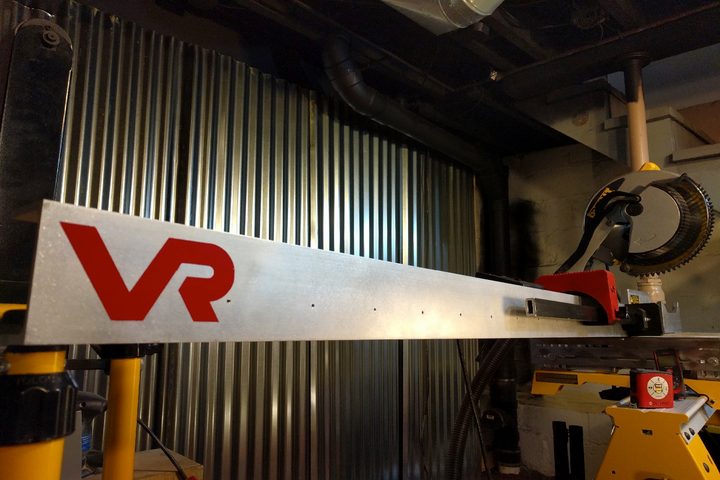
Image used with permission by copyright holder

The promise of Autoset is to let customers measure and cut stock much faster, more precisely, and with fewer errors — thereby improving efficiency and reducing scrap. You’ll need your own miter saw for it to work (unless you just plan to do a whole lot of measuring with no actual cutting), but Kriel says that the device has been designed to attach to any make and model out there.

“Autoset is built for the construction site in mind, but is just as useful in the wood shop,” he continued. “It’s for rough carpentry and finish carpentry. It’s for wood floors and tile and siding. It’s for plumbing. It’s for woodworking. Really, it’s for any operation that uses or can use a miter saw.”

Pre-orders are currently underway on Kickstarter, where Kriel and his team have 28 days to raise $50,000. An Autoset test kit starts at $349, which includes 8 feet of rail, carriage with stop and user controls, universal bracket for saw mount, iOS or Android app, and an eTAPE16 Bluetooth tape measure. Shipping is set to take place in June 2017.

Luke Dormehl
I'm a UK-based tech writer covering Cool Tech at Digital Trends. I've also written for Fast Company, Wired, the Guardian…
Starlink V5 is here, and it’s lighter, smarter, and far more efficient
The next-generation satellite internet kit promises improved efficiency while maintaining high-speed connectivity.
Starlink V4 vs V5

Not every hardware upgrade needs to be about speed. With Starlink V5, SpaceX is betting that a lighter design and lower power consumption matter just as much. The company has officially introduced its next-generation Starlink V5 kit, featuring a smaller and lighter design with significantly improved power efficiency.

Smaller, lighter, and far more efficient

Read more
Frontier joins the Starlink club with high-speed in-flight internet
The carrier plans to roll out SpaceX's satellite-powered Wi-Fi across its fleet starting in 2027.
Frontier Starlink partnership featured

If there's one thing budget airlines aren't exactly known for, it's great onboard Wi-Fi. In Frontier Airlines' case, it hasn't offered in-flight internet at all. That's about to change. Frontier Airlines has announced a partnership with SpaceX's Starlink to bring high-speed, low-latency internet across its fleet. Installations will begin in early 2027, making Frontier the first ultra-low-cost carrier in the United States to adopt Starlink's satellite-powered connectivity.

Streaming, browsing, and even gaming at 35,000 feet

Read more
OpenAI’s first hardware product sounds more like a companion than a speaker
The AI company is reportedly building a mobile home device that understands context and proactively helps users.
OpenAI press image

For months, rumors have suggested that OpenAI's first hardware product could be a wearable AI device, or perhaps even the beginning of its long-term smartphone ambitions. As it turns out, the company's first gadget may be something far simpler, yet arguably far more ambitious. It will help control smart-home appliances, play media, answer questions, respond to messages, and tap into the range of capabilities offered by OpenAI's ChatGPT, according to people familiar with the matter.

OpenAI's first AI device could end up being a speaker, following plenty of hype that the company is actually working on a wearable AI device and might even launch a smartphone down the road. According to a Bloomberg report, the speaker will serve as a human-like AI companion that will integrate directly with the smart home ecosystem.

Read more