  1. Home
  2. Emerging Tech
  3. News

Watch SpaceX practice an emergency escape from its Crew Dragon capsule

Add as a preferred source on Google
Danger on the SpaceX launch pad! Emergency egress rehearsed

This video shows SpaceX performing an emergency egress test this week for its Crew Dragon capsule at Launch Complex 39A at NASA’s Kennedy Space Center.

Recommended Videos

The Crew Dragon capsule will ferry astronauts to the International Space Station (ISS) as part of NASA’s Commercial Crew Program. But before it can be confirmed for long-term use, it has to go through a demonstration test flight to show that everything works correctly. This test flight, called Demo-2, is planned to go ahead next month, and will mark the first time that American astronauts have launched from American soil since the end of the Space Shuttle program in 2011.

When Demo-2 goes ahead, there needs to be a strategy for the crew to evacuate should anything go wrong during the launch. That is what the emergency egress exercise is simulating. “The end-to-end demonstration is the latest in a series of similar exercises to ensure the crew and support teams can quickly evacuate from the launch pad in the unlikely event of an emergency prior to liftoff,” NASA said in a blog post.

“NASA and SpaceX personnel, including the Kennedy pad rescue team, participated in the exercise. The primary objective was to demonstrate the teams’ ability to safely evacuate crew members from the launch pad during an emergency situation. Teams rehearsed locating injured personnel on the 265-foot-level of the launch tower, loading them into the pad’s slidewire baskets and safely descending the tower, then successfully loading the injured participants into Mine Resistant Ambush Protected (MRAP) vehicles staged at the pad perimeter.”
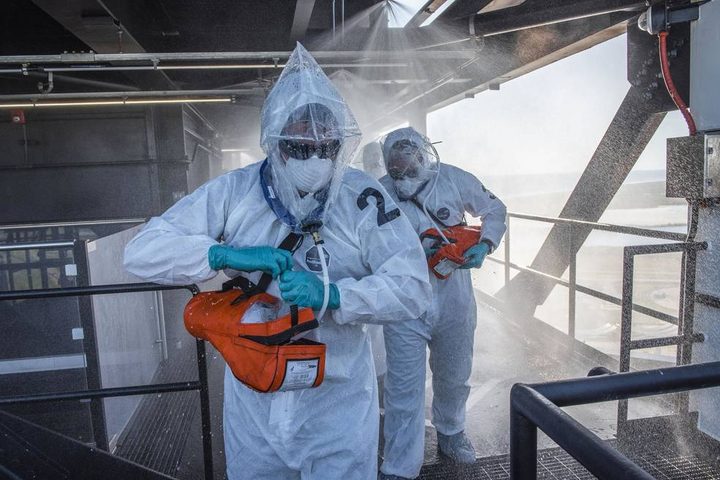
On Friday, April 3, 2020, NASA and SpaceX completed an end-to-end demonstration of the teams' ability to safely evacuate crew members from the Fixed Service Structure during an emergency situation at Launch Complex 39A at NASA's Kennedy Space Center in Florida.
On Friday, April 3, 2020, NASA and SpaceX completed an end-to-end demonstration of the teams’ ability to safely evacuate crew members from the Fixed Service Structure during an emergency situation at Launch Complex 39A at NASA’s Kennedy Space Center in Florida. SpaceX

Despite the global outbreak of coronavirus, officially called COVID-19, SpaceX and NASA have both firmly maintained that they plan to go ahead with the Demo-2 flight test soon. Bob Behnken and Doug Hurley, the NASA astronauts who will be participating in the test flight, are preparing for their roles. However, NASA has advised that the launch will be “no earlier than May 2020,” so there is a possibility that it may be delayed.

Georgina Torbet
Georgina has been the space writer at Digital Trends space writer for six years, covering human space exploration, planetary…
Meta goes toe-to-toe with the big boys as it launches Muse Wonder AI models
Illustration of Meta Muse Wonder AI model.

It's raining frontier AI models. Soon after Anthropic set alarm bells ringing with its Claude Fable model at the summit of AI peformance, OpenAI answered with GPT-6 Astra. Not one to be left behind, Google released Gemini 4 Argon. The race is now getting hotter as Meta enters the fray with two new AI models in the Muse series: Wonder and Wonder Full. Cheesy naming aside, these Meta AI models mean business, or at least that's what the benchmark figures suggest. More importantly, these AI models are already making their way to Muse users.

https://twitter.com/DigitalTrends/status/2109699549375988120

Read more
AI can’t tell if you’re gay or straight, but it thinks it knows what both look like
AI knows it shouldn't judge a face, but apparently, drawing one is a different story.
Emilia Clarke AI generated stock image. Gemini / Nano Banana is on the left

We've all been told not to judge a book by its cover, and you'd think AI would follow that rule, too. Ask an AI chatbot to guess someone's sexual orientation just by looking at their face, and it'll likely tell you that there's no reliable way to know. But what happens when you ask that same model to change someone's appearance to match a particular sexual orientation? Well, that's where things get uncomfortable.

A new study, accepted for presentation at the 2026 Conference on Empirical Methods in Natural Language Processing, found that AI models from OpenAI and Google can be inconsistent when handling sensitive personal characteristics. They might refuse to make assumptions about someone based on their appearance, but when asked to generate those same assumptions visually, the results tell a very different story.

Read more
A clinical study with Google’s special chatbot shows a strong future for AI in healthcare
Google’s medical AI could give doctors a useful second set of eyes
Google Articulate Medical Intelligence Explorer chatbot

AI is a useful tool for handling many tasks in private as well as professional settings, but medical advice, especially diagnosis, is one area where I generally draw the line. General-purpose chatbots tend to sound confident and convincing while giving medical advice, even when they are wrong, as studies have previously found.

That being said, Google's new research points to a much more convincing use for AI in healthcare. Its Articulate Medical Intelligence Explorer chatbot, or AMIE for short, could help prepare both sides before the appointment even begins.

Read more