1. Home
  2. Emerging Tech
  3. News

UK’s first-ever ‘plastic’ £5 bill comes with an app to check if it’s fake

Add as a preferred source on Google

With the dollar riding high against the U.K. pound in the wake of the Brexit vote, there’s never been a better time time for Americans to hop across the pond to experience the island nation’s many delights.

And if you do go, you’ll likely have a chance to fondle the new “plastic” fiver, released by the Bank of England on Tuesday.

Recommended Videos

Featuring an image of Queen Elizabeth II on one side and Britain’s World War II leader Winston Churchill on the other, the new fiver is the Bank’s first-ever bill made from polymer, a thin and flexible plastic material.

The more robust structure makes it extremely resistant to dirt and moisture, and should ensure it lasts around 2.5 times longer – about five years in all – than the old paper fiver. The material has also given the Bank the chance to introduce a bunch of new security features, which should help keep counterfeiters at bay.
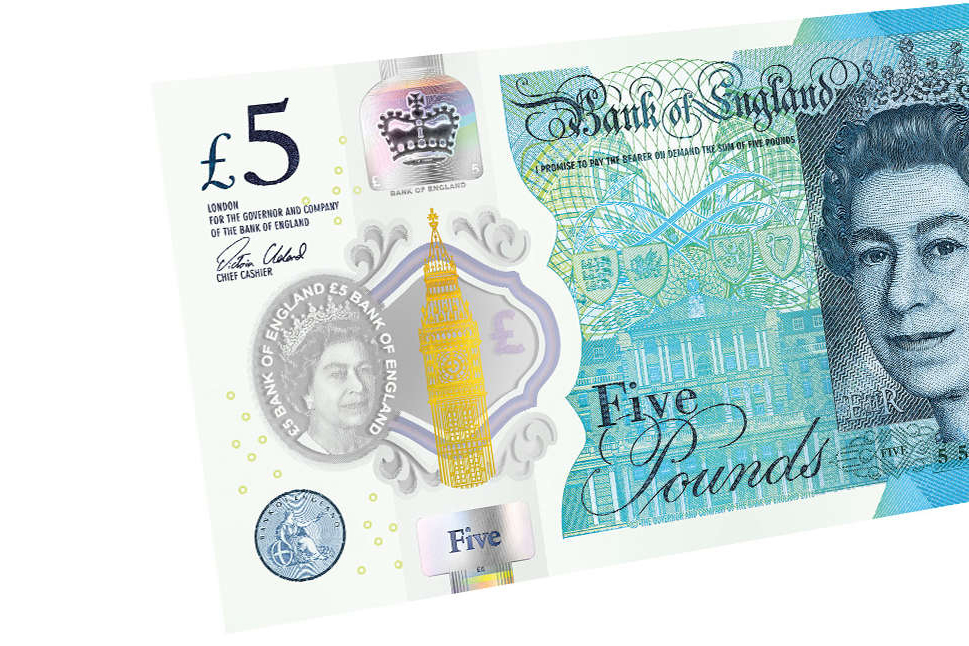
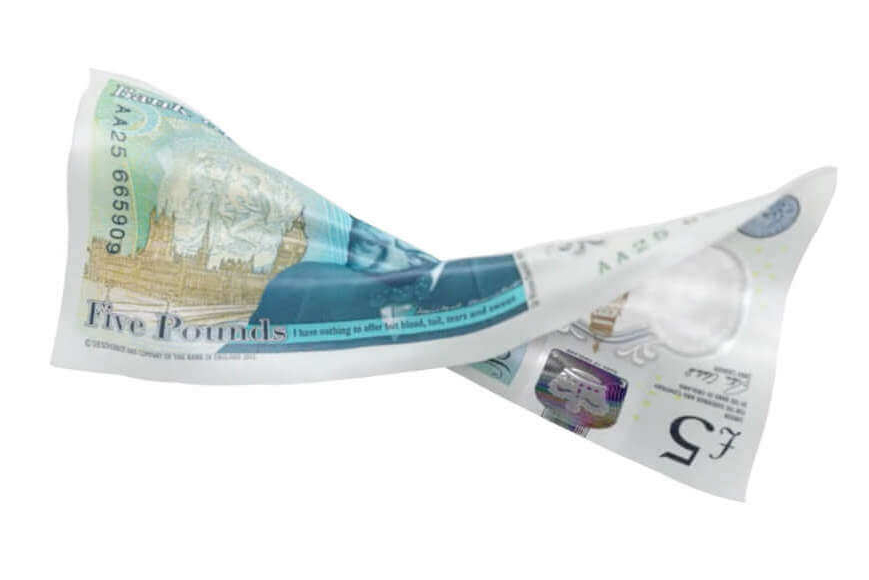
The security measures, which can be viewed in detail via the Bank of England’s iOS and Android app, include raised print, a see-through window with a foil Elizabeth Tower (pictured) that’s gold on the front of the bill and silver on the back, and a 3D image of the coronation crown that produces a rainbow effect when the bill is tilted. Also, shining a UV light on the new money shows up a bright red and green number “5” while the rest of the bill remains dull in contrast.

Around 440 million new fivers have been printed, all of which will go into circulation in the coming days and weeks. The Bank is also introducing its first polymer £10 next summer, followed by a polymer £20 bill by 2020.

Bank of England governor Mark Carney assured Brits – and overseas tourists – the new polymer fiver is able to withstand “a splash of claret, a flick of cigar ash, the nip of a bulldog, and even a spin in the washing machine.”

Judging by a torture test carried out by the BBC on Tuesday, it can also survive a cycle in the dishwasher:

Trevor Mogg
Contributing Editor
Not so many moons ago, Trevor moved from one tea-loving island nation that drives on the left (Britain) to another (Japan)…
I let Gemini take care of my houseplants, and they’ve never looked better
Study guide created by Gemini

I am, by every reasonable measure, a serial plant killer. I've lost count of the pothos, the peace lilies, the one very expensive fiddle-leaf fig that judged me silently for a month before giving up entirely. My problem was never a lack of love. It was that I'd either drown them out of guilt or forget they existed for a fortnight, with no middle ground. So when I started leaning on Gemini for the odd everyday question, letting it babysit my plants wasn't some grand plan. It happened almost by accident, and now my flat looks like something a person with their life together would own.

It started the way most of my plant emergencies do, with a leaf going a color it definitely shouldn't. Instead of doom-scrolling through contradictory Google searches like I usually would, I snapped a photo, handed it to Gemini, and asked what was wrong. What I got back was a proper answer, and it was the first of many.

Read more
I underestimated this NotebookLM feature until it completely changed how I study
google-adds-data-tables-feature-in-notebooklm

I'll admit it: I ignored NotebookLM's Mind Maps feature for far longer than I should have. I mostly used the app to ask questions about my documents or generate Audio Overviews and Short Video Overviews, while that little Mind Map button sat untouched. I assumed it was more of a nice-to-have than something I'd actually use. Turns out, I was completely wrong.

I stopped drowning in my own notes

Read more
The Concorde dream is within reach. NASA X-59 just has to silence the supersonic boom
The jet built to kill the sonic boom just reached full speed
Lockheed Martin’s X-59

NASA has already proved that its needle-nosed X-59 can move seriously fast in recent test flights. Now, the next step is to find out whether it can break the sound barrier without announcing its arrival to everyone below. The experimental aircraft recently reached Mach 1.4, or about 924 mph (1,487 kph), at an altitude of 55,000 feet. Those are the target conditions NASA plans to use during future tests of the X-59’s quieter sonic signature, making the flight a major milestone for the agency’s Quesst mission.

NASA’s supersonic jet has reached full speed

Read more