1. Home
  2. Emerging Tech
  3. News

Move over, quadcopters! A hexacopter could be the most versatile drone yet

Add as a preferred source on Google

Seemingly every week there is some new exciting drone design appearing on the horizon, both figuratively and literally.

One fascinating new concept is Voliro, a hexacopter with six individually tiltable axes, created by students from the Swiss Federal Institute of Technology and Zurich University of the Arts. With a massive 12 degrees of freedom in the air, this could be the most versatile unmanned aerial vehicle (UAV) yet!

Recommended Videos

“Multicopters have enabled a variety of possibilities and revolutionized entire industries with their potential,” Cliff Li, a mechanical engineering student who served as team leader on the project, told Digital Trends. “Yet multicopters are not unlimited in their flying capabilities. To hover, they have to stay horizontal, and to move they have to tilt. For the Voliro hexacopter this is not necessary. It can turn in midair, and move in any direction, no matter how it is oriented. It can fly vertically, upside down, or at any other angle, and proves that completely unrestricted flight is possible.”

Those are big claims, but watching Voliro in action makes us want to believe them. It almost certainly wouldn’t be the easiest drone to pilot, but the tantalizing promise of omnidirectional flight would make the steep learning curve worthwhile.
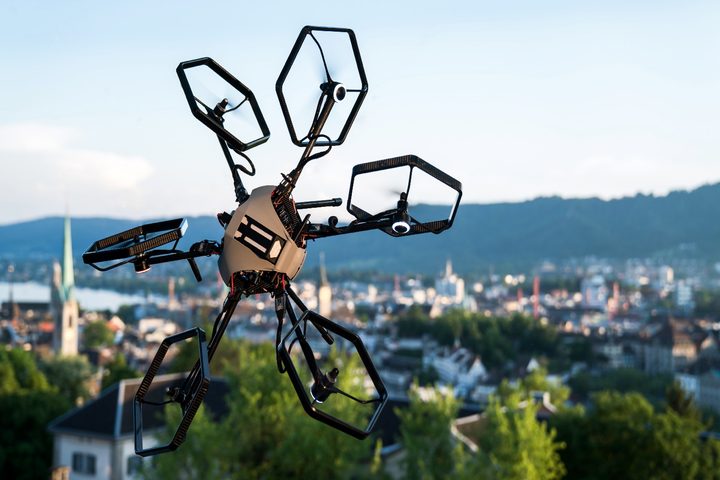
Image used with permission by copyright holder

“Similar to a regular multicopter, modules can be attached on the underside of the Voliro hexacopter, giving it further functionalities,” Li said. “One example is a camera module. The hexacopter can act as a gimbal and therefore doesn’t need one. It can also fly upside down and take footage of what is above the rotors, which is impossible for a regular multicopter with a gimbal. Another example is interaction with walls and various curved structures, as it can adapt its orientation to that of the surface.”

At present, however, Li said that the project has been more about demonstrating that omnidirectional fight is feasible than focusing on use-cases, but these applications are things the team might focus on next.

“Further research will most likely be scientific in nature, but commercialization is not ruled out,” he said. From the sound of things, we could be waiting a while, though.

Luke Dormehl
I'm a UK-based tech writer covering Cool Tech at Digital Trends. I've also written for Fast Company, Wired, the Guardian…
The Apple Car may be dead, but it became the foundation of Apple Intelligence
A decade of work on a canceled car project reportedly laid the groundwork for Apple Intelligence.
Apple Intelligence in Apple Car

The Apple Car may have never left the garage, but it apparently gave birth to Apple's AI ambitions. According to Bloomberg's Mark Gurman, Apple's canceled autonomous vehicle project, one that consumed more than a decade of work and over $10 billion before being scrapped in 2024, ended up laying the technological foundation for Apple Intelligence. In a rather ironic twist, one of Apple's most expensive failures may also become one of its most important long-term investments.

The Apple Car forced Apple to think like an AI company

Read more
Researchers hid a prompt injection inside a PNG, and AI fell for it
Hacker

AI coding assistants like Claude are becoming every developer's favorite coworker. They can review code, explain confusing functions, and even write entire features with a single prompt. But new research suggests that this growing trust could also become their biggest weakness.

A team of security researchers (professor Sudipta Chattopadhyay and researcher Murali Ediga) has demonstrated an unusual attack that doesn't target the AI model directly. Instead, it targets what the AI doesn't pay enough attention to during code reviews. Rather than hiding malicious instructions in lines of code, the researchers tucked them inside an image file. Since many AI review tools treat images as decorative assets rather than as something worth inspecting, the pull request can appear perfectly harmless and sail through the review.

Read more
AI has already fallen into the wrong hands and they’re using it to make bombs
Logo, Text

Artificial intelligence has quickly become the go-to tool for everything from writing emails and summarizing meetings to helping students study or developers debug code. But the same technology that saves people time can also be misused, and a new report suggests that terrorist organizations are finding ways to do exactly that.

According to a research paper shared with The New York Times ahead of its publication, researchers found evidence that members of Boko Haram have been using popular AI chatbots to support both day-to-day activities and combat-related tasks. Interviews with 27 former members conducted in Nigeria over the past two years suggest that tools such as ChatGPT, Gemini, Claude, Grok, Meta AI, and DeepSeek were used to gather technical information, troubleshoot weapons, and even assist with planning attacks.

Read more