1. Home
  2. Audio / Video
  3. News

Get ready for a new generation of wireless headphones: Bluetooth LE Audio is now a done deal

Add as a preferred source on Google

The Bluetooth Special Interest Group (SIG) — the entity tasked with evolving the Bluetooth wireless standard over time — has announced that it has completed its work on the new LE Audio specification, which officially opens the doors to a new wave of wireless headphones, earbuds, speakers, and hearing aids that work with the new standard.

Bluetooth LE Audio is fully backward-compatible with older Bluetooth versions, so you don’t need to worry about buying a new set of earbuds or headphones only to discover that they don’t work with your phone or computer. But it does add several new capabilities like Auracast (a broadcast-style audio sharing feature) and the LC3 codec, which promises better audio quality while reducing latency and extending battery life. To enjoy these additional features, both the transmitting device (like your phone) and the receiving device (headphones, earbuds, etc.) will need to support them.
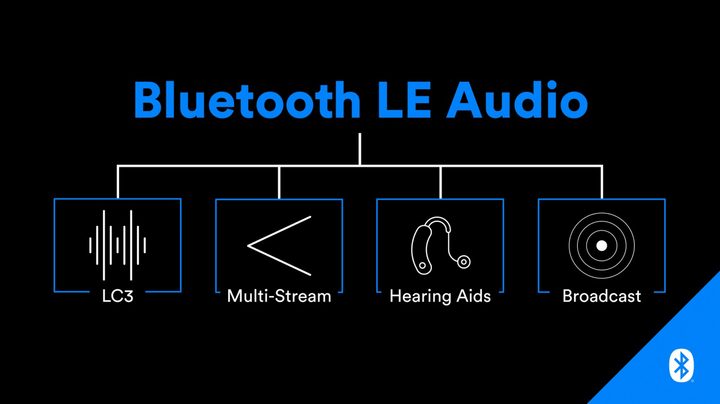
Bluetooth LE Audio diagram.
Bluetooth SIG

“LE Audio extends the boundaries of what’s possible for the wireless audio market,” said Mark Powell, CEO of the Bluetooth SIG, “including the introduction of Auracast broadcast audio, a new Bluetooth capability that promises to deliver life-changing audio experiences to consumers, bringing friends and family closer together and making public locations more accessible and enjoyable for all.”

Recommended Videos

So far, no companies have announced devices that support any or all LE Audio features, but that’s expected to change in the coming months, according to the Bluetooth SIG. It anticipates that LE Audio product availability will begin to accelerate as the 2022 holiday season approaches.

Like the HDMI 2.1 standard for TVs and video products, the LE Audio specification does not require that all LE Audio-certified devices support all LE Audio features. So when these products do begin to emerge, buyers will have to pay particular attention to the fine print. It’s possible, for instance, for a set of headphones to support the LC3 codec without supporting Auracast, which could be a problem if you had assumed that the promise of “LE Audio” in the item description meant that Auracast was automatically included.

Simon Cohen
Former Contributing Editor, A/V
Simon Cohen obsesses over the latest wireless headphones, earbuds, soundbars, and all manner of related devices and…
Proton reveals how smart TVs track you and the escape situation is pretty grim 
Modern smart TVs fingerprint your screen content at the chipset level.
Google TV applications on the Sony A95K TV.

Your smart TV may know far more about your viewing habits than you realize, even if you rarely use its smart features. In a new privacy explainer, Proton warns that many modern TVs quietly collect data about everything displayed on the screen and share it with manufacturers, advertisers, and analytics companies.

The worrying part is that escaping this tracking is becoming increasingly difficult because many privacy controls are buried deep in settings or enabled by default. Proton argues that buying a smart TV today often means accepting a level of surveillance that most people never knowingly signed up for.

Read more
LG is cracking down on smart TV apps that quietly turn your TV into a secret proxy
LG OLED Settings

If you own an LG smart TV, there's a chance one of your harmless-looking apps has been moonlighting as an internet relay for someone else's traffic. According to a report from KrebsOnSecurity, LG says it's finally stepping in to stop this menace. This week, the company confirmed it plans to suspend any webOS app that turns a TV into what's called a residential proxy node.

The move follows a report from security firm Spur, which found that more than 42 percent of apps on LG's webOS store include SDKs that quietly reroute internet traffic through your TV, indefinitely. Samsung isn't spared either, with over a quarter of Tizen apps carrying similar code.

Read more
The LG C6 OLED is great out of the box. These settings make it even better.
From Filmmaker Mode to shadow detail and AI Sound Pro, these are the settings that made the biggest difference after a month of testing the LG C6 OLED.
LG OLED Settings

The LG C6 OLED is one of the best mid-range OLED TVs you can buy right now. After spending the past month testing and using it every day, one thing became clear: straight out of the box, you're leaving picture quality on the table.

The good news is that getting more out of the TV doesn't require professional calibration or hours spent digging through menus. A handful of small adjustments can make movies look more cinematic, improve shadow detail, smooth out motion and even make the built-in speakers sound noticeably better. Here are the exact settings I've been using after living with the LG C6.

Read more