 It isn’t often that a manufacturer can reinvent a product that’s been dead for as long as the NAD 3020 amplifier. Introduced by NAD back in the late 1970s, the 3020 became the standard against which all of its future products would be judged. The powerful integrated amplifier offered performance, simplicity, and value; three concepts that would serve as the framework for the next thirty-five years of NAD’s existence.
Like every other high-end audio manufacturer, NAD has been forced to reinvent itself in order to survive in this era of portable digital audio and streaming media. Its traditional customers may still buy its integrated amplifiers and A/V receivers, but according to NAD, that left the “Digital Native” outside of its base, and unless it found a way to connect with customers who have grown up with iTunes and digital streaming services such as Pandora and Spotify, the future was going to be murky at best.
As part of the Lenbrook Group, which includes PSB loudspeakers, NAD has access to some of the best audio engineers and testing facilities in the world. With the guiding hands of Bjorn Erik Edvarsen and Paul Barton, it is easy to understand how NAD could be confident in its ability to introduce both headphones and digital amplifiers into an already extremely crowded market and convince the digital native to take next step.
NAD invited Digital Trends to a private press briefing this week to demonstrate its new Digital Classics series of components, and while we were impressed, it was the rebirth of the classic 3020 that really piqued our interest.
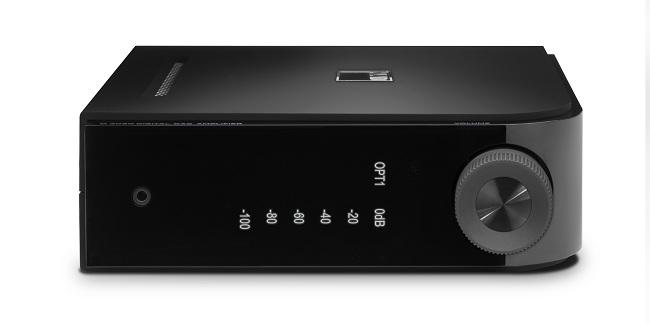
Designed for the next generation of listeners, the NAD D 3020 Digital Hybrid Amplifier ($500) offers a modern spin on the classic solid-state integrated with its universal class ‘D’ amplifier (UcD) designed in conjunction with Dutch manufacturer, Hypex.
 The D 3020 has a tiny footprint compared to the original and sits upright on your desktop. If not for its touch-sensitive panel and an LED display that indicates the selected source and volume level, one could easily mistake the D 3020 for an external hard drive.
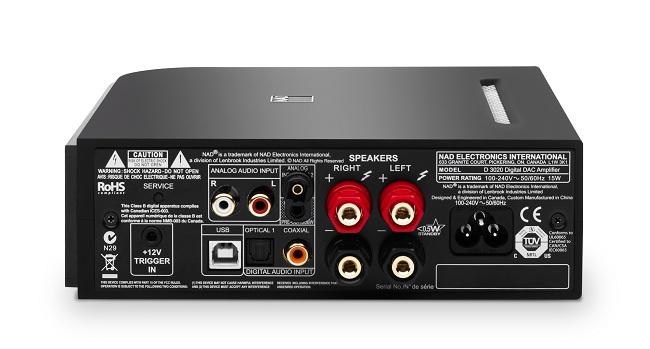
The D 3020 can output more than 30 watts per channel into 8 ohms, and doubles its output into 4 ohms. NAD claims that the D 3020 is stable enough to drive a 2 ohm load, but we’re not likely to be driving a pair of MartinLogan CLX electrostatic loudspeakers with this amplifier anytime soon.
NAD also claims that the D 3020 can drive a pair of Magnepan MMG planar-magnetic loudspeakers just as well as the original 3020, and we plan on putting that to the test when our review sample arrives in July.
The D 3020 also features a 24/96 USB DAC that works in asynchronous mode, which should help eliminate timing errors/jitter. The D 3020 also includes coaxial and optical digital inputs along with a single analog input which would allow users to connect a phono stage if they like. NAD has also included a subwoofer output and dedicated headphone amplifier.
Users can also stream music to the D 3020 from their smart device via Bluetooth with the aptX code (for those devices that support it).
 While the D 3020’s lack of support for Wi-Fi and AirPlay is a little disappointing, the package as designed offers more than enough connectivity options to make it a great desktop hub for those looking to assemble a first-rate system.
If you’re wondering how it sounded, you’ll have to wait until July for a more in-depth review, but we will say that we think NAD is going to have a very hard time keeping the D 3020 in stock when it hits retailers shelves in July. For only $500, NAD seems to have figured out how to teach an old dog new tricks. We’re almost envious of those who get to take the plunge for the first time with such a unique product.