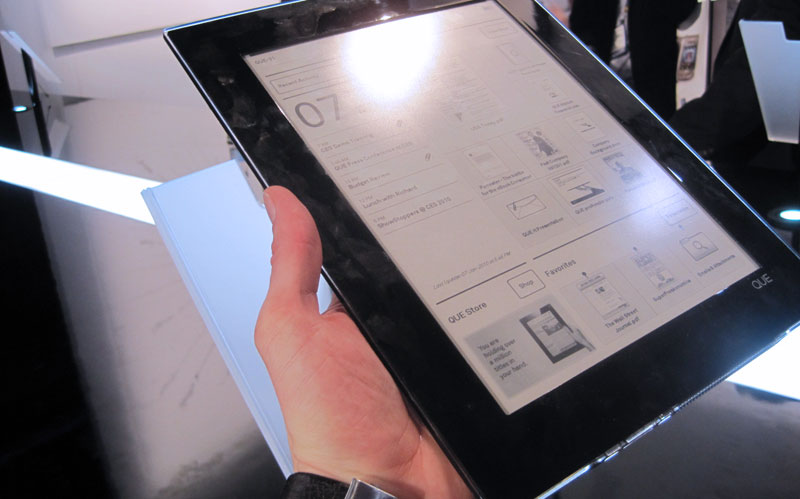
Of all the features we’ve heard people clamoring for in e-readers – bigger, touch-enabled screens, more content, additional file compatibility – the words “more expensive” just never seemed to make the list. That makes Plastic Logic’s new $800 Que proReader a bit of an eyebrow raiser right out of the gate, but despite the outrageous price tag, it does manage to fill many of the other feature holes that have kept e-readers stuck in the novelty zone for so long.
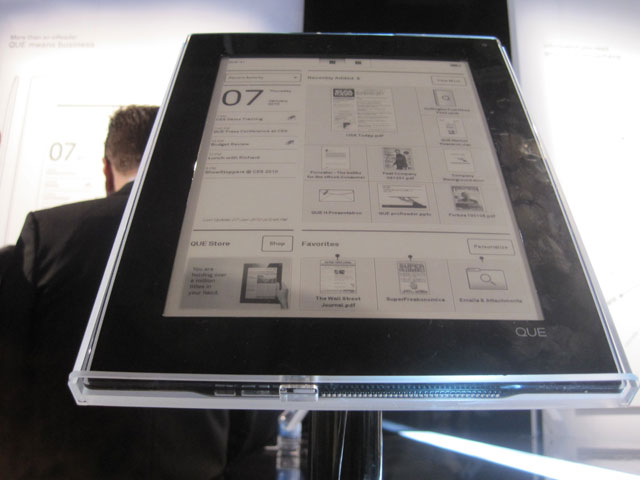 Plastic Logic set out to design an e-reader for the suit-and-tie crowd. If it appeared unbranded, you might even suspect it slipped out of the R&D labs at Research in Motion. The screen measures 10.7 inches across – a full inch larger than the Kindle DX. It uses e-Ink laminated to a full to plastic substrate for more durability than fragile glass e-readers. It measures only a third of an inch thick. And the entire screen is touch-enabled.
In person, the package immediately impresses. Despite its light weight, the Que feels solid, tightly put together, and incredibly intuitive to use. Much of the credit must go to a nearly buttonless design almost certainly inspired by Apple. Like an iPod or iPhone, the bezel has only a single button for home. The rest of the selections can be made entirely by touching the large, finger-friendly buttons on the screen.
Of course, we do have a few concerns. First and foremost, the touch screen lacked the responsiveness you may be accustomed to from quality smartphones. We really had to apply some pressure to make selections. Part of that sluggishness also carried into the page changes, which seemed a little too leisurely for our liking. And although it looks incredibly slick, all that shiny plastic around the edges also loved to pick up fingerprints, turning the floor model into quite a mess after a day of nerd manhandling at CES.
 As for content, a partnership with Barnes & Noble will score Plastic Logic both retail access to brick and mortar stores (so you can try the Que before cutting that $800 check) and access to the entire Barnes & Noble eBook Store – the same one used by the Nook. The company has also partnered with over 300 magazines and newspapers to preserve the formatting used in print copies on the e-reader. In other words, reading Popular Science on the Que should feel like thumbing through a monochrome copy of the magazine, not reading PopularScience.com copy and pasted into Notepad. In the limited browsing we were able to do on a preproduction model, the Que seemed to deliver on this premise.
For execs truly trying to justify the Que as a business expense, it can also tether to phones via Bluetooth to have e-mail delivered to the home screen automatically – and handle all the attachments you might normally need to print, including .doc, .xls, and .ppt.
The Que will appear in April at two price points; $649 and $799. The less expensive version will offer 4GB of memory and Wi-Fi but no built-in cellular connection, while the top-tier model will double memory to 8GB, keep Wi-Fi, and add lifetime AT&T connectivity.