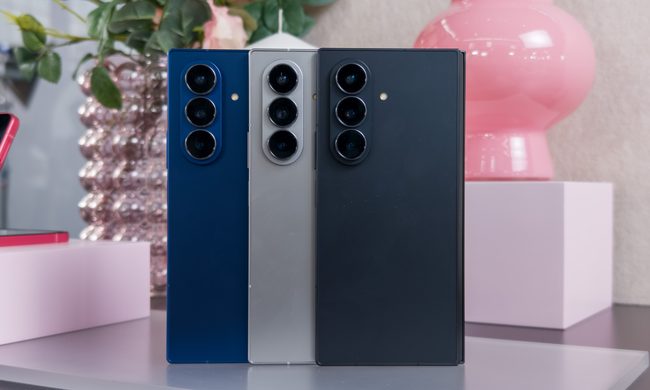
After already unveiling the One X9 for China last December, HTC reintroduced its newest all-metal midrange handset for the rest of the world during Mobile World Congress.
On the surface, the One X9 stays true to its midrange cousin, the One A9, in that it too utilizes an all-metal chassis with rounded corners. The One X9 even has the same ridged power button we liked so much on the One A9. Around back, the similarities continue with a 13-megapixel camera, capable of 4K video recording this time around, while a 5MP camera sits in the front. In addition, the One X9 also includes a MicroSD card slot to expand upon the 32GB of internal storage.
The similarities end there, however, once you take a look at what sits below that front-facing sensor: the return of stereo speakers, missing on the One A9, which flank the 5.5-inch, 1,920 x 1,080 IPS display. The One X9 also eschews the fingerprint sensor and software buttons found on the One A9 for more traditional capacitive keys, which you’ll either love or hate.
Taking a peek under the hood reveals even more differences between the One X9 and One A9: an octa-core MediaTek Helio X10 processor instead of the Snapdragon 617, 3GB of RAM instead of 2GB, and two nano SIM card slots instead of just one. The 3,000mAh battery in the One X9 is capable of fast charging, though we’re hoping there’s a fast charger in the box, since one didn’t come with the One A9.
Finally, the One X9 packs your standard array of wireless connections, including Bluetooth 4.2, Wi-Fi 802.11 a/b/g/n/ac, and NFC, though the latter’s availability will vary by region.
The biggest difference between the One X9 and the One A9, however, is in how they’re sold. Whereas the One A9 is available for purchase here in the United States, as well as several other regions, the One X9 will launch in North Asia, as well as Europe, the Middle East, and Africa. HTC didn’t say whether the One X9 would make its way to the West, though something tells us an import site will be the best bet for Westerners.
Also different, and quite significantly, is in pricing. The One A9 currently goes for $500 here in the U.S., whereas the One X9 will be sold for roughly $170. That’s a huge difference no matter how you look at it, but it’ll depend on how much having North American band support matters to you if you plan to pick up the One X9 for yourself. Either way, the $170 price tag puts the One X9 in direct competition with the Huaweis and Xiaomis of the world, so we’ll see how well the handset keeps up.