A decade ago, if someone had told you your phone could charge in less than 10 minutes or take a detailed photograph of the moon, would you have believed it? Despite our allegiance to technology, we certainly would have been doubtful. Yet, these things are possible today. Our smartphones have experienced enormous growth in almost every area. But, if there is one thing that has seen minimal evolution, it is the SIM card.
The SIM card is witnessing the next wave of transformation with the iSIM or the Integrated SIM, which are much smaller and offer more security than physical SIM cards or embedded SIMs (eSIM). Vodafone and Qualcomm recently showcased a proof of concept working with an iSIM and demonstrated how an iSIM could be a valuable commodity in upcoming smartphones. In this article, we will discuss how the adoption of iSIM could impact the future of smartphones and other smart devices.
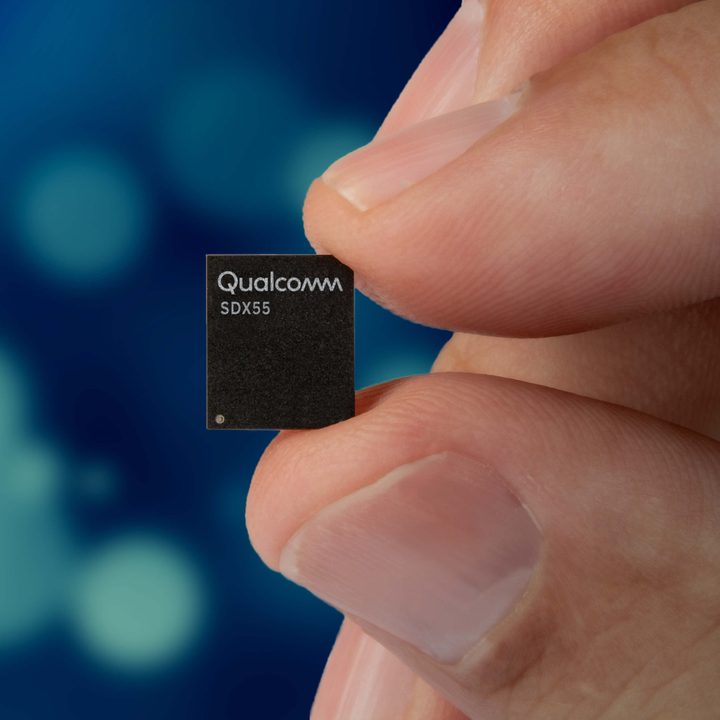
But despite being one of the core elements of a smartphone, the SIM card has seen fewer innovations than any other phone component. However, the integrated SIM brings a significant breakthrough by being more reliable, secure, and efficient.
What is a SIM card?
A “Subscriber Identity Module” or SIM stores the information about a subscriber’s account or phone subscription. A SIM card houses a primitive chip that allows a phone to communicate with a cell tower. It also features an International Mobile Subscriber Identifier (IMSI) that can identify your smartphone.
Additionally, a SIM card has a small amount of storage used to store SMS messages alongside details of your cellular subscription. Furthermore, a SIM can encrypt the connection between the cell tower and your smartphone — and, therefore, secure from an intersection.
The longstanding physical SIM card became smaller over the years and was eventually complemented by an “embedded SIM” or “eSIM.” The latest evolution in SIM cards is an integrated SIM or iSIM, which is incorporated within a mobile processor.
What is an iSIM? How does it differ from an eSIM?
An iSIM or Integrated SIM, also known as the Integrated Universal Integrated Circuit Card (iUICC), is the next step in the evolution of the SIM card. It is by far the most advanced, efficient, and flexible device-side network equipment.
A physical SIM card requires a dedicated slot on a smartphone, tablet, or any other smart device, while an eSIM requires a dedicated chip soldered to the device’s circuit board. An iSIM, in contrast, is embedded within a Tamper-resistant element (TRE) on the device’s system-on-a-chip (SoC). It eliminates the need to depend on discrete SIM hardware and can be activated wirelessly using an industry-wide secure protocol.
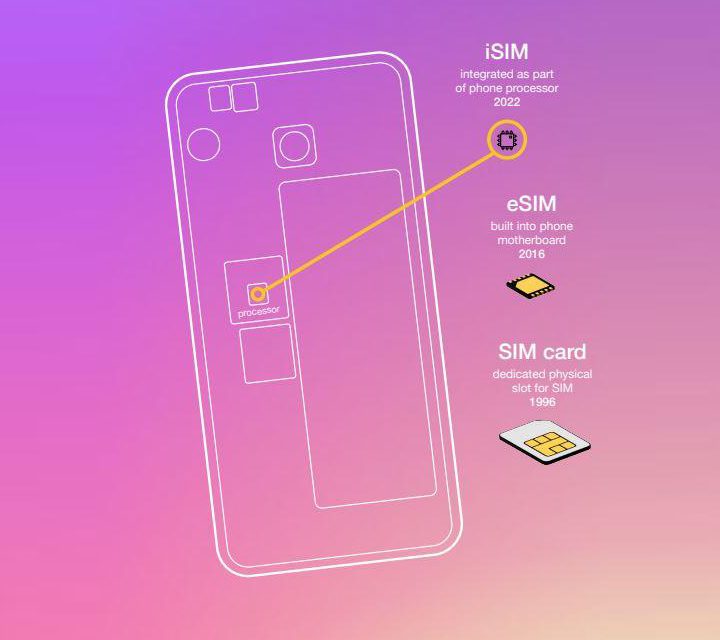
Exactly like an eSIM, an iSIM is a secure trove that stores details about a consumer’s cellular subscription. Just like the eSIM, an iSIM allows carriers to either preload network profiles or remotely send them out directly to a user’s handset — or any other smart device — without them having to visit a store physically.
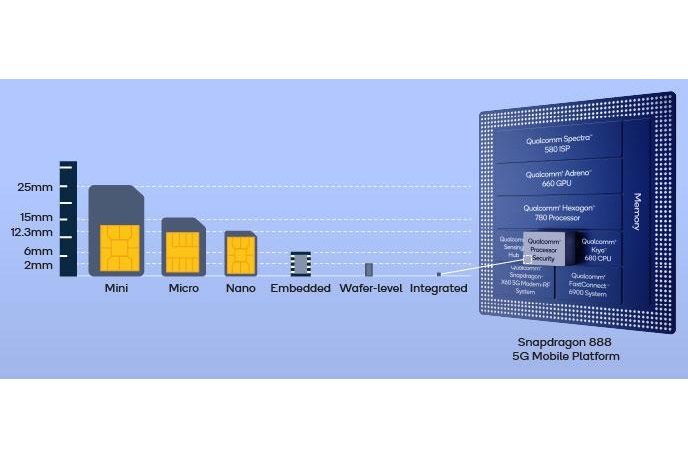
An iSIM is minuscule in size, measuring less than one-millimeter squared in surface area. Because an iSIM does not take up as much size within a smartphone body as a physical SIM or an eSIM, this space is freed up for other components, or to make the device more compact.
Other than smartphones, an iSIM can be useful in providing cellular connectivity to devices with size constraints, such as smartwatches. In addition, the freedom from a physical SIM means an iSIM can be used in a myriad of battery-operated IoT devices, instead of limiting them to Wi-Fi, alleviating any major constraints on the form or shape of the smart device. This is especially beneficial in the era of 5G as more device manufacturers are looking to use low power wide area (LPWA) networks to connect multiple devices in larger and larger inter-communicating networks.
Benefits of an iSIM
The iSIM is the most advanced version of a SIM card. It offers the following advantages over the prevalent forms of SIM technologies.
Size
As we saw above, the small footprint of an iSIM allows space to be freed up inside a device. This can allow for better optimization of internal space — either by adding more useful components or by reducing the overall size of the device. Businesses building IoT devices can reduce internal complexity, eliminate logistic hassles associated with pieces of isolated equipment for cellular connectivity, and can optimize production using smaller network controllers, such as iSIM.
This smaller size will be especially beneficial for consumer devices such as smartwatches or standalone augmented reality (AR) and virtual reality (VR) headsets, which could augment or even fully replace smartphones in the future.
Security
The iSIM is enveloped within a secure and trusted area inside a device’s SoC. The security of the iSIM can be customized as per the requirements of each device. Specifications for the Tamper-resistant element (TRE) are recognized by the Trust Connectivity Alliance and will be crucial in setting a consistent standard for iSIM security.
A TRE is an individual and independent hardware part of the SoC. It runs low-level software to defend the iSIM against physical or virtual attacks.
The first chipset from Qualcomm to support an iSIM is the Snapdragon 888, launched in 2020. The Snapdragon 888 features a Secure Processing Unit (SPU) which, in turn, comes with an integrated Secure Element (iSE) to secure the information stored on an iSIM.
Low power requirements
The iSIM draws power directly from the SoC and does not require a separate microprocessor to function. Since an iSIM’s functionality is still relatively limited, it has an insignificant power draw and does not impact the working of the SoC. In contrast, a more powerful SoC will be able to deliver power to the iSIM more quickly, improving cellular response.
The last aspect will be crucial in the future generations of mobile and IoT devices where gigabit speeds will be commonplace, and our dependence on data connectivity will also increase. LPWA technologies like LTE-M (LTE machine-type communications) and NB-IoT (narrowband IoT), companies can deliver high performance using 5G or more advanced cellular protocols.
Similar to game streaming services where all processing happens in a cloud-based server, it is also possible that the future processing capabilities of smaller devices like smartphones are offloaded onto the cloud, while barebones hardware is used to display that information. An iSIM with minimal power requirements will be incredibly useful in such a case.
Compatibility with 2G, 3G, 4G, and 5G
Unlike proprietary solutions like nuSIM, the iSIM is recognized throughout the industry and will be available with standard security protocols to be used with any carrier. The specifications of iSIM are standardized by GSM Association and other organizations, including 3GPP, European Telecommunications Standards Institute (ETSI), Eurosmart, and Trust Connectivity Alliance. The iSIM also complies with ETSI’s specifications for SIM as well as M2M (machine-to-machine) specifications by GSMA.
The iSIM can support 2G, 3G, 4G, and 5G networks and can be linked to any carrier service. It can also be used with multiple cellular plans. If you are traveling from one country to another, you can automatically switch between two different carriers without physically hunting for a new SIM.
Applications in IoT
With its small size and compatibility with a wide range of communication standards in the industry, the iSIM is a crucial stepping stone in popularizing standalone and battery-powered IoT devices. While our current idea of IoT includes large devices with big sensors, technologies like iSIM can enable much smaller form factors, such as electricity or gas meters, medical equipment, and even vehicle telematics — a field that deals with monitoring a wide range of information related to the car, especially in autonomous vehicles. Besides autonomous vehicles, telematics can also be applied to drones.
One of the remarkable examples of an iSIM’s applications in IoT is shown by Vodafone using a promotional video. The telecom giant envisions smart labels, powered by iSIM, that can be placed on parcels to track them through their entire shipping duration to monitor the state in which it is shipped. In this way, an iSIM can replace traditional solutions such as RFID tags.
Scope for iSIM’s use
Counterpoint Research predicts that the number of consumer electronic devices with iSIMs will reach approximately 75 million by 2022. This number is predicted to multiply further to 500 million by 2025 (via Thales Group). While the foremost recipients of the new technology are smartphones, we may witness it on a wide range of consumer products such as tablets, laptops, extended reality devices, and a wider gamut of IoT devices. Talking specifically of smartphones, rumors suggest that Apple could soon ditch a physical SIM slot — and while the iPhone 14 series will not bring about this transformation, it is easy to expect Apple to lead the smartphone industry in the direction of a market where phones are sold without physical SIM slots.
The use of integrated SIM in different forms of smart devices will allow various service providers and industries to harness a large number of data points that can then be harnessed to not only optimize physical assets like devices but also operations and services.
More than 370 mobile operators across 100 countries currently provide remote configuration capabilities for different smartphones with eSIM capabilities. With the wide adoption of iSIM, we can also see many operators effortlessly enhancing their systems to also support iSIM.