
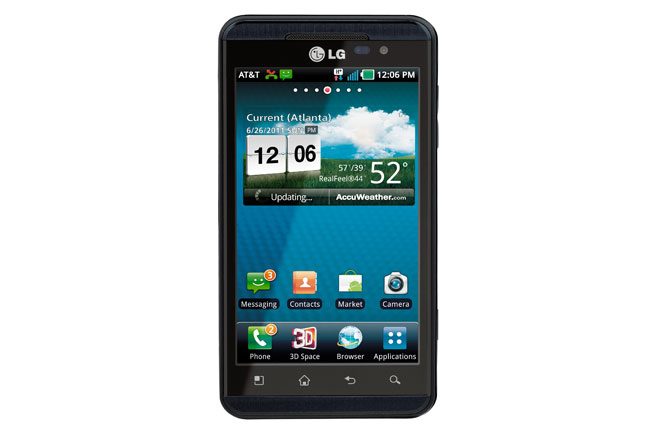
“The LG Thrill 4G does not thrill on many accounts outside of its pretty 3D display.”
- 3D display is novel
- Has some fun games installed
- Solid construction
- Dual-core processor
- 4.3-inch display
- 16GB storage (8GB internal, 8GB SD)
- Poor battery life on idle
- Runs Android 2.2
- Camera is slow, poor in low light
- 3D button doesn't work as camera button
- 3D camera adds bulk to phone
“Why you can trust Digital Trends – We have a 20-year history of testing, reviewing, and rating products, services and apps to help you make a sound buying decision. Find out more about how we test and score products.“
The LG Thrill 4G has been on AT&T shelves since early summer, when it arrived with one thing that almost no other phone has: glasses-free 3D. Yes, like the Nintendo 3DS, this phone can display 3D images without any need for those pesky glasses. Although the screen turns out to be a bit of a gimmick, a dual-core processor and other solid specs allow the phone to mostly hold up to the competition, especially with its low price $100 price tag on AT&T.
 Design and feel
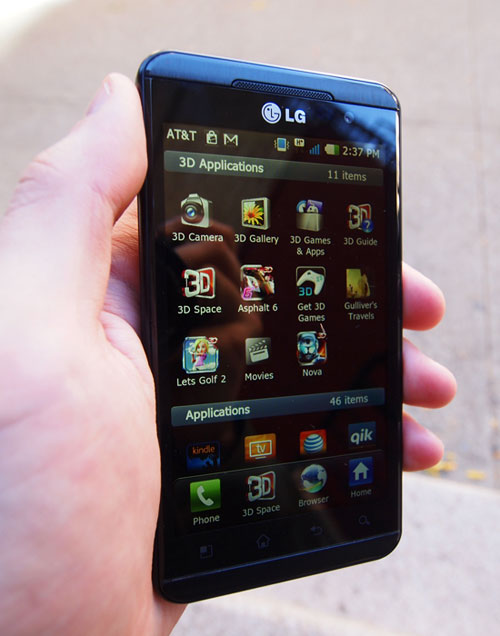
Like the G2x and LG Revolution, the LG Thrill feels like a premium handset when you hold it. All the guts are packed in tight enough to give it that little bit of heft you want in a top-rate handset, and it even manages to fool you into thinking it has metal accents. It doesn’t, but it’s quite sturdy nonetheless. The phone has a black finish and a nice rubberized backplate that removes to show the battery, microSD card, and SIM card.
That’s not to say there aren’t downsides. Because of the big focus on a 3D camera — the Thrill has two 5-megapixel cameras on its rear, laid out along the length of the phone — this is not exactly a thin phone. If you want to get precise, it’s about half an inch thick, or 11.9mm. There was a time when 11.9mm would have made you a super thin smartphone, but not anymore. Recently Motorola unveiled a new Razr that measures just 7.1mm thick. The iPhone 4S is 9.1mm thick.
The phone’s screen measures 4.3 inches, which has become the standard size for Android phones, though some now have screens exceeding 5 inches. We think 4.3 is plenty, and may actually be too big for some, so make sure to try it out before you buy. In our experience with the Thrill, it was quite comfortable to hold and we didn’t have trouble reaching the volume rocker or power button.
As far as ports go, the Thrill has a micro USB port and a micro HDMI port, as well as your standard audio jack. As a bonus, LG includes an HDMI-to-micro-HDMI converter in the box, so the Thrill can connect to a standard HDTV without buying any additional adapters.
3D
Two glasses-free 3D phones hit the market this summer: the Thrill 4G (AT&T) and the HTC EVO 3D (Sprint). Since they’re on different carriers, there shouldn’t be much of a conflict here, but both phones are fairly evenly matched. HTC’s device has the edge when it comes to user interface (as HTC phones usually do), but the Thrill comes with better 3D software. The Thrill has a 3D button where the camera button should be. Pressing this brings up a 3D menu that lets you select from different apps and games, all 3D ready. After using the phone for an extended period of time, we’ve come to the conclusion that no one is going to use 3D very much. It’s a gimmick, but it can be a fun one. Who doesn’t want to whip out their phone and show their friends a 3D game of Nova or Asphalt 6?
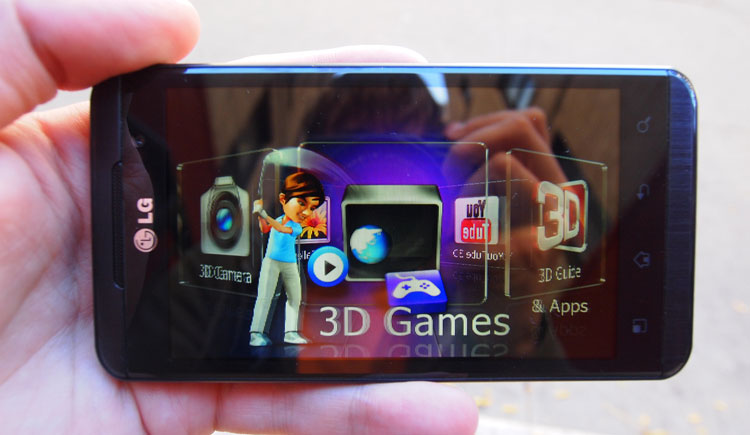
3D is a great way to impress somebody real quick, but that’s all it is. It’s a bit of wow. After a few minutes, the 3D effect will start to hurt your eyes, and it only works if you’re looking directly at the phone. If you or the phone move, the 3D effect breaks. It also cuts your resolution in half. Games and apps that use 3D are dimmer and look like those ribbed plastic 3D images we used to see on book covers and annoying posters. You know, the ones that change as you look at them from different angles, but never really look very good from any angle?
To read more about how the EVO 3D and Thrill 4G compare, check out our comparison article from CTIA.
Power and specs
The 3D is a gimmick, but luckily it doesn’t come at the cost of processing power. The Thrill runs on a 1GHz dual-core TI OMAP 4 processor, has 8GB of built-in storage, and comes with an 8GB microSD card. The only thing disappointing about its specs is the RAM. With only 512MB of RAM, it has half that of most new dual-core devices, and does tend to hiccup here and there, slowing down when things get rough or when opening certain apps. It’s nothing too bad, but it’s noticeable. As for the screen, when it’s not displaying 3D images, its resolution is 480 x 800.
Operating system
Sadly, though LG has promised an update to 2.3, our review unit is still running Android 2.2.2 (Froyo). Many of the issues we have (hiccups, battery life) can be attributed to this elderly OS still running on it. Android 2.2 isn’t able to manage its applications as well as later versions and lacks a lot of the gloss we’ve begun to get used to in Android 2.3 (Gingerbread). LG does modify the Android interface. It’s modifications mostly revolve around separating apps into folders in the app screen and displaying 3D. Most of the visual modifications look eerily similar to earlier versions of Samsung’s colorful, toy-like TouchWiz interface. The UI isn’t bad, but it’s nothing impressive. LG, please update this phone! Android Gingerbread came out a year ago. If the Gingerbread update doesn’t come soon, LG might as well wait and just update it to Android 4.0 (Ice Cream Sandwich) as that will be out in a few weeks.
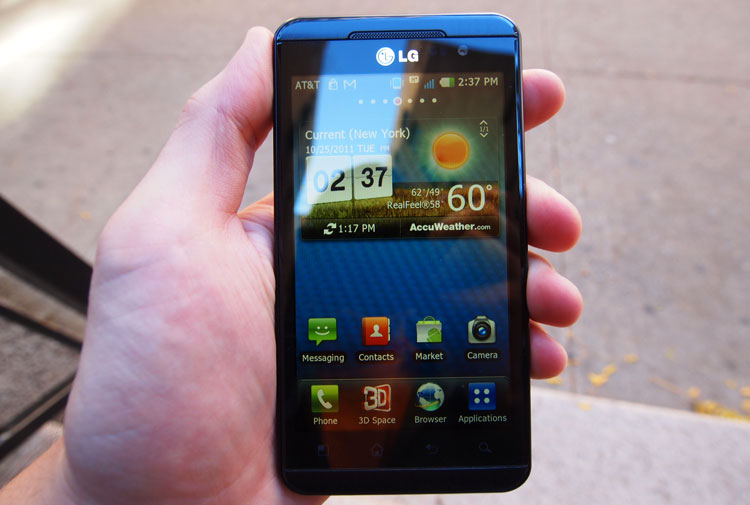
The Thrill doesn’t come preloaded with much in the way of interesting apps. There are maybe a half-dozen AT&T apps on the phone and 10 apps and games built specifically for 3D. The default browser appears to be Google’s Android 2.2 browser, which gets the job done well enough, but other browsers like the Dolphin browser can be found on the Android Market.
Camera
The Thrill has two 5-megapixel rear cameras with an LED flash and one front-facing VGA (0.3-megapixel) camera. You can take 3D pictures and video with the device, but neither looks that great, and there are no decent standards for 3D video yet anyway, so it’s hard to say if your pictures will be accessible or usable in the future. As a 2D recording device, it works pretty well. Thanks to an update, it can record 1080p video like every other dual-core phone and LG’s camera holds up fairly well. We wish that the 3D button doubled as a shutter button, but it doesn’t.
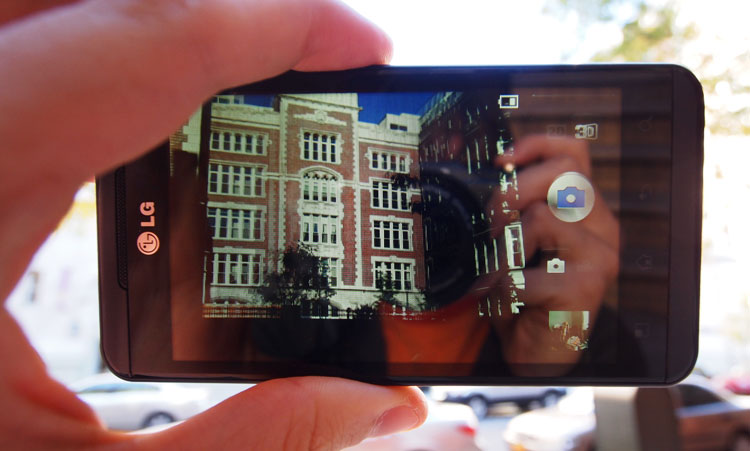
There are issues. The camera snapshot speed is slow. Not as slow as a Motorola camera, but slow. And though the autofocus works, you can’t focus on other areas of the picture besides the middle. This is a common feature on Motorola, Samsung, and HTC Android devices. Focusing on the fly is also not possible here. Still, the pictures usually come out with a decent amount of color, though we had some grainy issues in low-light conditions. Don’t buy this one for the camera. In a pinch though, it should get the job done.
Call quality and data speed
We made several calls on the LG Thrill and took a call or two as well. Voices on the other end of the phone were as crisp as they come on a cell phone and no one had any complaints about my voice (well, there were plenty of complaints, but none related to the call quality). We didn’t have any issues with reception either. As a phone, the Thrill is solid.
Data speed on AT&T’s HSPA+ 3G network (the carrier calls its network “4G” but it’s not comparable to WiMax or LTE) was typical. In Manhattan, New York, we got an average of 1.5Mbps to 2.5Mbps download speeds and about 1Mbps to 1.5Mbps upload speeds. This is faster than ordinary 3G, but far slower than Verizon’s 4G LTE network, which exceeds 10Mbps in every test.
Battery life
We really hope that LG updates this phone to Gingerbread, because Android 2.2 doesn’t manage battery life well. On factory settings, we’ve found that the phone drains its battery within three to four days while sitting idle. There’s no good excuse for this, as it should last about two weeks if not being used. Experienced users will be able to tinker with settings and turn off bad apps (maybe), but those who don’t want to mess with all that junk will feel compelled to charge their phone every day even if they don’t use it much. Gingerbread would help fix this, we think.

Conclusion
The LG Thrill 4G does not thrill on many accounts outside of its pretty 3D display. Having said that, no other phone beside the HTC EVO 3D can even claim to have glasses-free 3D, so it’s a plus. This is a good dual-core phone that holds up in most areas beside battery life. We’re hoping LG issues an Android 2.3 update soon. If it did, the battery life may improve quite a bit. Overall, for the $100 price, this is a far better phone than some that AT&T offers. If you want a dual-core device (you do), but don’t want to pay the $200 price tag of other phones, try the Thrill. It will do the job.
Highs:
- 3D display is novel
- Has some fun games installed
- Solid construction
- Dual-core processor
- 4.3-inch display
- 16GB storage (8GB internal, 8GB SD)
Lows:
- Poor battery life on idle
- Runs Android 2.2
- Camera is slow, poor in low light
- 3D button doesn’t work as camera button
- 3D camera adds bulk to phone


