


“Motorola’s Droid 2 takes only baby steps forward from the original, struggling to keep up with new titans like the Droid X.”
- Bright, colorful, glossy 3.7 LCD screen
- Slide-out horizontal QWERTY
- Google Android OS v2.2
- 5-megapixel camera with dual-LED flash
- 3G mobile hot spot
- 8GB built-in memory; 8GB card pre-installed
- Long battery life
- Sluggish physical keyboard
- VGA video recording
- Fewer features than Droid X, same price
“Why you can trust Digital Trends – We have a 20-year history of testing, reviewing, and rating products, services and apps to help you make a sound buying decision. Find out more about how we test and score products.“
 Introduction
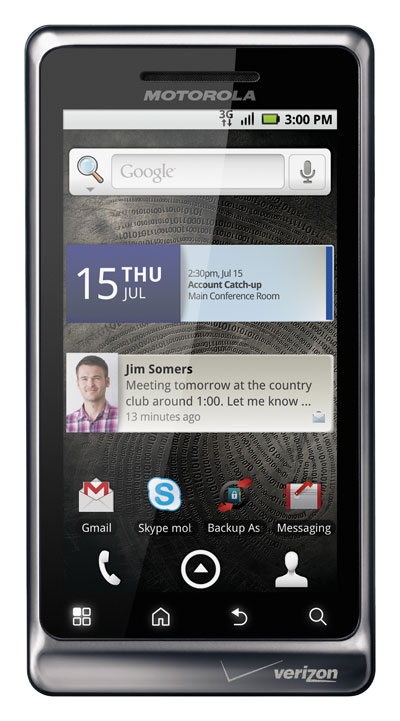
When the second generation of a product is unveiled, you expect major upgrades from the first model. Motorola takes a different approach with the Droid 2, the follow-up to last year’s ground-breaking Droid, both from Verizon. Rather than a fanboy’s dream update, Droid 2 is barely a minor shift. If we were cynical, we’d say Droid 2 is Motorola’s greedy attempt to stabilize the price of the phone (the original is currently on sale at Best Buy for $49.99), now back up to $199.99. Considering the allure of the identically-priced but more feature-rich Droid X (despite reported problems with its implementation of Android 2.2), it’s even more surprising the Droid 2 isn’t more of a radical shift from the first Droid. Not that it’s a bad phone – but Motorola has missed an opportunity to take the slide-out keyboard Droid to the next level.
Features and Design
Physically, the Droid 2 is nearly identical to the original; a chrome frame around the top of the phone is the easiest way to differentiate the two.
Operationally, Motorola has re-arranged the four Android navigation buttons below the screen (Back, Menu, Home, Search become Menu, Home, Back, Search – oh, goody); the slide-out keyboard (which isn’t as spring-loaded smooth as, say the one on the Samsung Epic 4G from Sprint) now has individual directional buttons, rather than a square toggle that depresses at each edge; and, there are some meaningless differences in the way Android 2.2 is implemented (the original Droid can now be updated) – different icons, primarily. Big deal.
Performance-wise, Droid 2 does step up to a 1GHz processor from the 550MHz chip in the original, so the Droid 2 is slightly faster. Also now standard is DLNA connectivity, a widescreen still-photo setting, and an included Blockbuster app. You even get the same amount of memory – 16GB, albeit arranged a bit differently: the Droid 2 has 8GB built in and a pre-installed 8GB microSD card, while the original had 256 MB built-in but an included 16GB card. Otherwise you still get the same black horizontal slider with a three-row QWERTY keyboard (no dedicated numeric row), a widescreen 3.7-inch 854 x 480 LCD, 5-megapixel camera with dual LED flash and 4x digital zoom, Wi-Fi, Bluetooth 2.1.
A bit more dismaying is how much more you get with the Droid X at the same price as the Droid 2: a 4.3-inch screen, an 8-megapixel camera, 24GB included total memory (8GB built-in and a pre-installed 16GB card), and HD video recording. The second Droid’s only advantages are its slide-out QWERTY keyboard and longer talk time.
Besides the faster processor, the Droid 2 includes three other major upgrades from the Droid: 3G mobile hot spot capabilities for connecting up to five devices, more built-in memory, and a third more rated talk time (6.4 hours vs. 9.6 hours) despite same-size batteries.
Multimedia

The Droid 2 has the same crisp, colorful display as the original, and includes a Blockbuster app, but not any of Verizon’s video offerings or MobiTV. Its widescreen is perfectly proportioned for viewing side-loaded movies, but if you’re interested in the Droid as a PMP, you should be looking at the Droid X with its 4.3-inch screen.
Either Motorola or the new Android 2.2 OS has solved the original Droid’s issue of not remembering what music track you left off from when switching to and from another multimedia app.
Sound Quality
Conversations are loud and clear from Droid 2, but listeners on the other end reported a bit of muddiness coming through.
Sound may be muffled for speakerphone and multimedia listening since the long, thin speaker is mounted on the rear of the phone.
Phone Functionality
If you prefer a physical QWERTY keyboard, you’ll be drawn to the Droid 2 – falsely. The Droid 2’s humped keys on its slide-out QWERTY keyboard are an improvement over its predecessor’s flat, flush keys. But they still have little spring or feedback, which means you’ll need a hard press to ensure action. As a result, thumb typing is a bit of a slog, albeit one that’s more assuredly accurate.

Conversely, your thumbs will fly over the widescreen touch-screen QWERTY, but with no haptic feedback you’ll spend more time editing.
Bottom line: Do you want speed or accuracy?
Web
Verizon may not technically have the nation’s fastest network, but you’d be hard pressed to tell with the Droid 2. Mobile-optimized pages such as CNN, The New York Times and ESPN pop in three seconds or less, about as near instantaneously as any 3G phone we’ve used. As per usual, non-optimized pages take their sweet time to fully load, depending on their graphic content.
Camera

Motorola has improved an already impressive Droid camera by adding a widescreen 5-megapixel mode, which lets you cram a lot more image into the frame. Outdoor photos are crisp and colorful, but not true – colors tend to skew toward the blue end of the spectrum.
Shots taken indoors, with or without the flash, stay surprisingly in focus compared to other high megapixel cell cams, but also tend to be grainier.
The Droid 2’s most surprising shortcoming is its WVGA, rather than HD, video recording. Videos come out pixel-free, but details are fuzzy, especially when blown up full screen on a standard-sized PC monitor.
<span class=”mceItemObject” classid=”clsid:D27CDB6E-AE6D-11cf-96B8-444553540000″ id=”ooyalaPlayer_8z11n_gdaqxai9″ width=”650″ height=”433″ codebase=”http://fpdownload.macromedia.com/get/flashplayer/current/swflash.cab”><span name=”movie” value=”http://player.ooyala.com/player.swf?embedCode=M2MDlvMTp05Wj_GrObciKaU2UQ6f77HT&#038;version=2″ class=”mceItemParam”></span><span name=”bgcolor” value=”#000000″ class=”mceItemParam”></span><span name=”allowScriptAccess” value=”always” class=”mceItemParam”></span><span name=”allowFullScreen” value=”true” class=”mceItemParam”></span><span name=”flashvars” value=”embedType=noscriptObjectTag&#038;embedCode=M2MDlvMTp05Wj_GrObciKaU2UQ6f77HT” class=”mceItemParam”></span><span class=”mceItemEmbed” src=”http://player.ooyala.com/player.swf?embedCode=M2MDlvMTp05Wj_GrObciKaU2UQ6f77HT&#038;version=2″ bgcolor=”#000000″ width=”650″ height=”433″ name=”ooyalaPlayer_8z11n_gdaqxai9″ align=”middle” play=”true” loop=”false” allowscriptaccess=”always” allowfullscreen=”true” type=”application/x-shockwave-flash” flashvars=”&#038;embedCode=M2MDlvMTp05Wj_GrObciKaU2UQ6f77HT” pluginspage=”http://www.adobe.com/go/getflashplayer”></span></span>
Battery Life
Even though the Droid 2 has the same sized battery as the first Droid, Motorola must have done some power-saving tap dancing to get nearly 10 hours of talk time. In real-world usage, with Bluetooth and Wi-Fi running on and off, the Droid 2 lasted nearly two days of semi-regular phone calling, Web surfing, picture-taking and sharing before we were obliged to recharge.
We were unable to test the 3G hot spotting, but experience tells us connection sharing is a real battery drainer.
Conclusion
Come the day after Labor Day, when the Droid X becomes re-available, Droid droolers will have to decide between two $200 Droids: the Droid X with its 4.3-inch screen, 24GB memory and HD video recording, and the Droid 2, with its physical keyboard and long battery life. Unless you absolutely refuse to use a touch-screen keyboard, the Droid X is by far the more advanced Droid.
Highs:
- Bright, colorful, glossy 3.7 LCD screen
- Slide-out horizontal QWERTY
- Google Android OS v2.2
- 5-megapixel camera with dual-LED flash
- 3G mobile hot spot
- 8GB built-in memory; 8GB card pre-installed
- Long battery life
Lows:
- Sluggish physical keyboard
- VGA video recording
- Fewer features than Droid X, same price


