T-Mobile’s 5G network already offers unmatched 5G speeds and coverage throughout the U.S., with 98% of the population covered by some flavor of T-Mobile’s 5G and more than 90% benefiting from its higher-speed 5G Ultra Capacity (5G UC) network.
That translates to the “Uncarrier” taking first place in 5G performance in 46 U.S. states. However, T-Mobile isn’t content to sit at 90% coverage. It’s been working steadily to increase the footprint of its 5G UC network to reach even further, and is bringing those top speeds to areas previously served only by its lower-frequency 5G Extended Range network.
A ‘Massive 5G Boost’
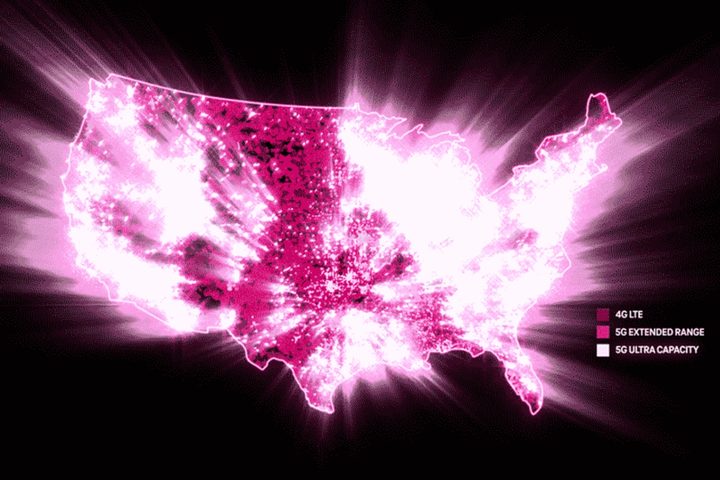
Today, T-Mobile announced that it’s lighting up some new 5G spectrum acquired in a recent Federal Communications Commission (FCC) auction to bring its 5G UC network to new communities while increasing the available bandwidth in some of its more congested urban areas.
The most significant boost will be in rural areas, where T-Mobile says “tens of millions of [its] 5G customers will get an immediate performance boost” as the new spectrum comes online “over the next few days.”
Despite having the broadest midband coverage of any U.S. carrier, T-Mobile’s 5G UC network has mostly been confined to denser population centers, where the extra capacity is needed to provide faster 5G speeds and keep up with the higher number of customers. Many rural areas have been left out of that expansion and limited to the slower performance of T-Mobile’s 5G Extended Range network, which often isn’t much faster than 4G/LTE service.
“Thanks to years of planning, T-Mobile is ready to put this spectrum to use right now for millions of our customers, delivering gam- changing Ultra Capacity 5G to more people and increasing speed and performance for others,” Mike Sievert, T-Mobile’s CEO, said in the company’s press release. “This type of execution is exactly why T-Mobile is the new network leader in the U.S., and we continue to give customers the greatest value at the same time.”
New midrange 5G spectrum for all
The secret sauce behind T-Mobile’s expansive 5G UC network is its early acquisition of 2.5GHz midrange spectrum that could be used for new 5G deployments, thanks to its 2020 merger with Sprint. This gave the “Un-carrier” a significant head start over its rivals, which had to wait until the FCC auctioned off some new C-band spectrum just below the 4GHz range before they could roll out their own midband 5G networks.
Even before it took advantage of that lucrative set of 2.5GHz frequencies, T-Mobile had already become the first carrier to boast 5G coverage in all 50 states. However, that was a low-band 5G network that ran on 600MHz spectrum — enough to light up the 5G indicator on your smartphone, but not enough to deliver the faster download speeds that 5G technology promised.
Fortunately, T-Mobile wasted no time in putting that 2.5GHz spectrum to good use. By the end of 2021, its new midband 5G UC network covered over 200 million people, before extending to 300 million by the end of last year.
Although the carrier has augmented its 5G UC network with some of the higher-frequency C-band spectrum used by Verizon and AT&T, that’s merely to add extra capacity in the densest areas. The backbone of the 5G UC network still runs on 2.5GHz, and it’s more of this spectrum that the company recently won in an auction and is now turning on.
It’s also been licensed to deploy the new spectrum just about everywhere in the U.S. While T-Mobile customers in previously unserved rural areas will see the most significant difference as they get the 5G UC indicator lighting up on their phones for the first time, the carrier expects all of its customers to see at least some performance boost, as the additional spectrum is used to increase the capacity and performance of existing 5G UC networks.

In its press release, T-Mobile cites Louisiana as just one example, noting that the spectrum from the latest auction will “benefit customers in 92% of the counties in the Pelican State.” To put that in perspective, Louisiana came in 34th place in January’s Ookla 5G market report, with median download speeds of 84.77Mbps overall and 163.33Mbps for T-Mobile customers in that state. While T-Mobile took the crown for top 5G performance in New Orleans at 185.55Mbps, that city was still in 68th place overall. Baton Rouge, down at 88th, only had a median 5G download speed of 110.8Mbps, with no clear winner among the three carriers.
For Louisiana, T-Mobile promises the new spectrum will offer “immediate improvements in connectivity for more than 1.7 million people, nearly 500,000 of whom are in rural areas.” Improvements in Pennsylvania will reach 2.2 million people overall, with nearly 1 million of those in rural communities.
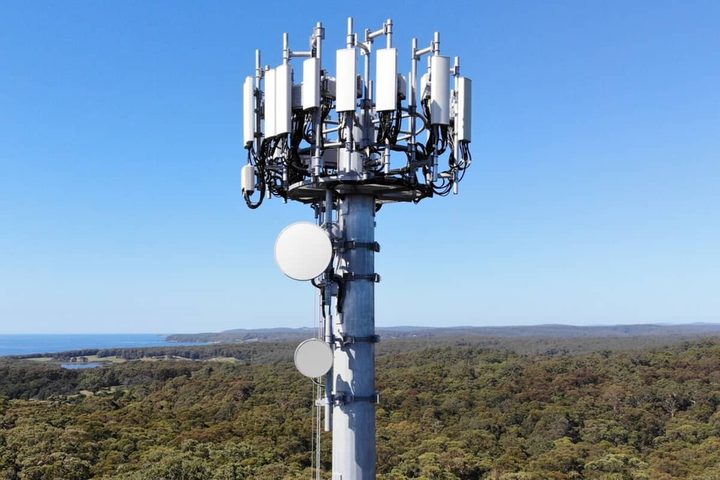
The new spectrum is expected to cover 80 million people by the time the rollout is done. The first phase will go online using existing towers over the next few days, covering around 60 million customers over nearly 300,000 square miles. The rest will require the carrier to build new towers to expand coverage. While the carrier hasn’t said exactly when that will happen, with T-Mobile’s track record, we expect those towers will likely be up and running by the end of this year, if not sooner. While some of those 80 million people are already covered by T-Mobile’s 5G UC network and will merely be benefiting from extra capacity, T-Mobile is only about 30 million people shy of blanketing the entire U.S. with its fastest 5G service, so it’s possible it could reach nearly the entire U.S. population by the time the dust settles on this new spectrum rollout.