Amazon founder Jeff Bezos is convinced that one day “we are going to have to leave this planet.” And he believes that his Blue Origin space company can help make it happen.
Outlining his ambitious vision at the Space Development Conference in Los Angeles during a recent on-stage chat with GeekWire‘s Alan Boyle, Bezos said that, ideally, Blue Origin would collaborate with NASA or ESA, Europe’s space agency, to move toward his goal, though he said that if that doesn’t work out, his company would go it alone.
It’s not the first time Bezos has described his plan for colonizing other space rocks, but his most recent comments suggest the long-term plan is still very much at the forefront of his mind.
Bezos believes earthlings will one day have to shift some of their industry to the moon to help our planet better cope with pressures brought on by a rising population. He told Boyle that leaving Earth will “make this planet better,” adding, “We’ll come and go, and the people who want to stay will stay.”
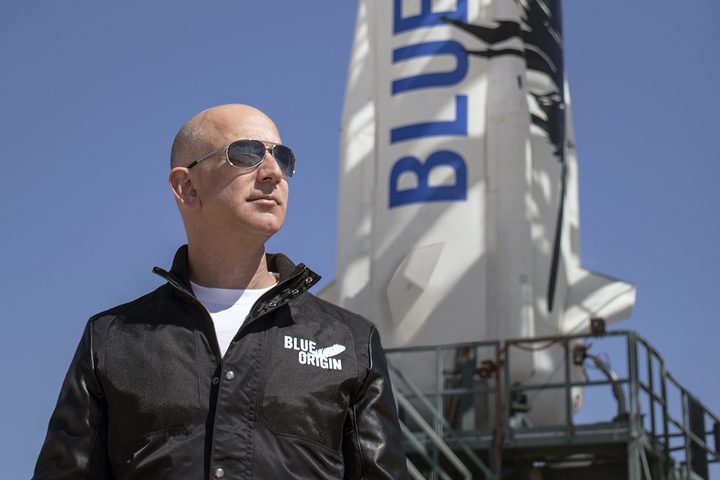
The billionaire entrepreneur predicted that the moon could one day be a home for heavy industry driven by solar power, while Earth would be for residential and light industrial use.
“The Earth is not a very good place to do heavy industry,” Bezos said. “It’s convenient for us right now, but in the not-too-distant future — I’m talking decades, maybe 100 years — it’ll start to be easier to do a lot of the things that we currently do on Earth in space, because we’ll have so much energy.”
While Blue Origin is enjoying success with the development of its New Shepard reusable rocket system, it’s designed for suborbital missions for a proposed commercial space tourism business.
But Bezos’ company is also working on the far more powerful New Glenn rocket, powered by seven BE-4 boosters.
He wants to use that rocket system to transport the necessary components to the moon to build the lunar base. Think of it as a long-distance Amazon delivery service. Such a project could begin in the 2020s, with humans arriving at an unspecified time after that.
The Blue Origin boss is already intent on building more powerful rockets and landers, and is now eyeing the necessary work to create the parts required for a functioning moon base that can support human life.
Time to return to the moon
In March 2017, Bezos wrote: “It is time for America to return to the moon — this time to stay. A permanently inhabited lunar settlement is a difficult and worthy objective. I sense a lot of people are excited about this.”
By the end of the year, the U.S. government authorized NASA to once again focus on achieving a moon landing, 45 years after the last one.
For sure, a moon landing is a long way from a moon settlement. But many space fans will sense the two ambitions edging closer together, where relatively brief visits will eventually develop into longer stays that Bezos believes can one day become permanent as well as productive.