
“A handful of updates make Creative’s fresh 720p shooter a better value, but image quality still largely lags behind leaders like Kodak and Flip.”
- Superior low-light performance
- Wide-angle lens
- Slender and lightweight
- Manual exposure control
- Inexpensive
- Unnaturally tinted colors
- Touch controls less precise than hard buttons
- Poor automatic exposure adjustment
- Half the memory as competitors, predecessor
- No external storage slot
- No macro mode
- Durability issues with USB arm
“Why you can trust Digital Trends – We have a 20-year history of testing, reviewing, and rating products, services and apps to help you make a sound buying decision. Find out more about how we test and score products.“
Introduction
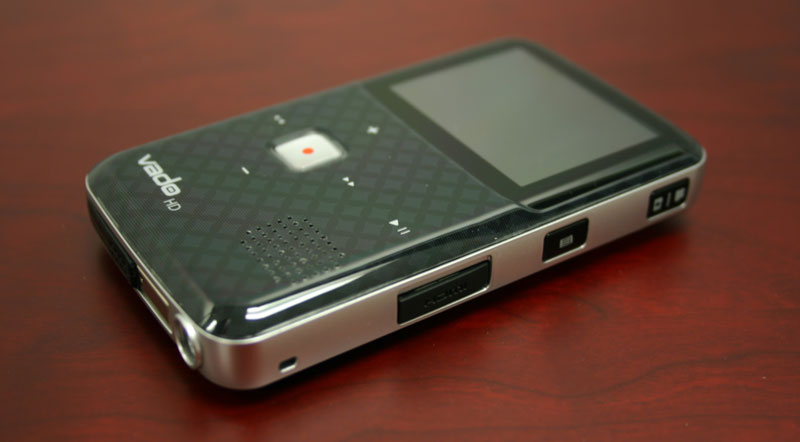
Creative’s first-generation Vado HD may have fallen off the horse the first time we threw it in the ring in our mini HD camcorder roundup, but Creative has dusted the little guy off and come back for more. The new third-generation Vado HD departs from the first and second generations with a sleek new design, additional features like external microphone support and improved low-light recording, while oddly dropping in storage from 8GB to 4GB. Do these tweaks and a lower $180 justify snagging one over the likes of its many competitors? Let’s find out.
 Features and Design
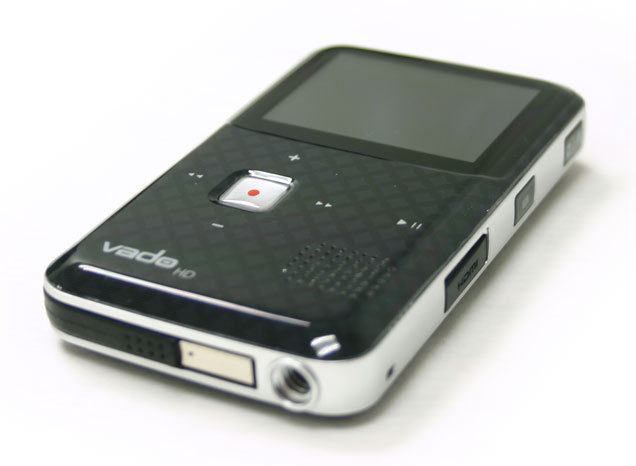
At 3.9 inches tall, 2.2 wide and 0.6 thick, the deck-of-cards-sized Vado HD hasn’t changed dimensions a bit for its third generation, but it has dropped a sliver of weight from 100 grams down to just 93. As far as mini HD camcorders go, this one really is a featherweight.
The design has been rounded off even more than previous versions, and dressed in a glossy checker pattern that feels a bit feminine – especially combined with violet, turquoise, bright red and black as color choices. Although the all-plastic Vado HD doesn’t exude the quality of say, the alumimum-clad Flip MinoHD, it does feel generally well put together. The one exception seemed to be the rubber around the USB port, which gets picked at when you peel it out of the recess it hides in, and started to peel away from the metal on our review unit.
Specs for the Vado HD will look very familiar to anyone who has eyed the previous models: it uses a 2-inch LCD, offers 2x digital zoom, and, as we mentioned, sports identical dimensions. Unfortunately, unlike previous iterations, third-gen is only available with 4GB of internal memory, not 8GB. The lack of any storage slots will also prevent users from adding additional space if they need it.
While Kodak, Sony and even Samsung have stepped up to 1080p resolution on their latest HD camcorders, Creative and Flip have both remained content with the 720p resolution they’ve both been touting for over a year now. While technically superior, we will concede that 1080p content also gobbles a lot more memory without a major visible difference unless you plan to show it on a 1080p set. Still, we wish Creative had included the superb 60fps option Kodak includes for shooting 720p on both its Zi6 and Zi8. The Vado HD is only good for the standard 30fps.
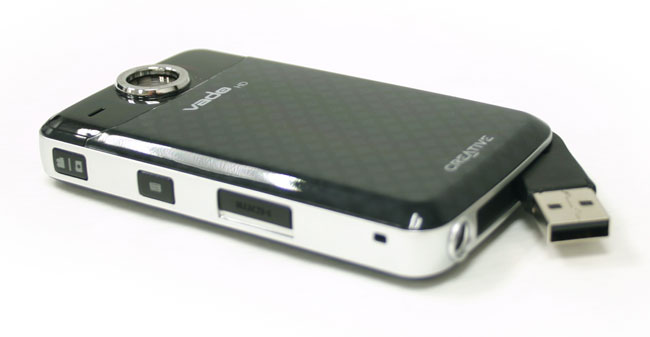 Like Kodak’s Zi8, the Vado HD now includes an external microphone port for recording better audio, and it doubles as a headphone jack for listening to playback on a pair of headphones. You’ll also find more common accouterments like an HDMI output jack, dedicated switch to flip between shooting stills and shooting video, and the all-important flip-out USB jack. This one is hinged on rubber for more flexibility, and handles charging as well.
Accessories
With its charger and data cable built right in, the Vado HD doesn’t really need any accessories, but Creative throws in an HDMI cable for outputting video to HDTVs, and a short USB extension, which can be useful when dealing with the crowded ports on the back of a desktop. We missed the silicon skin bundled with the original Vado HD, but the accessories still stand above the likes of Flip’s MinoHD, which includes frills like an accessory pouch and lanyard, but no HDMI cable to pair with its HDMI port. We’ll opt for the HDMI and make due with a sock and string, thanks.
Testing and Usage
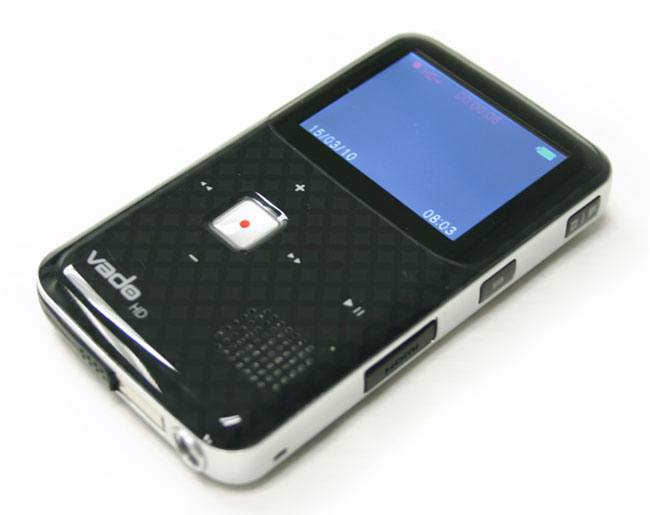
As a go-anywhere tech accessory, the Vado HD scores right up there with the MinoHD for portability. Frankly, you can throw it in a pocket and forget it’s there.
Like seemingly every mini camcorder, the Vado HD uses a simple control scheme with a record button in the center, fast forward and rewind buttons to the right and left, and zoom controls above and below. A separate review button bounces you from live recording mode to playback mode. Although the record button itself clicks, the rest are just touch-sensitive spots on the plastic, with no feedback to speak of. They respond quickly to the lightest touch, but we still prefer a tactile control scheme, which makes it harder to accidentally trigger them with the brush of a finger.
While much of the appeal of mini HD camcorders can be derived from their point-and-shoot automation, Creative offers power users a chance to step up their game with a rare feature on this class of camera: manual exposure. By clicking left and right while shooting, you can raise and lower the exposure settings, or return it to the middle position to set it back to auto. While undeniably handy, we wish Creative had improved the sluggish automatic exposure adjustment, rather than giving us manual controls. Pan from a dim inside shot to a sunlit window, for instance, and the Kodak Zi8 lowers the exposure to compensate in a split second, while the Vado HD will dawdle on a blown out white screen while it scrambles to figure out what to do. You could master the manual controls to tame this type of effect, but when other cams do it so effectively on their own, we’re not floored by the manual option.
Like its predecessor, the Vado HD uses an extremely wide-angle lens, which makes it far easier to squeeze everything into the frame indoors than with many competing cams. Because the slight zoom effect of other cams tends to magnify jitters, we also think the wide angle tends to help smooth jerky camerawork.
Creative wasn’t kidding when it claimed low-light performance had been improved on the Vado HD. Not only does it produce exceptionally smooth footage with less noise than other mini cams, it avoids the yellowy cast that many competitors take on when the lights drop low.
Unfortunately, many of our complaints about the original Vado HD video quality still persist. Footage doesn’t quite look as sharp as the output from other cams. Indoor scenes tend to take on a bluish cast, and outdoor scenes tend to look almost purple. And without macro mode, getting in close becomes an impossibility.
Conclusion
The third-generation Vado HD isn’t as sleek as Flip’s second-generation MinoHD, and doesn’t shoot as well as Kodak’s Zi8, but a few shining high points keep it in the game. Superior low-light performance and a wide-angle lens give the Vado HD a huge boost when shooting indoors, and at $180 with 4GB of built-in memory, it’s a good value, too. While we do find the lack of an 8GB option or external storage annoying, most casual users should find 4GB plenty to play with. Still, annoyances like the peeling rubber around the USB arm, missing macro mode, and more major issues like unnatural color tinting all prevent the Vado HD from running with the top tier of mini HD cams.
Highs:
- Superior low-light performance
- Wide-angle lens
- Slender and lightweight
- Manual exposure control
- Inexpensive
Lows:
- Unnaturally tinted colors
- Touch controls less precise than hard buttons
- Poor automatic exposure adjustment
- Half the memory as competitors, predecessor
- No external storage slot
- No macro mode
- Durability issues with USB arm


