1. Home
  2. Wearables
  3. Mobile
  4. Legacy Archives

Swatch’s first smartwatch will arrive just in time to go head-to-head with the Apple Watch

Add as a preferred source on Google

Swiss watchmaker Swatch is known for its traditional and relatively affordable watches, and now CEO Nick Hayek has confirmed the company will venture into the smartwatch world in the next three months, as reported by Bloomberg.

According to the report, Swatch’s smartwatch will communicate through NFC, which will also be used for mobile payments with the smartwatch, although how this will work (and on which system it will operate) isn’t known yet. Hayek does say the company is talking to retailers about possible partnerships. The device will work with both Windows and Android operating systems, but evidently not Apple’s iOS.

Recommended Videos

Most interesting, however, is that the smartwatch will not need to be charged. Hayek did not reveal how that would be possible, though there are two ways that can happen, the first being an “automatic” watch that utilizes a generator. This tiny generator is spun by the motion of an eccentric-weighted rotor. This rotor would be moved by your arm’s movement. The second way is by using a watch cell battery, which can sometimes last for between six months and a year before needing replacement.

Swatch is well-equipped to launch a smartwatch. Watches made by its sister brand Tissot have had touchscreens for years, and it already incorporates essential sensors including a compass and an altimeter into other timepieces. However, Swatch isn’t the only big name watchmaker eyeing the smartwatch market. TAG Heuer’s first smartwatch is expected before the end of the year, and Montblanc has its own take on the smartwatch phenomenon called the e-Strap.

Hayek did not reveal any details about pricing, though its availability will put it squarely against the Apple Watch, which will launch sometime in April. One area where the Apple Watch will likely falter against Swatch’s smartwatch is battery life, which might not be anywhere near impressive.

Williams Pelegrin
Williams is an avid New York Yankees fan, speaks Spanish, resides in Colorado, and has an affinity for Frosted Flakes. Send…
This smart ring makes a blood pressure promise Apple and Oura still won’t
The $399 Signal Ring provides actual systolic and diastolic readings, but it’s launching as a wellness device without FDA clearance
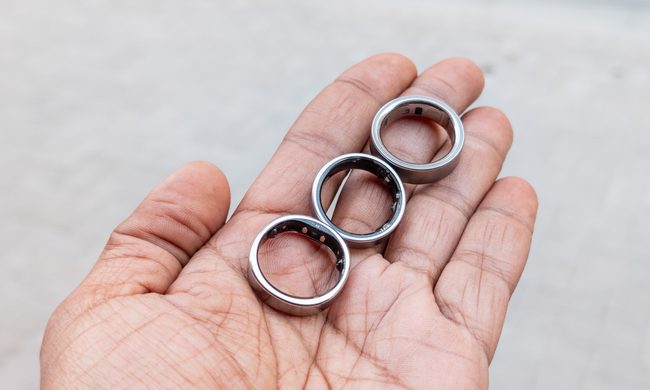
Oura Ring 4, Galaxy Ring and RingConn Gen 2 in the palm of a hand

Vital Signals has unveiled a $399 smart ring that goes further than Apple and Oura currently dare. The Signal Ring displays numerical blood pressure readings without requiring an arm cuff for initial or recurring calibration.

Bloomberg reports that preorders open July 16, with shipping scheduled to begin in October. The ring can collect readings during the day and overnight, then display the results through an iOS or Android app.

Read more
HTC’s smart glasses are apparently coming to the US, but HTC hasn’t said so
Amazon briefly listed the VIVE Eagle for a September 1 launch, while HTC still says the $499 glasses are only available in Taiwan
A woman wearing the HTC Vive Eagle smart glasses

HTC’s VIVE Eagle smart glasses could finally be heading to the US. Apparently, Amazon got the memo before HTC was ready to share it.

Notebookcheck spotted six versions available for preorder at $499, each carrying a September 1 release date. Amazon has since pulled the pages, so new orders are closed and anyone who already placed one is left wondering whether it still counts.

Read more
Don’t expect smartwatches and fitness bands with replaceable batteries anytime soon
Turns out even the EU thinks your smartwatch is too small for a battery swap.
Wristwatch, Arm, Body Part

The EU has a habit of pushing tech companies to adopt meaningful changes in their product. It's the reason your iPhone finally has a USB-C port, and it's also why companies now have to offer spare parts and repair support for electronics for several years after launch. So naturally, many of us assumed wearables were next in line for mandatory swappable batteries. Turns out, the EU just went the other way.

So what did the EU announce?

Read more