“While its sound quality may not best our favorite Bluetooth speakers, the Deck offers a user experience and feature-set unmatched by its competition, and that’s worth a lot.”
- Clear, present sound
- Excellent form and function
- Packed with fun features
- Class-leading Bluetooth range
- Underwhelming bass response
- Occasional clipping at full volume on heavier tracks
- Pricey
“Why you can trust Digital Trends – We have a 20-year history of testing, reviewing, and rating products, services and apps to help you make a sound buying decision. Find out more about how we test and score products.“
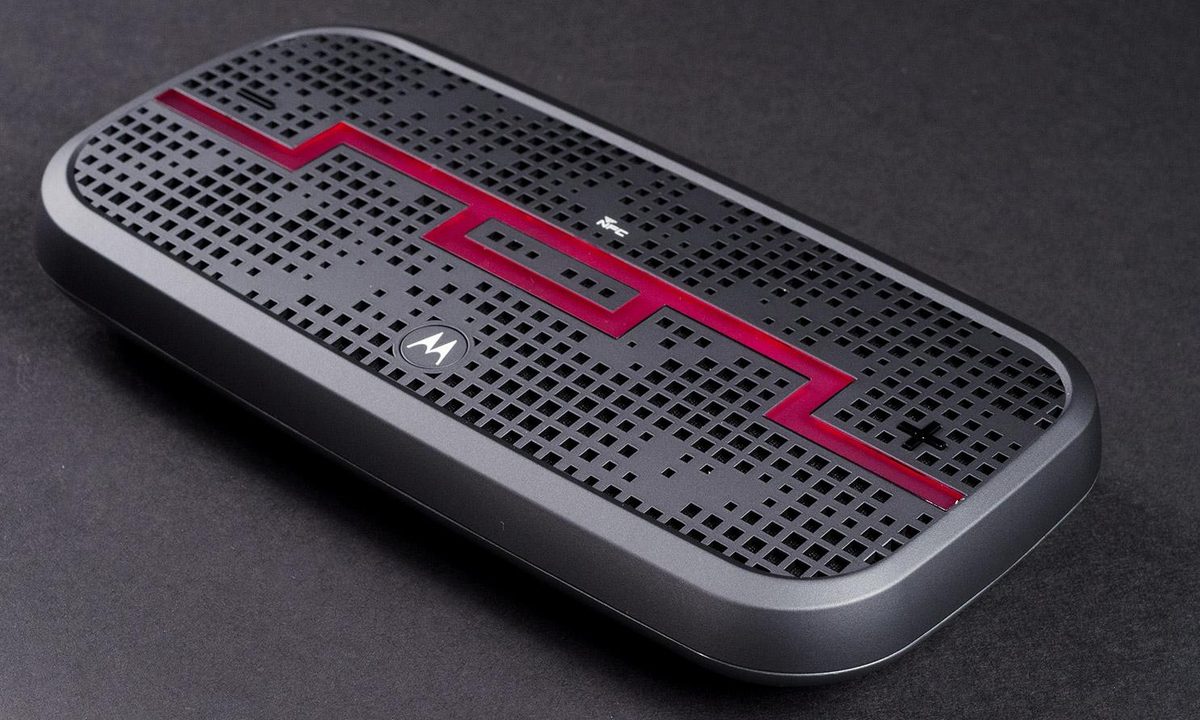
If you’ve watched much network TV lately, there’s a good chance you’ve seen a commercial showing a group of friends huddled around a funky-colored pad with a vibrant pattern of lights beaming across the top. The sleek little platform is called the Deck (available at $200), and it’s a new Bluetooth speaker that is the result of a joint venture between headphone designer Sol Republic, and mobile powerhouse Motorola.
The speaker had a real aptitude for the thick, fuzzy synth tones of EDM and electronic rock.
Unboxing
Out of the box
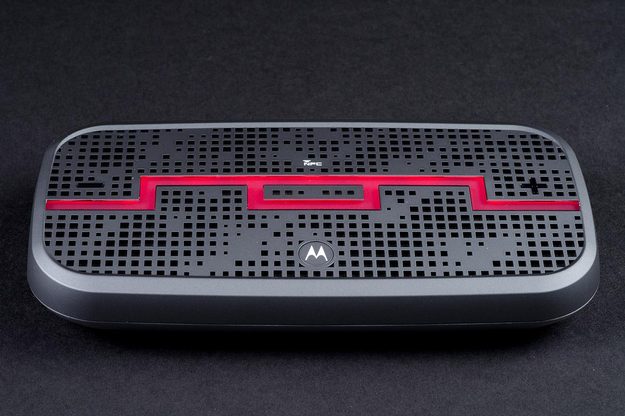
The Deck is packed in a slim box which matches the speaker’s slim profile. After some fumbling with the packaging, we removed the speaker from its bedding to reveal a flat pad, about the size and shape of a PlayStation Vita. The all-black device is covered with smooth, gripping silicone around the edges, with a rubberized pad underneath and wild patterns of cubes etched across the top and bottom faces. Our black model put off a more demure aesthetic, but the speaker is also available in brash shades of yellow and red.


In the bottom of the package we found a tight, black skin of a case, which is purportedly “acoustically transparent,” allowing you to listen clearly even while the Deck is suited up. Inside the case was a 3.5mm Aux cable, a USB to mini-USB charging cable, and a DC adapter with dual USB ports.
Features and design
The Deck’s flashy outward appearance may lead some to believe it’s all about looks, but after spending some time with the device, we realized its design is as much about usability as style. For instance, the laser light pattern that spells ‘SOL’ across the face (called the Status light) not only adds a cool visual element, but also assigns a color to each device it’s connected to (it can simultaneously pair with five). In fact, we can’t remember having a better initial user experience with a portable speaker. Everything from its pleasant blips and robotic voice, to the manual which reads more like a wisecracking buddy than a stuffy set of instructions was a refreshing change of pace.
…in Heist Mode, anyone can override the current track by simply pressing play on their connected device.
Holding the key switches an on-board EQ between “Indoor Mode,” and “Outdoor Mode,” which bumps up the upper frequencies to cut through ambient noise. The volume keys also pull multiple duties including cueing a battery update, which prompts the speaker to call out phrases like “battery almost full.”
On the Deck’s rear is its nerve center which includes a power button, a mini-USB charging port, an Aux input, an Aux output for daisy-chaining or connecting the device to a stereo, and a sliding key which slips the speaker between single user mode, Bluetooth pairing, and the Deck’s most unique feature: Heist Mode.
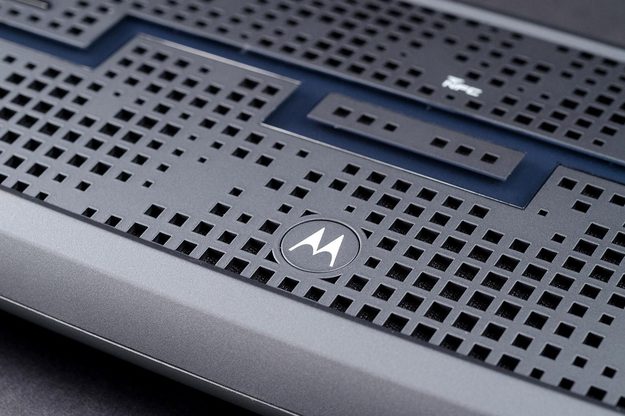
Sliding the switch to Heist Mode allows up to five devices to connect simultaneously. While in Heist Mode, anyone can override the current track by simply pressing play on their connected device, prompting a flash from the Status light of that device’s correspondent color. The speaker waits to pair new devices for five minutes after Heist Mode is activated, after which you can easily connect by toggling the switch to Bluetooth.
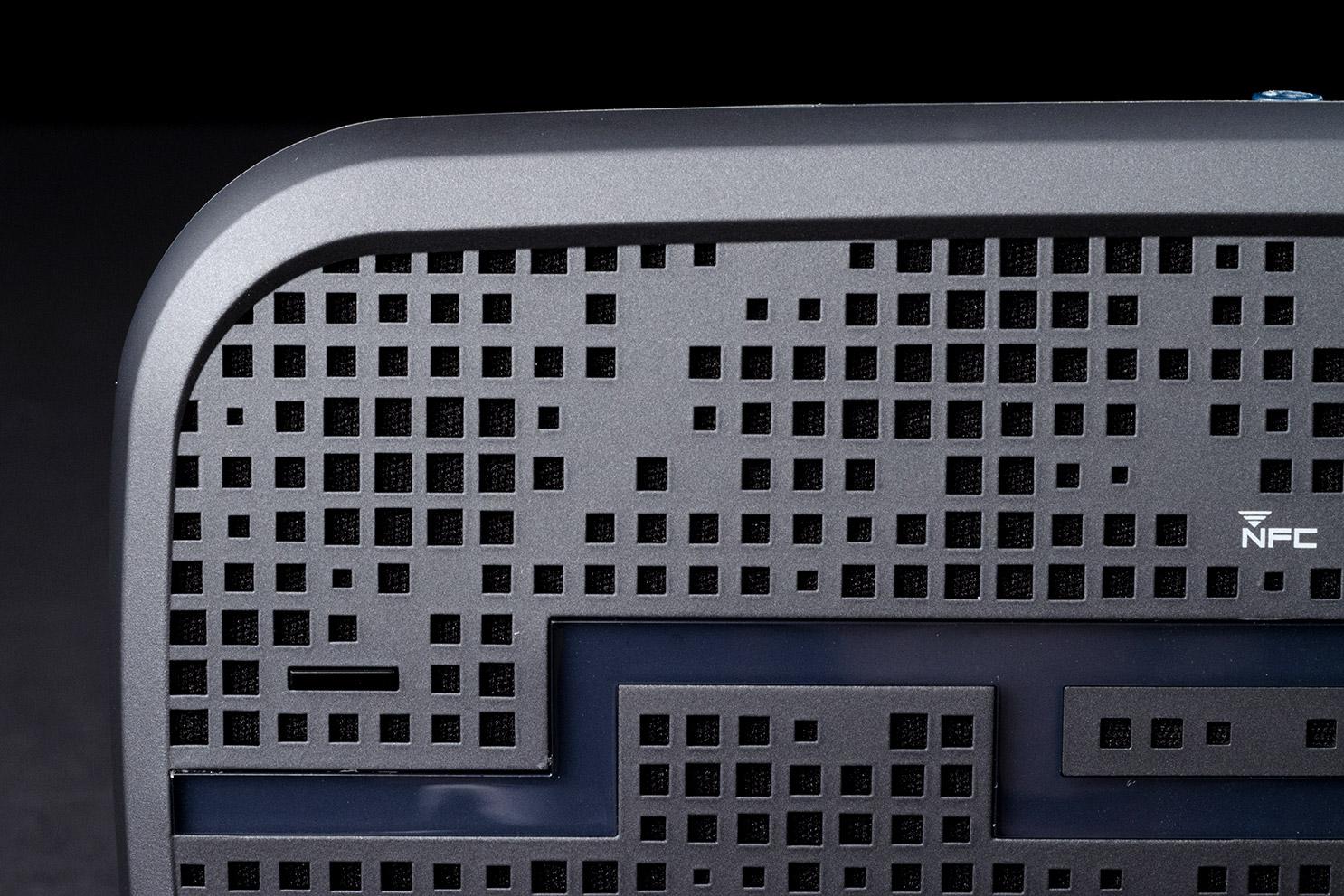
The Deck’s sound is handled by its omnidirectional “R2 sound engines.” Bass is reinforced by a small port at the left side. Other features include simple-touch NFC pairing, an estimated 10-hour battery runtime, and a purported 300-foot wireless range. That distance is almost 10 times the normal range of the Bluetooth protocol, and, frankly, we had our doubts about that number right away.
Audio performance
We sat the Deck at the center of our living room and threw just about every music genre we had at it. The little speaker produced a relatively powerful burst of sound, blending rich layers from the lower midrange, with a taught, transparent upper register. The sound occasionally leaned a shade too bright for our taste, and we wished for a bit more force down in the bass sometimes, but overall, the Deck did a good job balancing clarity and warmth for a pleasant sonic experience.
 The speaker had a real aptitude for the thick, fuzzy synth tones of EDM and electronic rock. When we cued up “Before Your Very Eyes” off the premier album from Atoms For Peace, the speaker poured out the Moog synthesizer’s fat sine waves with rich, analog warmth. And the Lion formerly known as Snoop Dogg’s “G Funk Intro” was kicked out with smooth fuzz bass, while countering with plenty of punch from the snare and hi-hats over the top. We did wish for more bass response here, and pushing the speaker too hard on heavier tracks such as this tended to invoke some clipping.
Like most speakers of its size, the Deck paid a lot of attention to the midrange
Like most speakers of its size, the Deck paid a lot of attention to the midrange, rendering vocals with a lyrical presence while still revealing admirable detail within the instruments underneath. One of our favorite examples came from the Cat Stevens tune “The Wind.” The speaker paid homage to the nooks and crannies of Cat’s intimate vocal lines, underscoring the consonances and timbres while still providing accuracy in the finger clicks and string slides from the foundational acoustic guitars.
We were less impressed when it came to lighter recordings, where the upper midrange seemed to falter a tad, especially in the percussion. Tracks like “Helter Skelter” from the Beatles’ White Album sounded chintzy in the cymbals and thin electric guitars, and we wished for more definition in the extreme treble. Still, it never became an overt issue, and we experienced plenty of enjoyable moments, from powerful pop rock tracks like Ben Folds’ “Rockin the Suburbs,” to the smokey horns of Ray Charles’ “Greenbacks.”
In the field
The first thing we tested outdoors was the speaker’s supposed 300-ft. range. Unfortunately, it did not reach that colossal distance for us. We got to just under thirty paces at line-of-sight before the speaker began to cut out. We worked that out to be approximately 90-feet – respectable, but a far cry from 300. That said, it’s the furthest we’ve ever gotten from a Bluetooth speaker without losing signal, and the connection never faltered indoors as we moved from room to room. We also auditioned the Outdoor Mode during our distance test, and the extra oomph in velocity and treble definitely helped the speaker cut through the air more clearly.
As for Heist Mode, it’s a freaking blast. Thanks to the override system, no longer will a party be ruined when a domineering compatriot’s phone pulls up Dan Fogelberg’s “Run for the Roses” on shuffle.
We experienced one instance of a phone dropping connection while testing the mode, but other than that, the feature worked brilliantly, flashing alternating colors as each phone pushed the others out of the way.
Finally, we took a few calls on the speaker, and it performed right at the top of our list, allowing for easy conversation on both ends without straining to hear, or hovering over the speaker.
Conclusion
While Sol Republic/Motorola’s new Deck isn’t our top choice sonically, it sounded good enough for our purposes, providing a clear midrange, a detailed upper register, and enough pulse in the low end to keep us happy. Pair that with a boatload of features, class-leading wireless range, and a fun, intuitive interface, and we think the two companies have crafted a winner here. The Deck’s $200 price tag is its biggest obstacle, and if your budget is tight, there are plenty of good alternatives like the JBL Flip or the Braven 600. But if you want a feature-packed speaker that looks cool, performs well, and stands out from the crowd, the new Deck is a solid choice.
Highs
- Clear, present sound
- Excellent form and function
- Packed with fun features
- Class-leading Bluetooth range
Lows
- Underwhelming bass response
- Occasional clipping at full volume on heavier tracks
- Pricey