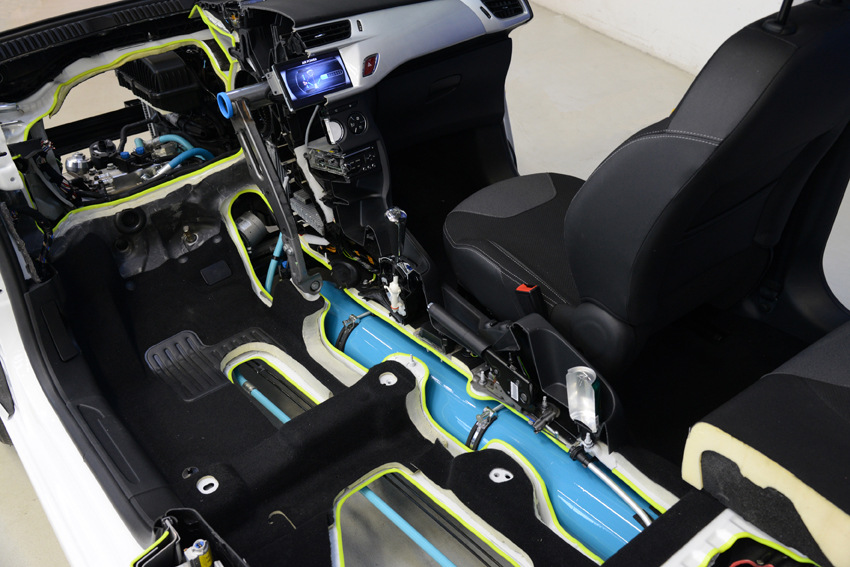
Peugeot Citroën this morning unveiled a new hybrid drive system unlike anything we’ve seen outside of a bushy-haired inventor’s shed. It’s a compressed air and gasoline hybrid. Unlike the other hybrid powertrains we’ve seen on the road, this one does not use a battery pack whatsoever.
Peugeot Citroën has posted plenty of pretty pictures and graphics for us but have been somewhat miserly with an English-language detailed system explanation. That said, here’s what we’ve been able to piece together from the broken English PDFs that were sent to us: Up front, under the hood, is a three-cylinder standard gasoline engine. Bolted to that is an automatic transmission. On the other side of the transmission is a hydraulic pump and hydraulic motor. These power systems propel the front wheels of the vehicle either alone or together, depending on the driving scenario.
Above 70 KPH (around 43 MPH) the gasoline engine drives the vehicle by itself, behaving like a standard gasoline-powered car. Should the driver apply the brake, the system will initiate the hydraulic pump, slowing the vehicle, capturing some of the forward energy, and storing it in the form of compressed air. This is commonly referred to as regenerative braking.
Below 70 KPH, however, the air system is engaged and depending on the driving demands will either power the vehicle alone – allowing the gasoline engine to shut off – or power the vehicle in tandem with the gasoline engine. Peugeot Citroën says a hill climb is perfect example of when the two systems would work together.
Our mechanical instinct tells us that simply using a hydraulic pump for regenerative braking alone won’t produce enough energy to propel a car very long. So there must be a way that the gas engine not only powers the car but also the hydraulic pump at the same time, filling the on-board tanks with compressed air. That, unfortunately, was not readily apparent from the Peugeot Citroën press release.
Peugeot Citroën plans to begin selling these new-style hybrids as soon as 2016 and aims to have 21 percent of its entire sales comprised of compressed air hybrids by 2020.
We love this new technology. It’s so simple; we can’t believe someone else hasn’t implemented it before. We’ve always been wary of hybrids that capitalized on precious earth metals for many reasons but at the same time loved the gas savings they presented. Now it appears we can have the best of both worlds.
reply to thomas skinfil;
I will assume you didnt read the article very closely or you would have noticed that this compressed air machine is not a compressed air machine. it requires a gasoline motor connected to a compressed air motor connected to a hydrolic drive motor..and nothing could go wrong….OK.
well, if YOU had read the article, its clear it IS a compressed air machine -with a limited air capacity. As with any compressed air-powered vehicle, to keep the air tank managebly small and to ensure a decent range on just the compressed air, of COURSE its wise to add a way to replenish the air tank while driving. All systems are compromises. However there are plenty of systems that run reliably for decades without undue maintenance or reliability issues. And hate to say it, but the linkages you made – gas engine to compressor pump, to motor/pump -doenst seem to be that complicated. Obviously Peugeot seems to think its simple enough, reliable enough, and tough enough to market it. Rather than just dumping on it as though you have all the schematics right in front of you, why not wait and see how it shakes out? That usually is the way things are best developed – not shelved because someone is “sure” that it has no merit whatsoever….
Wow. I hope they get this off the ground and into production. Sounds more sci-fi than reality
I think this is a bunch of hot air. this looks about as simple as necular physics in russian. Where did they
get this idea from a train wreck , this is a break down nightmare. I have patent a Sterling based heat engine that will get all the miles you can drive and use no fuel of anykind it has been built, tested and patent and i b et it will compete easily with this Rubes machine.
The compressed air technology has been around some time, and since its really just a tank of air and a pump, not much can go wrong. Its hardly a Rube Goldberg machine… and its NUCLEAR – not necular.
The compressed air machine is not just a compressed
air. this one says it has a gasoline engine, hooked to a compressed air motor hooked up to a hydrolic drive and nothing could go wrong…maybe you should have read the article a little closer..
necular.
Compressed air with a gasoline engine sounds pretty cool, but I wonder how further you could go with a diesel engine with this attached to it? Might turn some French and others in Europe since it’s hard to adapt diesels here in the States. It’s an abstract idea…
Hydraulic hybrids have been around a few years, UPS uses them in a few markets, This is just storing compressed air instead of fluid, but basically the same idea, and it works well in trucks. I guess in France the battery companies don’t have as strong a lobby as they do here.