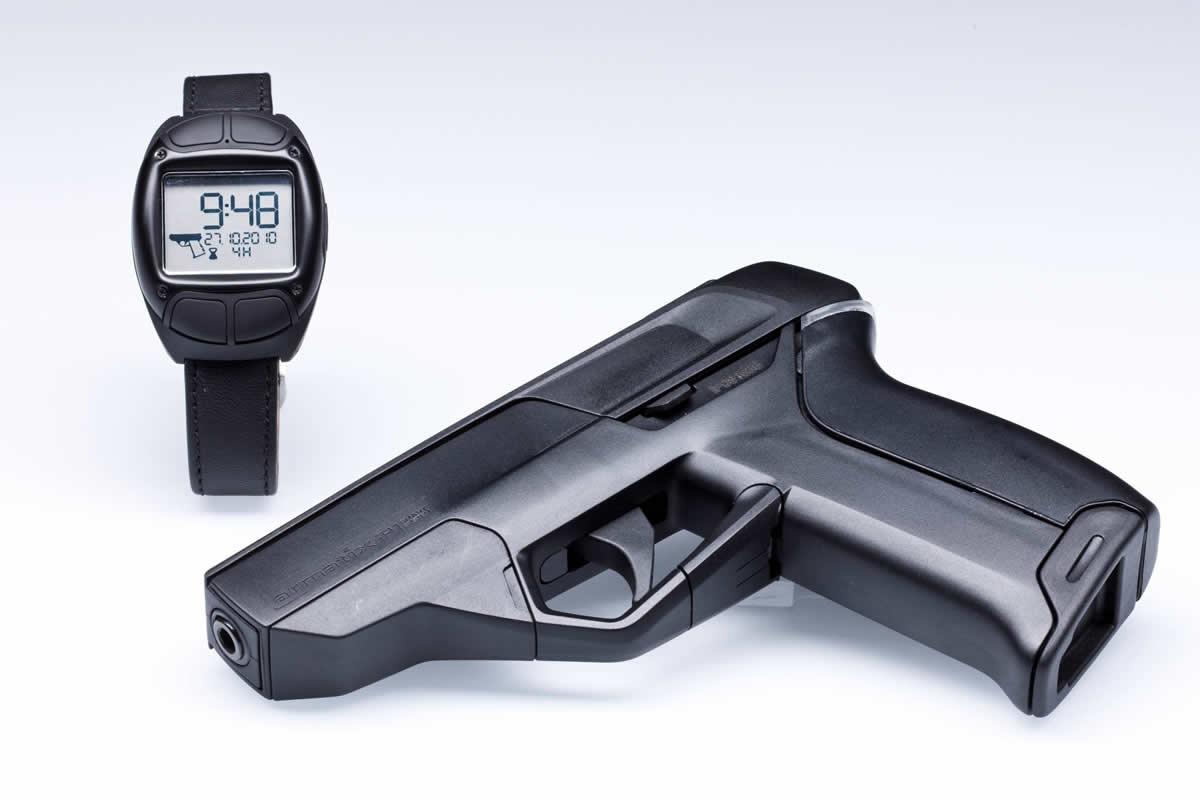
Detailed by the Washington Post earlier this week, the Armatix iP1 is a handgun that is only capable of firing when in range of the included waterproof wristwatch. Utilizing a RFID chip with a proximity of about ten inches, a light just above the grip will turn green when the gun is ready to fire. When the watch is more than ten inches away from the pistol, the light on the handgun will turn red and nothing will happen when the trigger is pulled. In addition to displaying the time, the watch also shows the charge level of the device, can be set for timed weapon deactivation and includes a PIN system for managing the weapon.
The downside to the Armatix iP1 is the exorbitant cost when compared to handguns of the same caliber or even a greater caliber. While a typical, mid-range .22 pistol can run between $300 to $600, the .22 caliber Armatix iP1 is being sold at about $1,399 in the United States and that doesn’t even include the watch. The RFID wristwatch costs an additional $399, so the entire package will be at least three times the cost of a standard .22 pistol. For the moment, only the Oak Tree Gun Club in Los Angeles is selling the weapon according to the Post.
Of course, Armatix isn’t the only company that’s building smart technology into weapons. A company called TriggerSmart has created a detachable piece on the handgun grip that contains a RFID chip. When the piece is attached, the gun is capable of firing within a quarter of a second. However, the handgun is incapable of firing without the RFID chip locked in place.
There are also development teams pursing research into other forms of smart guns. Silicon Valley investor Ron Conway put up a $1 million dollar prize last year for the creation of something similar to the fingerprint scanner on the iPhone 5S. Presumably, this technology would be sold or licensed to gun manufacturers. Speaking about the tech, Conway said “You let the free enterprise system take over. Just like everyone opted into the iPhone and abandoned the flip phone and BlackBerry, consumers will vote with their feet. We want gun owners to feel like they are dinosaurs if they aren’t using smart guns.”
There are a number of concerns with integrating smart tech into weapons. For instance, someone that forgets to swap out the battery within a RFID accessory could end up with a useless weapon when it’s needed the most. There’s also the potential for losing the RFID device. In a more sophisticated scenario, RFID jamming or hacking to respectively disable or enable the weapon without the need for the RFID accessory could be an issue.
Alternatively, proponents of the technology like the fact that the weapon would be useless if stolen by a criminal during a robbery or discovered by a member of the household that’s not allowed to handle the weapon. Taking the technology a step further into a hypothetical future, these smart functions could end up being tied to our mobile devices, thus providing functions like location tracking using GPS or remote disabling if the gun was stolen along with the RFID device.