  1. Home
  2. Phones
  3. Android
  4. Apple
  5. Mobile
  6. News

Tinder rolls out its new video-looping feature, Loops, across the world

Tinder now lets users across the globe upload GIFs to their profiles

Add as a preferred source on Google
Image used with permission by copyright holder

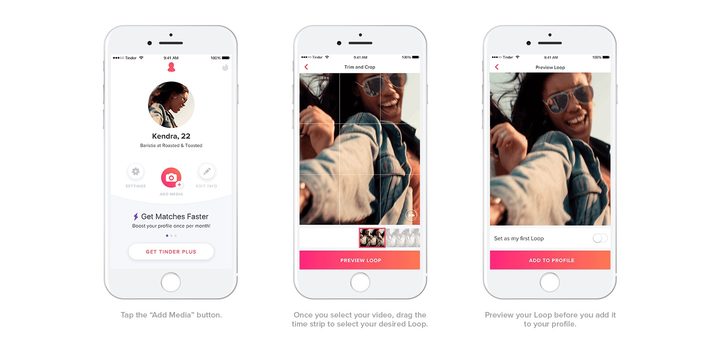
Back in April, Tinder announced it had begun testing out a new feature that will allow users to swipe through more than just photos. With Loops, users are able to create a two-second loop from an existing video that can then be added to their profiles. And now, three months later, praise be — Loops has been rolled out to more users (on iPhones) in countries around the world, including the U.S., U.K., France, Germany, and Spain.

Originally tested on iOS devices exclusively in Canada and Sweden, the feature (which is now more widely available) is similar to Instagram’s Boomerang. After uploading a video from your smartphone to the app, you will be able to drag the time strip to select where you would like the loop. Once you’re satisfied with it, you can then add it to your profile.

Recommended Videos

The videos are meant to be available in addition to the photos you already have attached to your profile. Currently, Tinder says it’s testing the ability to add nine photos or Loops in your profile rather than six.

With Loops, it seems the company is attempting to encourage its users to portray their more fun and active sides. Whether you’re filming yourself roller skating or playing sports, the new feature allows you to highlight your favorite parts and shorten it into a two-second video.

Tinder isn’t the first dating app to add a video feature. This past summer, Hinge gave users the ability to add upload an existing video from Facebook, Instagram, and their camera rolls. In addition to the photos and questions that are already featured on a user’s profile, the video is set on autoplay and loops as you scroll through a potential match’s profile — equipped with sound.

At the moment, the Loops feature only supports videos or Live Photos that are imported directly from your iOS camera roll. It won’t allow you to record Loops directly within the app the way Boomerang does.

But still, it may add just the right amount of dynamism to your online dating profile to get that right swipe you’d like from a welcome digital admirer.

Updated on July 5: Tinder has rolled out Loops to users across the world. 

Lulu Chang
Fascinated by the effects of technology on human interaction, Lulu believes that if her parents can use your new app…
TSMC might set up a price hike that could come straight for your next phone, laptop, or tablet
Here's what TSMC's rumored 10% chip price increase actually means in dollar terms, and why your next phone or laptop could end up costing more.
TSMC Fab

My wallet flinched the second I saw the words "TSMC" and "price increase" in the same headline, and honestly, yours should too.

Turns out the company behind the silicon powering basically every flagship device out there, including Apple’s A-series and Qualcomm’s Snapdragon processors, is reportedly about to make all of it a little pricier.

Read more
Samsung’s free storage doubling for preorders is gone in Austria, and the replacement isn’t as sweet
Samsung's free storage doubling deal might just be history.
The back of the Galaxy Z Fold 7

If you've pre-ordered a Samsung foldable purely for the free storage bump, tomorrow's Unpacked event might sting a little.

For years, pre-ordering a new Galaxy meant automatically getting double the storage at no additional charge. Buy the 128GB model, walk away with 256GB for the same price. The same applied to the 256GB and 512GB models. However, that might change at the upcoming Galaxy Unpacked event. 

Read more
Apple fixes Hide My Email bug that exposed users’ real email addresses
Here's how Apple's Hide My Email flaw leaked real addresses for over a year, and why it only got fixed once the story went public.
apple-merging-sign-in-with-apple-hide-my-email-icloud+

Turns out the "Hide" part of Hide My Email wasn't doing its job quite as advertised, something that I covered early in July. Security researcher Tyler Murphy reported the flaw in June 2025, but despite Apple claiming it was resolved in March 2026, independent tests confirmed it remained exploitable, at least until July 3, 2026.

So how did this bug actually work?

Read more