It pretty much goes without saying that — when you consider everything from our smartphones to giant displays like the Microsoft Surface Hub — there are more touch-sensitive displays around than ever.
But how do you easily pair them in a way that fits with the goal of achieving increasingly connected technologies? Researchers from Carnegie Mellon University have an answer. They’ve developed a system called CapCam, which lets users pair mobile devices with other touchscreens simply by pressing them together.
It’s a smart, speedy solution — and offers all the file-transferring capabilities that come from pairing devices, without any of the frustrating slowness of a technology like Bluetooth. Nor does it require added hardware like NFC technology. Instead, CapCam uses a device’s built-in camera, which is employed to register a brief flashing color pattern which conveys the instructions for pairing.
“Increasingly we have big, whiteboard-sized interactive touchscreen displays,” researcher Robert Xiao told Digital Trends. “Often these are used in public locations, such as subways. These displays are very useful: they can display information in a way that’s a good complement to smartphones. What we wanted to do with our work was come up with a way to pair these devices with our smartphones quickly and efficiently. We wanted to make it effortless, without fiddling with things like typing in codes or passwords, or scanning a QR code.”
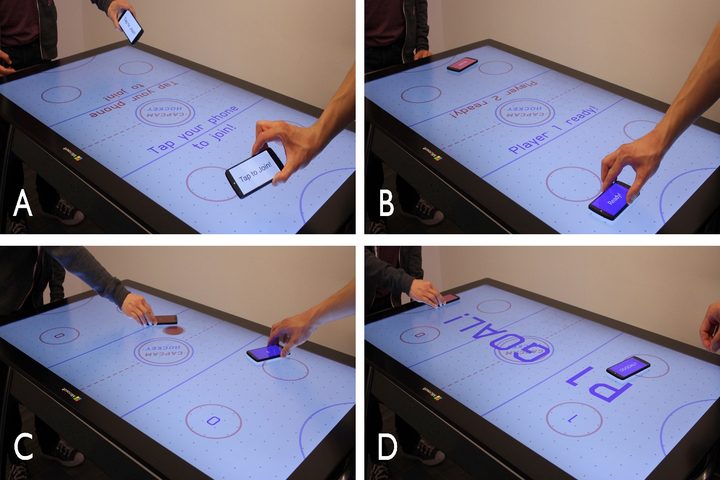
A video demonstration created for the project shows off some possible use cases for CapCam. These include useful applications like transferring files from one display to another, as well as more frivolous ones such as being able to use smartphones as paddles for a giant air hockey game on a much larger screen.
At present, the team is searching for a partner interested in licensing and commercializing the technology. Once this happens, it could be just a matter of time before it starts arriving on our mobile devices — possibly even as an app to download.
“You can imagine in the future that as larger touchscreens become ubiquitous, you’ll be able to use them to get important contextual information about your surroundings,” Xiao continued. “Walk up to a map in the mall or a real-time bus schedule, and you could immediately download that information onto your phone using just a tap. Another use case would be going to a meeting, and being able to press your phone to a display and immediately transfer the correct files for a presentation.”