1. Home
  2. Emerging Tech
  3. News

Watching a swarm of mini robots throw shapes is weirdly hypnotic

Add as a preferred source on Google

Like a flock of sparrows or a giant school of fish, researchers in Harvard University’s Self-Organizing Systems Research Group have developed a “large-scale robot collective” capable of assembling to form a variety of different shapes.

In the work — which was recently presented at the International Symposium on Distributed Autonomous Robotic Systems (DARS) — the 725 Kilobot robots start out in a tight grid-like group, before those not required to form a certain pattern disperse to leave the desired shape. Doing this requires a coordinated system in which the robots are able to determine a plan of action, based on a single overhead light, which they follow.

Recommended Videos

Impressively, much like the aforementioned example of birds or fish, they are able to do this despite only being able to communicate with robots up to three body lengths away — so that each robot can only communicate with a maximum of 36 other robots at any given time.
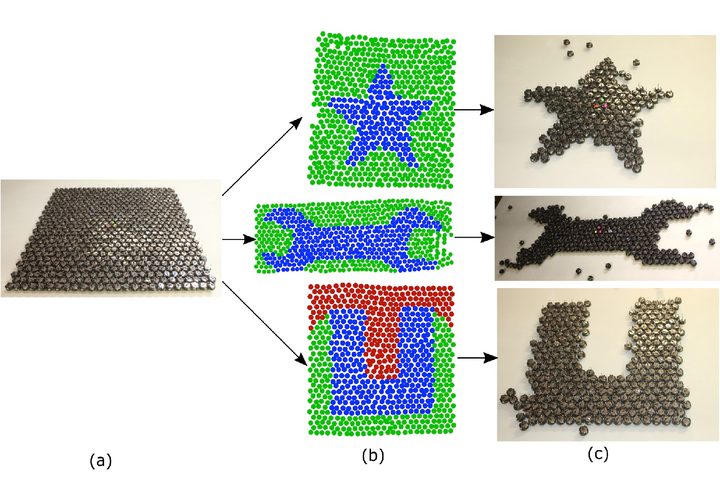
Image used with permission by copyright holder

“Shape formation is an important problem in multi-agent systems,” researcher Melvin Gauci, a postdoctoral fellow in the Self-Organizing Systems Research Group, told Digital Trends. “It is a challenging, multifaceted problem that requires high degrees of autonomy, and is therefore a good test-bed for integrating atomic algorithms into higher-level behaviors. In this case, the atomic behaviors include self-organized coordinate system formation, consensus, and random and light-based motion.”

According to Gauci, one possible real-world application of this work is in building multi-robot systems that are able to assume a desired formation in order to adapt to its changing environment.

“Further down the line, the vision is to scale these systems down in size to achieve programmable matter where a user will be able to create a tool or part on the fly from a ‘bucket’ of robotic ‘atoms,’” he said.


Luke Dormehl
I'm a UK-based tech writer covering Cool Tech at Digital Trends. I've also written for Fast Company, Wired, the Guardian…
Yet another study says AI is bad for elections, and the rabbit hole gets worse
AI may be an election bomb waiting for someone to light the fuse
Voters cast their ballots on Election Day

Another election, another study has concluded that asking an AI chatbot for political guidance is a spectacularly bad idea. Research conducted during Hungary’s 2026 parliamentary election found that ChatGPT and Google Gemini offered not just inaccurate but also inconsistent and unreliable voting advice. The chatbots misclassified voter profiles, overlooked relevant parties, recommended parties absent from the ballot, and sometimes produced materially different answers when given the same information repeatedly.

AI keeps failing the voter test

Read more
Samsung’s humanoid robot ambitions are real, but factories come first
Samsung’s new robotics division has humanoids in its sights, although its immediate business is far more practical factory automation
Robot Touch Human Finger

Samsung wants a place in the humanoid race, but its new robotics push begins with machines built for factories rather than homes.

The CEO-led RX robotics division will initially focus on manufacturing robots. Samsung has separately identified humanoids as a priority, although it hasn’t announced a commercial model or explained where one fits into the division’s immediate plans.

Read more
The future of AI may depend on this one behind-the-scenes change
Running Claude on Android.

Whenever a new AI model arrives, it's easy to get caught up in the bells and whistles. We talk about how much smarter it is, how quickly it answers questions, or how realistic its images have become. But here's the thing: none of that matters much if the AI can't reliably work with the apps and services people use every day.

That's why an upcoming update to the Model Context Protocol (MCP) caught my attention. It isn't a new chatbot or a fancy AI model. In fact, most people will never even know it's happening. But it could quietly make the AI ecosystem a lot healthier. If you've never heard of MCP before, don't worry. Think of it as a shared language that lets AI assistants safely talk to apps like Gmail, Slack, calendars, databases, and countless other services. Instead of every company inventing its own way to make those connections, MCP gives everyone a common rulebook.

Read more