  1. Home
  2. Emerging Tech
  3. Health & Fitness
  4. News

Scientists demonstrate that it’s possible to send lemonade over the internet

Add as a preferred source on Google

What could be better than having a cool glass of lemonade on a hot day? How about having a cool glass of lemonade on a hot day — that’s served over the internet?

That’s exactly what scientists at the National University of Singapore have been working on, with an experiment designed to simulate the taste and appearance of lemonade in a regular glass of tap water using a system of electrodes and sensors.

Recommended Videos

“The system consists of three main components: the lemonade sensor, communication protocol, and a customized tumbler, acting as the lemonade simulator,” researcher Nimesha Ranasinghe told Digital Trends. “Initially, the sensor captures the color and the pH value of the lemonade, and encodes this information based on an established communication protocol for wireless transmission. On receiving the information from the sensor, the lemonade simulator overlays the color of the drink on plain water using an RGB Light Emitting Diode (LED). and simulates sour taste sensations on the user’s tongue via electrical stimulation [by] applying controlled electrical pulses on the tip of tongue.”

According to Ranasinghe, there are a few possibilities that the work opens up. “We believe similar technologies will be helpful for sharing beverage or real flavor experiences with remote people digitally,” he said. “This will also helpful to cut down the calorie intake for patients on restricted diets. More interestingly, this technology will allow digital controllability or customization of the flavors in a beverage — for example using a mobile app.”
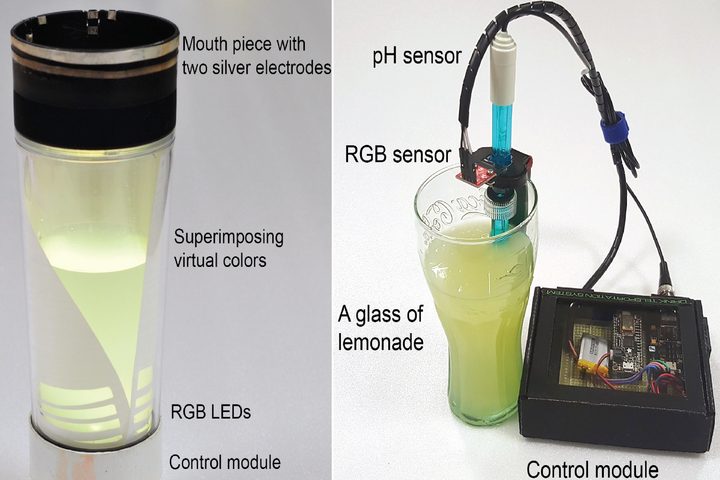
Image used with permission by copyright holder

There’s still work to be done, though. Without a scent element, which is far more responsible for how we taste things than many people realize, the taste spectrum that can be transmitted is fairly narrow. The team is now trying to integrate this sensory aspect, and is also working out how to transmit a sense of fizziness.

Over time, the plan is to be able to simulate any drink available. If that could help cut down on teeth-decaying sugars, or even allow a person to sip an “alcoholic” tasting drink without getting drunk, this may well turn out to be important research.

We’ll keep checking our in boxes, just in case. You never know when someone’s going to email us a beer!


Luke Dormehl
I'm a UK-based tech writer covering Cool Tech at Digital Trends. I've also written for Fast Company, Wired, the Guardian…
AI security cameras may soon recognize your walk before they recognize your face
A new AI gait system tracks body motion through skeletal keypoints, aiming at long-range identity checks where face scans and fingerprints fall short.
Security cam

Security cameras are built to look for faces. New research suggests they may soon have another target, the small habits buried in the way someone walks.

A paper published in the International Journal of Reasoning-based Intelligent Systems describes SKDMap-Net as a gait recognition system designed to identify people from walking video, even when the camera doesn’t get a clean look at their face. Instead of relying on a close-up scan, it studies how a body moves from frame to frame.

Read more
A 20-second 3D printer breakthrough comes with exactly the kind of catch science loves
The process can create complex microstructures far faster than some laser-based methods, but full 3D control is still a work in progress.
Aluminium, Smoke Pipe

A 3D printer that can make a structure in about 20 seconds sounds like a lab claim wearing a cape. The clever bit is real. The catch arrives before anyone starts dreaming about instant replacement parts.

University of Utah researchers have demonstrated a holographic 3D printing technique that hardens tiny structures in one exposure instead of building them layer by layer. That one-shot approach could avoid the weak, leaky seams that stacked printing can leave behind. For now, though, this is a tool for microstructures, not a shortcut to printing whatever object pops into your head.

Read more
Amazon is full of copycats and shady brands. This Chrome extension lets you avoid them.
Advertisement, Poster, Text

Shopping on Amazon used to be simple. You searched for a product, compared a few familiar brands, and checked out. These days, it often feels like you're scrolling through an endless parade of names that look like someone leaned on a keyboard before hitting publish. That's exactly the problem Knockoff is trying to solve.

Created by developer Josh Pigford, the Chrome extension doesn't promise to expose counterfeit products or magically tell you what's good. Instead, it tackles something arguably more annoying: the flood of unfamiliar, mass-produced brands that dominate Amazon search results.

Read more