  1. Home
  2. Emerging Tech
  3. News

This tarantula-inspired hexapod robot was built in its inventor's garage

Add as a preferred source on Google

“It’s a terrifying robot tarantula, run for your liiiii — oh, it’s slow. Maybe just walk for your life, then!”

The MX-Phoenix isn’t really that scary at all. It’s a six-legged, spider-inspired robot — yes, we know that spiders have eight legs — that uses 18 different motors to crawl over uneven ground.

Recommended Videos

Unlike most of the impressive robotics projects we see, MX-Phoenix didn’t spring from a top-flight university or Google-owned research lab, but rather from the garage of Norwegian amateur robot maker Kåre Halvorsen, aka Zenta.

An engineer at the Assistive Technology Centre for Rogaland in Bergen, Norway, Halvorsen’s robotics career is relegated to evenings and weekends.
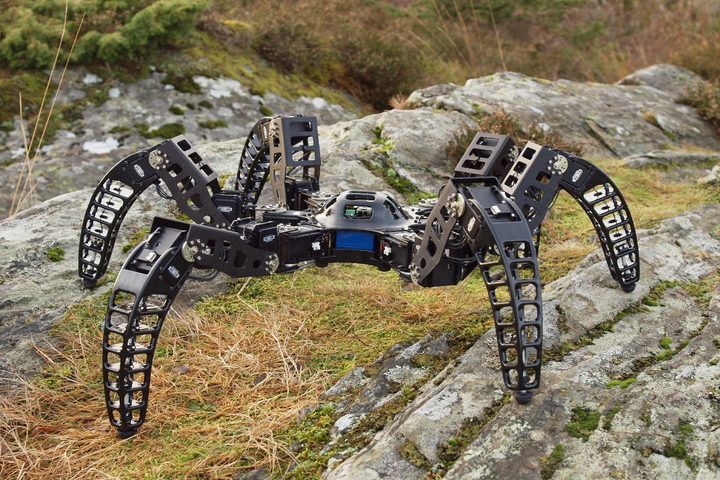
Image used with permission by copyright holder

“MX-Phoenix is a six-legged hexapod walking machine with three motors on each leg,” Halvorsen told Digital Trends abouthis latest creation. “Almost all parts are 3D printed in ABS plastic. It’s remotely operated using a custom-made remote controller. Unlike most of the hexapod robots, MX-Phoenix is able to walk on rough terrain, not just flat and level floor. All 18 motors are controlled using advanced control algorithms that are computed inside an onboard microcontroller.”

The robot has been in development since last November, but only took its first (surprisingly fluid) steps recently. The advantage of a hexapod robot is that it is more stable than two or four legged robots, and can keep moving even if a leg is disabled.

“My main goal is to have fun, and keep learning and developing new robots,” Halvorsen said. He added that a few potential uses for this particular bot could include “search and rescue” missions, or as some kind of animatronics tool for movies.

“My future plan is to work more on the gait algorithm and do some minor modifications,” he said.

There’s no word yet on whether he plans to market and sell this particular creation any time soon, but it’s certainly something we’d love to have crawling around our apartment.

Luke Dormehl
I'm a UK-based tech writer covering Cool Tech at Digital Trends. I've also written for Fast Company, Wired, the Guardian…
Anti-surveillance clothing is getting cheaper, but don’t expect an invisibility cloak
Affordable shirts now claim to confuse facial recognition, although their protection depends heavily on the camera and software watching you
Chart, Plot, Adult

Anti-surveillance clothing is starting to look less like an art-school experiment and more like something you could actually wear outside. Shirts designed to confuse facial recognition systems now cost about as much as ordinary streetwear, although buying one won’t make you disappear.

The Guardian reports that designers are using face-like prints, unusual cuts and infrared lights to interfere with computer vision. These techniques target specific weaknesses, so their success depends on what happens to be watching you.

Read more
This spinning drone hides in plain sight using a visual illusion
This drone doesn't turn invisible. It tricks your brain into thinking it has.
Phantom Twist

For decades, engineers have chased the dream of an invisible drone. The usual approaches have involved transparent materials, camouflage coatings, or complex optical systems that bend light around an object. Researchers at Northwestern University decided to take a completely different route. Instead of hiding the drone itself, they chose to fool the human eye.

The result is Phantom Twist, an experimental drone that spins so rapidly it almost disappears into the background. It's not technically invisible, but to anyone watching, it looks more like a faint blur than a flying machine.

Read more
This smart knitted fabric can flip switches, count your steps, and even change shape
Grandma's knitting just entered its Iron Man era
Representative Image

For most of us, knitting brings to mind sweaters, scarves, and perhaps an ambitious grandmother determined to make winter more fashionable. Researchers at Harvard University, however, have a far more futuristic vision. They've transformed ordinary knitted fabric into a programmable material capable of changing shape, acting as an electrical switch, sensing movement, and potentially forming the foundation of tomorrow's wearable technology.

The research, published in Advanced Functional Materials by scientists at the Harvard John A. Paulson School of Engineering and Applied Sciences (SEAS), demonstrates how machine-knitted textiles can "snap" between multiple stable shapes without relying on motors or rigid mechanical parts.

Read more