1. Home
  2. Emerging Tech
  3. News

A new way to fake photosynthesis could help put CO2 back where it belongs

Add as a preferred source on Google

Scientists at the University of Central Florida have discovered a method for triggering artificial photosynthesis using a synthetic material — opening up a new way to both generate energy and also convert greenhouse gases into clean air.

“The practical applications of this work include the development of future technology that will transform CO2 (carbon dioxide) into useful materials, including what we call ‘solar fuel,’” Dr. Fernando Uribe-Romo, a research professor who worked on the project, told Digital Trends. “This is very important because at the rate we currently emit CO2, plants on earth are not able to fixate this CO2 back into the earth — resulting in accumulation in the atmosphere, which is why we have global warming.”

Recommended Videos

The work involved the preparation of materials called metal-organic frameworks (MOFs). These materials contain nanometer-sized holes small enough to absorb carbon dioxide. They are then able to capture sunlight and store its energy in chemical bonds, transforming carbon dioxide into an intermediate state between CO2 and sugar.
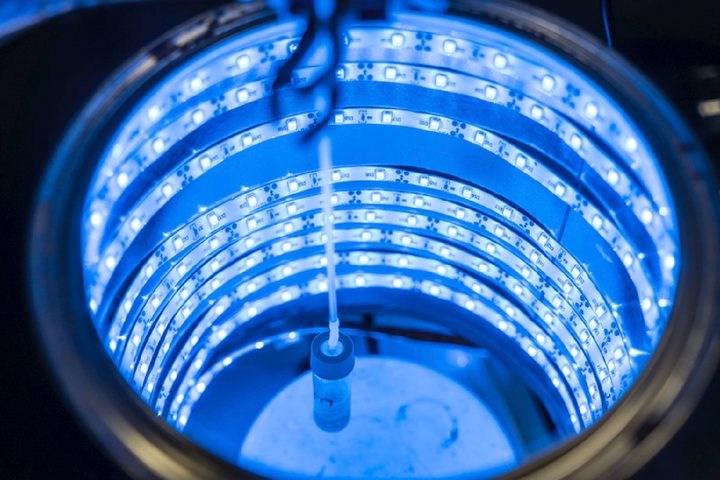
Image used with permission by copyright holder

Previous work by scientists has demonstrated that MOF materials can be used in this way to absorb energy from natural light. However, those earlier materials were both pricey and rare, and scientists have had difficulty developing alternative materials able to absorb sufficient energy to trigger photosynthesis.

“We made MOFs that contain titanium, a metal that is used commonly in artificial photosynthesis,” Uribe-Romo continued. “We added molecules that we call ‘light harvesting antennae’ that can help capture sun rays to promote the chemical transformations at more efficient rates.”

These light-absorbing materials are called N-alkyl-2-aminoterephthalates, and allowed for the absorption of blue light.

The eventual target, Uribe-Romo said, is to make synthetic materials that are as efficient as plants, or even more so, when it comes to carrying out photosynthesis. That could still be a way off, however. Right now, what the team has demonstrated is that this is a feasible technology. Next up is plenty more R&D to optimize the technique for real world use-cases.

“I foresee these materials being utilized primarily in large scale technologies that produce large amounts of carbon dioxide, for example power plants or in gas flare at oil refineries or oil drill sites,” Uribe-Romo concluded.

The work is described in a new paper published in the Journal of Materials Chemistry A.

Luke Dormehl
I'm a UK-based tech writer covering Cool Tech at Digital Trends. I've also written for Fast Company, Wired, the Guardian…
Starlink V5 is here, and it’s lighter, smarter, and far more efficient
The next-generation satellite internet kit promises improved efficiency while maintaining high-speed connectivity.
Starlink V4 vs V5

Not every hardware upgrade needs to be about speed. With Starlink V5, SpaceX is betting that a lighter design and lower power consumption matter just as much. The company has officially introduced its next-generation Starlink V5 kit, featuring a smaller and lighter design with significantly improved power efficiency.

Smaller, lighter, and far more efficient

Read more
Frontier joins the Starlink club with high-speed in-flight internet
The carrier plans to roll out SpaceX's satellite-powered Wi-Fi across its fleet starting in 2027.
Frontier Starlink partnership featured

If there's one thing budget airlines aren't exactly known for, it's great onboard Wi-Fi. In Frontier Airlines' case, it hasn't offered in-flight internet at all. That's about to change. Frontier Airlines has announced a partnership with SpaceX's Starlink to bring high-speed, low-latency internet across its fleet. Installations will begin in early 2027, making Frontier the first ultra-low-cost carrier in the United States to adopt Starlink's satellite-powered connectivity.

Streaming, browsing, and even gaming at 35,000 feet

Read more
OpenAI’s first hardware product sounds more like a companion than a speaker
The AI company is reportedly building a mobile home device that understands context and proactively helps users.
OpenAI press image

For months, rumors have suggested that OpenAI's first hardware product could be a wearable AI device, or perhaps even the beginning of its long-term smartphone ambitions. As it turns out, the company's first gadget may be something far simpler, yet arguably far more ambitious. It will help control smart-home appliances, play media, answer questions, respond to messages, and tap into the range of capabilities offered by OpenAI's ChatGPT, according to people familiar with the matter.

OpenAI's first AI device could end up being a speaker, following plenty of hype that the company is actually working on a wearable AI device and might even launch a smartphone down the road. According to a Bloomberg report, the speaker will serve as a human-like AI companion that will integrate directly with the smart home ecosystem.

Read more