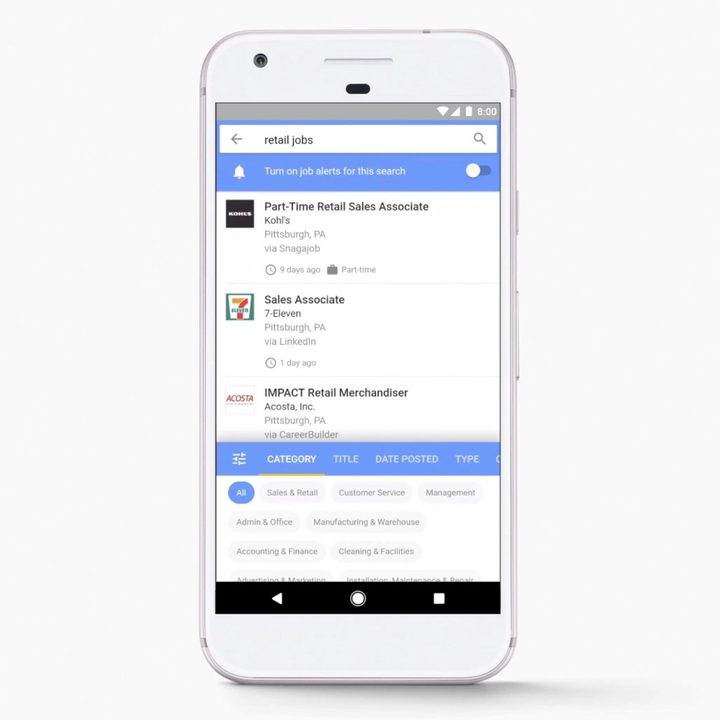
Google wants to make your next job search a lot less painful. That is one of the initiatives the company addressed during the keynote presentation of this year’s Google I/O conference in Mountain View, California, on Wednesday. It is called Google for Jobs and it embeds powerful and intuitive job search tools right in Google Search for faster, more relevant results.
Google demoed the feature during the presentation. A quick search for “retail jobs” brought up a list of nearby positions, which could then be filtered by category, title, date posted, and even commute times. You are even able to turn on job alerts based on the criteria you set.
The project was driven by a desire to solve what Google CEO Sundar Pichai termed a “complex, multifaceted problem” — the disconnect between talent shortages at employers and an abundance of people looking for work.
“Just like we focused our contributions on teachers and students through Google for Education, we want to better connect employers and job seekers,” Pichai said on stage at I/O.
To that end, Google’s CEO says the company has invested the past year in developing a machine learning-based solution — a cloud jobs API provided to employers that Google says has already produced promising results in testing. Johnson and Johnson, for example, cited an 18 percent increase in applicants through the use of Google’s API. Pichai says the list of employers using that API is growing, but the real magic begins when job seekers type their desired position into Google Search.
“We realized the first step for many people when they start looking for a job is searching on Google,” Pichai said. “So we built a new feature in search with the goal that no matter who you are, or what kind of job you’re looking for, you can find the job postings that are right for you.”
The CEO made a point to reiterate that Google’s solution is designed for employees of all wage and experience levels, as well as those working positions that have been historically difficult to classify or search for online.
Even better, Google is using machine learning to clear up the confusion created by employers using a wealth of different titles to describe similar positions, and job seekers being unable to adjust to the terminology used by each hiring office. So a search for “retail jobs” will produce results for store clerks, sales representatives, customer service associates, and more.
Tapping a listing will bring you to a Google-designed general overview page detailing basic information about the position, as well as a Maps window showing the location. An “Apply” button will send you instantly to the listing on the employer’s hiring site.
“Whether you’re at a community college looking for a barista job, a teacher who’s relocating across the country and you want teaching jobs, or someone who’s looking for work in construction, the product should do a great job of bringing that information to you,” Pichai said.
The feature should roll out to users in the U.S. in the coming weeks, with the rest of the world to follow.