1. Home
  2. Emerging Tech
  3. Health & Fitness
  4. News

More or less teeth? Computer modeling helps work out the recipe for a perfect smile

Add as a preferred source on Google

Computer modeling can do anything. It can create microworlds for teaching robots how to pick up real-world objects. It can help model the spread of influenza through social media posts. And it can let you know whether the smile you’re flashing Brenda from accounts receivable is more “welcome to the company” or crazy Jack Nicholson from The Shining.

This last idea is one that researchers from the University of Minnesota recently set out to explore with a new study, designed to uncover the components inherent in a good smile.

Recommended Videos

“We teamed up with a digital artist and medical facial specialists to develop a 3D model of the human face capable of realistically creating the subtle spatio-temporal variations seen in facial expressions,” Dr. Sofia Lyford-Pike, one of the author on the study, told Digital Trends. “We created short animations of smile-like expressions by systematically manipulating three spatial features: smile angle, smile extent, and teeth show, as well as dynamic symmetry. To determine which combinations of smile features were most successful, we asked over 800 participants to rate the smile animations in terms of their ‘effectiveness,’ ‘genuineness,’ ‘pleasantness,’ and perceived emotional intent.”
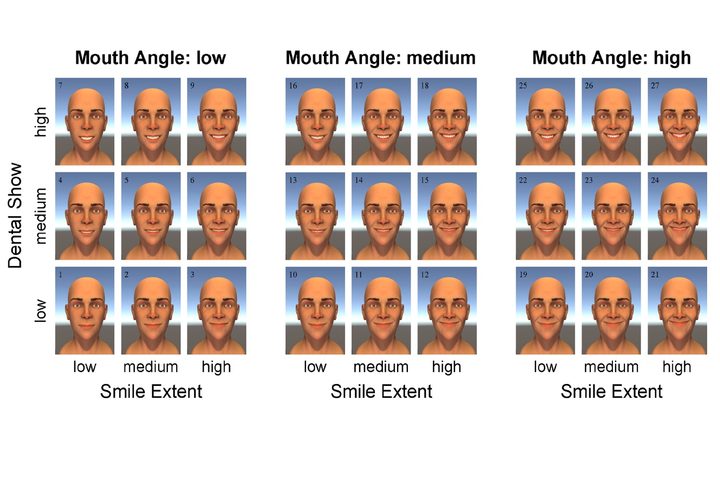
Image used with permission by copyright holder

The conclusion the researchers reached was that, for the most part, big V-shaped smiles with lots of teeth are worse than subtler, less manic ones. And that there is such a thing as a smile that’s too perfect. “Two aspects of the results were surprising,” Lyford-Pike said. “The smile ‘sweet spot’ that we discovered contradicts the ‘more is always better’ principle, which is currently guiding medical practice. [Also], slight temporal asymmetries are preferred over smiles that evolve in a perfectly symmetric fashion. To our surprise, perfect mirror image smiles were rated as faker and creepier than smiles with slight temporal asymmetries.”

If you’re wondering why researchers are investing so much time in figuring out the perfect smile, though, don’t worry: this isn’t open-ended research with no useful applications. “The goal is to understand precisely what makes a smile successful, for the purpose of improving facial reanimation surgeries for patients with partial facial paralysis,” Lyford-Pike concluded. “Beyond this immediate application, our results can be useful for creating more realistic animation of facial expressions in digital environments. A future goal is the development of personalized biofeedback applications, which can be used to improve one’s ability to display and perceive facial expressions.”

You can read the full study in the online journal PLOS One.

Luke Dormehl
I'm a UK-based tech writer covering Cool Tech at Digital Trends. I've also written for Fast Company, Wired, the Guardian…
OpenAI just made GPT-5.5 Instant more fun to talk to, and users may actually notice
The company says its most-used ChatGPT model is getting better at advice, decision-making, and everyday conversations.
Man using ChatGPT on a laptop

For years, AI companies have competed by talking about benchmarks, reasoning scores, and coding performance. OpenAI's latest ChatGPT update takes a different approach. Instead of focusing on raw intelligence, the company is making its most popular AI model more enjoyable to talk to.

OpenAI says GPT-5.5 Instant now better understands what users want

Read more
Claude can now join your Slack channels and work alongside your team
Laptop running Claude Fable

For years, AI assistants have been siloed. You open ChatGPT, Claude, Gemini, or Copilot, type a prompt, get an answer, and move on. Anthropic's new Claude Tag feature takes a different approach. Instead of making employees jump into a separate AI chat every time they need help, it brings Claude directly to where many teams already spend their day: Slack.

Add Claude to a channel, grant it access to needed tools, and tag @Claude for help — whether analyzing data, writing reports, reviewing code, or investigating incidents. But Claude Tag isn't just another chatbot integration. Its key differentiator is that Anthropic positions it as a digital coworker for your team, enabling seamless collaboration where multiple users can jointly interact with the same AI within their work environment.

Read more
Getty Images accused AI of wholesale theft. It’s now an official ChatGPT image partner.
Advertisement, Shop, Clothing

The AI industry's most fascinating stories often come from unlikely alliances, and this is certainly one of them. Getty Images, a company that has spent years raising concerns about how AI models are trained and how creative work is used, is now officially partnering with OpenAI.

The new agreement will allow Getty Images' licensed content to appear across ChatGPT's search and discovery experiences. That means users may begin seeing Getty's professionally licensed photos and visual assets integrated into ChatGPT responses, adding more visual context to searches and AI-generated answers. Getty says the goal is to make AI-powered search more useful and trustworthy by relying on high-quality, licensed content rather than the murky sourcing practices that have sparked countless debates across the AI industry.

Read more