The futuristic DFAB House at Switzerland’s ETH Zurich University is finally open, proving a bold proof-of-concept that was constructed using a first-generation robot that built a 200-square-foot home on the school’s campus. The project brought together a suite of cutting-edge technologies including 3D printing, modular construction, and new methods of construction. Reportedly, it’s the first house in the world to be designed, planned and built using primarily digital processes.
“The architectural potential of digital fabrication technologies is immense. Unfortunately, these technologies are still scarcely used on construction sites. With the DFAB House, we are able to test new technologies hand in hand with industry and thus accelerate the transfer from research to practice,” Matthias Kohler, ETH Professor of Architecture and Digital Fabrication, said in a statement.
While not the most cutting-edge smart home in the world, the DFAB House does come with a lot of nifty technology pre-installed. A simple command opens the blinds and warms the kettle for the inevitable cup of tea. Intelligent, multi-stage home security, automated glare and shading options, and the latest generation of networked, intelligent household appliances complete the design, at least for now.
The 200-square-meter house, which is mounted on the uppermost platform of the university’s modular research and innovation building, also saves heat from wastewater, pumps hot water back into the boiler when not in use, and employs photovoltaic modules on the roof that supply roughly one and a half times the energy needed to power the unit. More importantly, the project demonstrates the viability of a range of digital building technologies used together, instead of alone.
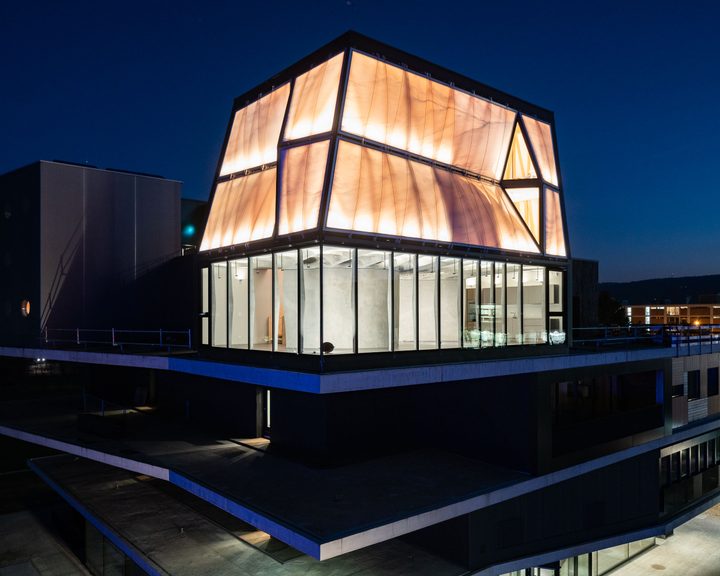
“Unlike construction projects that use only a single digital building technology, such as 3D-printed houses, the DFAB House brings a range of new digital building technologies together. This allows us to use the advantages of each individual method as well as their synergies, and express them architecturally,” Kohler said.
These new technologies included an invaluable new robot, the In Situ Fabicator I, which is mounted on caterpillar tracks that can fabricate dense mesh sections that act as a framework and reinforcement for poured concrete walls. This robot is dust-proof and waterproof and is internet-connected so that architects and builders can make real-time changes to its construction process at any time. Once the walls hardened, they were topped with an integrated ceiling slab manufactured by a large-scale 3D printer.
Simultaneously, the individual rooms for the second and third floors were prefabricated at ETH Zurich’s Robotic Fabrication Laboratory using constructing robots to assemble the timber and concrete elements.

In addition to testing new building and energy technologies under real-life conditions, the ETH Zurich house project will also enable the team to design solutions for future robots. The current In Situ Fabricator I is too heavy to enter many standard buildings, and can only manipulate objects up to 88 pounds. The team has already designed and built a next-generation robot arm with a hydraulic actuator that can manipulate heavier objects with equal precision and better reliability.
The DFAB House is part of the National Center of Competence in Research (NCCR) Digital Fabrication Project. Along with other futuristic construction experiments, the university has integrated the DFAB House on the periphery of the NEST (Next Evolution in Sustainable Building Technologies), a modular research and innovation building at the ETH Zurich campus.
In around two months’ time, the first residents and academic guests will move into DFAB House, testing it as a residential and working space for guest researchers of the NEST project.
Updated on March 12, 2019: The DFAB House is now open and residents and academic guests are expected to move in soon.