There are some amazing examples of how smart electroencephalography (EEG) interfaces can allow people to control everything from drones to prosthetic limbs using their thoughts. Neurologists at the University of Washington have just added yet another impressive feat to the collection by developing a hands-free, thought-controlled musical instrument — no movement required!
Its creators hope the technology can be used to help empower and rehab patients who have motor disabilities, resulting from stroke, spinal cord injury, amputation, or other pathologies.
“What’s exciting to me is that this combines two passions of mine: music and helping those with neurological disorders, that were previously two completely different lives I lived,” Thomas Deuel, the University of Washington neuroscientist who led the project, told Digital Trends.
The “Encephalophone” technology works using a brain cap that is able to turn brain signals into musical notes. It analyzes two brain signals associated either with the visual cortex or the part of the brain that deals with thoughts concerning movement. Thanks to a synthesizer, the resulting notes can then be used to sound like a broad range of instruments. In a study, 15 healthy adults were shown capable of using the instrument to recreate musical tones, without having to undergo training to be able to do so. A paper describing the work is published in the journal Frontiers in Human Neuroscience.
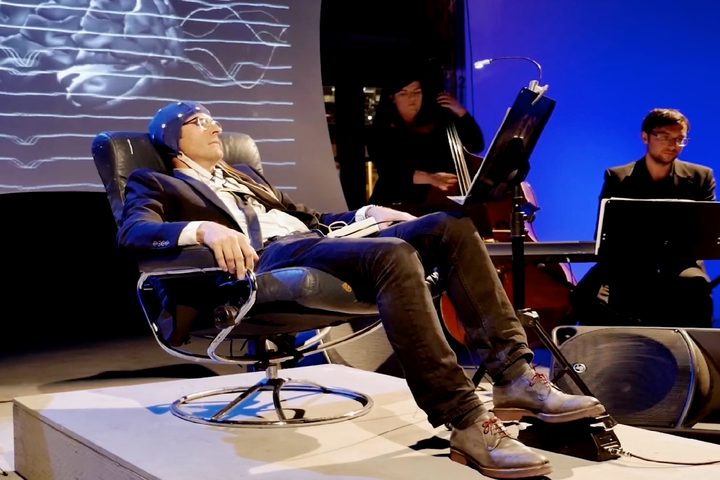
At present, Deuel said the majority of the demonstrations have involved the musical applications of the device, but he’s hoping that future studies can test whether it can aid with cognitive and motor rehabilitation for patients.
“We are going to investigate if the Encephalophone can be used to help in neuro rehabilitation for patients with motor disability,” he continued. “We are [currently] developing more advanced algorithms to improve the accuracy of the device, through such techniques as machine learning. We are [also] improving the musical generation algorithms to create more expressive capability, and will use the Disklavier at the University of Washington — a remote control real piano, as opposed to a synthesized piano — to allow patients to play a real instrument, with piano keys moving, without having to move themselves, using only thought control.”
Given that locked-in syndrome patient Jean-Dominique Bauby dictated his beautiful memoir The Diving Bell and the Butterfly while only being able to blink his left eye, perhaps it is not out of the question that a paralyzed musician may one day be able to use a tool like the Encephalophone to compose a great symphony!