  1. Home
  2. Phones
  3. Mobile
  4. News

Google taking ARCore to next level with AR Stickers, more on Pixel 2, Pixel 2 XL

Add as a preferred source on Google

Google launched ARCore, an augmented reality development platform for Android, in August. It’s available in preview on the Google Pixel, Pixel XL, and Samsung Galaxy S8 ahead of a launch on phones from LG, Asus, and Huawei. But that’s just the start. At an October 4 event in San Francisco, Google announced a slew of ARCore updates pegged for the holiday season.

One of the highlights is AR Stickers, a Google-designed app launching in preview alongside the Pixel 2 and Pixel 2 XL. Using ARCore’s environment-scanning algorithms, the app overlays digital decorations on surfaces like floors, tables, walls, and chairs. Google demoed a few inspired by the hit Netflix series Stranger Things at the event in San Francisco, and said it’s teaming up with brands like Disney, the NBA, NBC, Netflix, and others for the first few sticker packs.

arcore
Image used with permission by copyright holder

The other new ARCore apps are less exclusive — Google says they’ll work on “most” Android devices running 7.0 Nougat or newer. A new League of Legends app lets spectators watch matches unfold in their living rooms. An updated Lego app puts hundreds of digital kits and pieces at your fingertips. (Google showed a Lego astronaut zooming around in a spaceship.) And a shopping app from Houzz lets you pick, personalize, customize, and “place” furniture before you order it.

Recommended Videos

The Pixel 2 and Pixel 2 XL are uniquely optimized for ARCore, Clay Bavor, Google’s vice president of AR and VR, said. Thanks to high-fidelity gyroscopes and accelerometers, top-end cameras, and powerful image processors, they’re able to run most ARCore apps at a consistent 60 frames per second — a smoother image than you’re likely to get on less powerful devices.
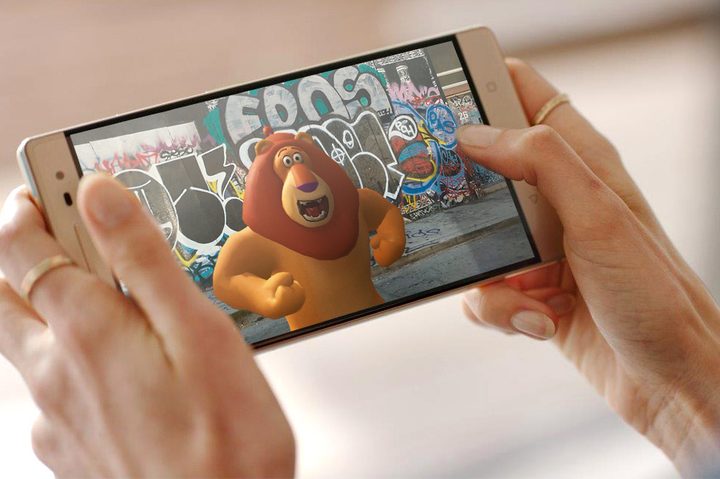
arcore
Image used with permission by copyright holder

Google said that ARCore focuses on three critical elements — motion tracking, environmental understanding, and lighting. It determines a device’s position and orientation in space by anchoring onto specific “landmarks” — furniture, for example — in a room, and adjusts for factors like ambient lighting. It’s not unlike Project Tango, the Google-designed depth-sensing platform built into LG’s Phab 2 Pro and Asus’s ZenFone AR. But Google sees the two technologies as complementary.

“We think of Tango more and more as an enabling technology — it’s akin to GPS, where you don’t see devices or apps branded as having this technical capability,” Google told us. “[The public] may not see consumer-branded Tango devices moving forward .”

The new ARCore-enabled apps will be available from Google’s AR Experiments showcase and the Google Play Store when they launch later this year.

Kyle Wiggers
Kyle Wiggers is a writer, Web designer, and podcaster with an acute interest in all things tech. When not reviewing gadgets…
Personal Intelligence in Search now connects to Google Calendar
Google Search AI can now read your Calendar and add events automatically
Google Calendar

Google is taking another step toward making Search feel less like a search engine and more like a personal assistant. The company has announced that AI Mode's Personal Intelligence can now connect directly to Google Calendar, allowing it not only to reference your schedule but also to create calendar events on your behalf.

Until now, Personal Intelligence mainly pulled information from apps like Gmail and Google Photos to provide more relevant responses. Calendar changes the equation because it becomes the first connected Google app that doesn't just provide context. It can actively act. The feature is rolling out now to users in the United States, with a wider international rollout planned later.

Read more
OnePlus’ North America and Europe chapter has officially come to an end
Existing owners will continue to receive software updates and warranty support, with the option to switch from OxygenOS to ColorOS down the line.
The rear of the OnePlus 15R, propped up on a wooden table.

After months of straight-up denying it, OnePlus just confirmed it’s tapping out of North America and Europe. In a community forum post, the company dressed up the news as a “proactive global strategy adjustment,” but for buyers in these markets, the outcome is straightforward. There will be one less brand to choose from the next time you go phone shopping.

Existing owners will get support, plus an optional software switch

Read more
Belkin’s new power bank can charge your phone and save you from stubbing your toes at 2am
Your next power bank could light the way to the bathroom
Furniture, Table, Lamp

Power banks serve a very simple yet handy purpose. Charge your accessories or phones in a pinch, while on the go. But every now and then, a model comes in with a little more style of functionality–like built-in cables or magnetic/wireless charging. Some can even charge up bigger gadgets like laptops.

But Belkin is doing something a bit different. The Belkin BoostCharge Pro Power Bank 10K with Motion Sensing Light has launched in China for 329 yuan, or approximately $49. Alongside its 10,000mAh battery and 45W USB-C charging, it carries a pop-up LED lamp that can illuminate a hotel room, bedside table, or dark hallway when it detects movement. 

Read more