  1. Home
  2. Cars
  3. News

Ford’s EksoVest exoskeleton turns workers into assembly line superheroes

Add as a preferred source on Google

Robots have been used on automotive assembly lines for decades. Way back in 1961, General Motors created an industrial robot that performed simple tasks like spot welding, and it didn’t take long for other automakers to follow suit. Fast forward to 2017 and there’s a ‘bot for almost everything — including Ford’s “Robutt” that tests the durability of car seats. Now, Ford is trying something new with a device called the EksoVest.

Instead of a fully automated machine, the EksoVest is an assistive upper-body exoskeleton that helps assembly line workers do their jobs more efficiently. It sprung from a partnership between Ford and Ekso Bionics — a company that has worked with BMW in the past — and is aimed at reducing the chance of fatigue and injury at work.

Designed specifically to help with overhead tasks, the lightweight wearable elevates and supports a worker’s arms and can be used by people between 5 feet and 6 foot 4 inches tall. The amount of assistance ranges from 5 to 15 pounds per arm, and while that won’t exactly help you in a scuffle with The Hulk, it will certainly lessen the physical toll of raising your arms 1 million times a year, which Ford estimates many of its workers do.

Recommended Videos

“Collaboratively working with Ford enabled us to test and refine early prototypes of the EksoVest based on insights directly from their production line workers,” said Russ Angold, co-founder of Ekso Bionics. “The end result is a wearable tool that reduces the strain on a worker’s body, reducing the likelihood of injury, and helping them feel better at the end of the day – increasing both productivity and morale.”

The EksoVest is currently part of a pilot program at two of Ford’s U.S. plants, but the brand plans to expand the program into Europe and South America soon. It’s not the only company experimenting with sci-fi-inspired tech. In 2016, Hyundai detailed a heavy-duty exoskeleton that allows its wearer to lift hundreds of pounds, and earlier this year, Roam Robotics debuted a featherweight exoskeleton made from foam, plastics, and fabrics that helps regular people deal with heavy lifting. Moving day, you’ve finally met your match.

Andrew Hard
Andrew first started writing in middle school and hasn't put the pen down since. Whether it's technology, music, sports, or…
Volvo is rolling out Apple Music to over 2 million cars with a simple OTA update
Your Volvo may soon get Apple Music without needing CarPlay
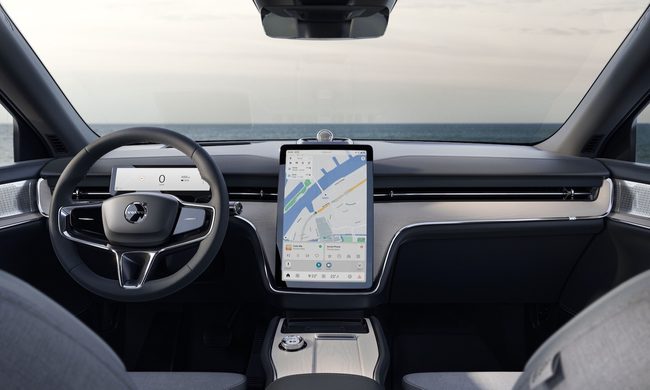
Interior view of the 2024 Volvo EX90.

The line between your smartphone and your car continues to blur. Volvo has announced that it is rolling out an over-the-air software update that brings Apple Music directly to the infotainment systems of more than 2 million vehicles worldwide. Instead of relying on Apple CarPlay or plugging in an iPhone, eligible drivers will be able to stream music natively from their car's built-in system, making Apple Music another integrated feature of Volvo's software experience.

The update is arriving for a wide range of Volvo models, including the EX90, ES90, XC90, S90, V90, XC60, S60, V60, XC40, EX40 and EC40, covering model year 2020 onwards. Availability, however, may vary depending on the vehicle.

Read more
Chery’s latest EV packs flagship tech for the price of a base Tesla, but you can’t buy it
Here's everything packed into Exeed's 2027 Exlantix ES, from its 27-sensor autonomous driving suite to its 860 km range, all starting under $31,000.
Car, Transportation, Vehicle

Chery's premium arm just dropped a sedan that makes you wonder why American EVs cost twice as much for half the tech.

Exeed's 2027 Exlantix ES ships with a driver-assist system called Falcon 700. It is built around an Nvidia Orin-Y chip and a genuinely stacked sensor suite.

Read more
A new AI model wants self-driving cars to think before they swerve
Forget guessing games, this self-driving AI actually shows its work.
Self driving car

Self-driving cars have gotten pretty good at driving. The harder problem is teaching them to drive safely in situations nobody planned for. We have heard horror stories of self-driving cars, behaving erratically in emergency situations, often times delaying first responders from reaching the scene.

A team at Seoul National University, led by professor Jun Won Choi from the Department of Electrical and Computer Engineering, thinks they have cracked part of that puzzle with a new AI model called SafeDrive. The research was recently selected as a highlight paper at CVPR 2026, a distinction that goes only to roughly 3% of all submissions.

Read more