1. Home
  2. Emerging Tech
  3. News

Octinion’s strawberry-picking bot is quick, nimble, and ready to replace humans

Add as a preferred source on Google

With everything from self-driving tractors to robots being able to monitor crops, it’s no secret that agriculture is currently in the middle of a high-tech revolution. Well, robots just added another farmyard job they can do better than us puny humans: Picking strawberries.

The robot in question is designed and built by Belgian engineering company Octinion. Using some smart machine vision algorithms and a 3D-printed hand, it’s able to work out when a particular strawberry is ripe for plucking, and then pick it off the forb (yep, we hadn’t heard that word either!) without causing any damage.

Recommended Videos

“We have developed a fully autonomous strawberry picking robot,” CEO Tom Coen told Digital Trends. “It’s able to navigate autonomously with centimeter precision. Thanks to local beacons, no structural changes to a greenhouse are necessary. Using our own 3D vision system, the robot can perfectly detect and localize ripe strawberries. Our patented soft touch gripper then picks strawberries without bruising, just like a human picker.”
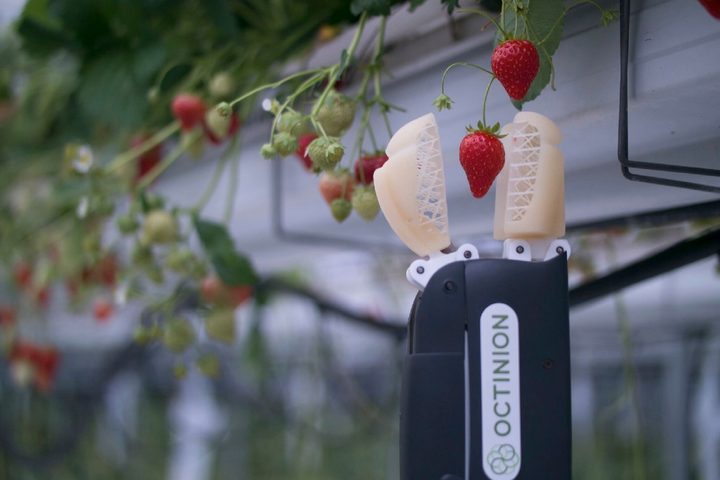
Image used with permission by copyright holder

While robots have been getting way better at the kind of fine-grain movements required to pick strawberries, Coen said the team still faced challenges developing their bot. One of the big ones was the risk of bruising the fruit, which they eventually solved using a “soft touch gripper that spreads the pressure evenly over the surface of the strawberry.”

Another challenge was figuring out whether the strawberries were ripe, which was achieved by training a dedicated AI system for the task, and also picking the strawberry without any of the attached greenery. This last challenge required turning the strawberry at an angle of 90 degrees, which required the creation of an entirely new robotic arm different to others on the market.

“The robot currently picks at a speed of one strawberry every five seconds, which is close to a human picker,” Coen said. But while humans may be able to beat the robot in terms of speed, the robot has the edge when it comes to not damaging the fruit, as well as being just as keen to pick at night (and on weekends and holidays) as during the day. “Most importantly, the robot picking cost is now competitive to the human picking cost,” Coen continued.
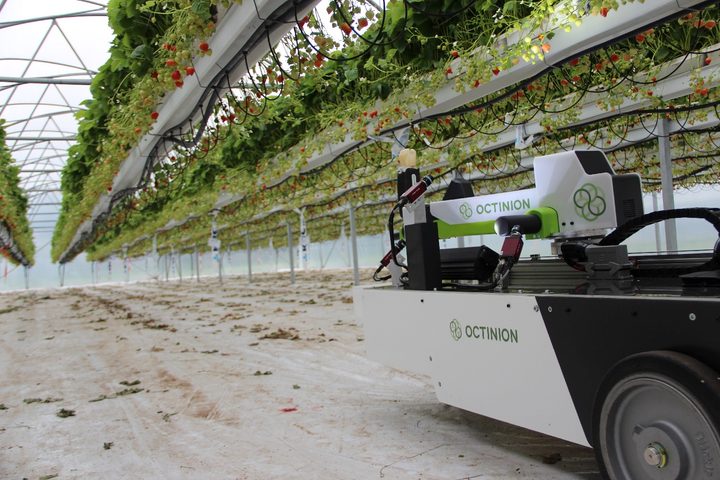
Image used with permission by copyright holder

Next up, the robot will expand its skills to also cover sorting the fruit in both size and quality, picking conditionally depending on strawberry characteristics, predicting harvests and precision farming, and packaging the strawberries up ready for shipping.

“Our robots will be picking strawberries for pilot partners in 2018,” he said. “We expect that we will have about 100 robots in greenhouses worldwide in 2019.”

Luke Dormehl
I'm a UK-based tech writer covering Cool Tech at Digital Trends. I've also written for Fast Company, Wired, the Guardian…
Starlink V5 is here, and it’s lighter, smarter, and far more efficient
The next-generation satellite internet kit promises improved efficiency while maintaining high-speed connectivity.
Starlink V4 vs V5

Not every hardware upgrade needs to be about speed. With Starlink V5, SpaceX is betting that a lighter design and lower power consumption matter just as much. The company has officially introduced its next-generation Starlink V5 kit, featuring a smaller and lighter design with significantly improved power efficiency.

Smaller, lighter, and far more efficient

Read more
Frontier joins the Starlink club with high-speed in-flight internet
The carrier plans to roll out SpaceX's satellite-powered Wi-Fi across its fleet starting in 2027.
Frontier Starlink partnership featured

If there's one thing budget airlines aren't exactly known for, it's great onboard Wi-Fi. In Frontier Airlines' case, it hasn't offered in-flight internet at all. That's about to change. Frontier Airlines has announced a partnership with SpaceX's Starlink to bring high-speed, low-latency internet across its fleet. Installations will begin in early 2027, making Frontier the first ultra-low-cost carrier in the United States to adopt Starlink's satellite-powered connectivity.

Streaming, browsing, and even gaming at 35,000 feet

Read more
OpenAI’s first hardware product sounds more like a companion than a speaker
The AI company is reportedly building a mobile home device that understands context and proactively helps users.
OpenAI press image

For months, rumors have suggested that OpenAI's first hardware product could be a wearable AI device, or perhaps even the beginning of its long-term smartphone ambitions. As it turns out, the company's first gadget may be something far simpler, yet arguably far more ambitious. It will help control smart-home appliances, play media, answer questions, respond to messages, and tap into the range of capabilities offered by OpenAI's ChatGPT, according to people familiar with the matter.

OpenAI's first AI device could end up being a speaker, following plenty of hype that the company is actually working on a wearable AI device and might even launch a smartphone down the road. According to a Bloomberg report, the speaker will serve as a human-like AI companion that will integrate directly with the smart home ecosystem.

Read more