  1. Home
  2. Emerging Tech
  3. Cars
  4. News

New Lidar tech uses 128 lasers to help self-driving cars see in high resolution

Add as a preferred source on Google

When it comes to autonomous vehicles, Lidar is one of the driving forces that make it all possible. A laser-based surveying method, Lidar builds up a depth-based image of the world by shining out laser lights and then measuring how long it takes for the reflected pulse to be bounced back to the sensor.

And thanks to the work of pioneering company Velodyne, Lidar just got a whole lot better.

Recommended Videos

Unveiled this week, Velodyne’s new VLS-128 sensor set a new record by doubling the number of laser beams on its previous top-of-the-line Lidar system to a massive 128, while shrinking the overall size of the sensor by 70 percent. By doing so, the system promises to bring a crazy new level of resolution to the myriad applications that call for Lidar technology — from helping cars drive autonomously to mapping sites from the air.

“A 360-degree Lidar sensor such as the VLS-128 is optimal for keeping drivers and passengers safe in all situations,” Anand Gopalan, chief technology officer at Velodyne, told Digital Trends. “It provides the clearest view of both stationary and moving objects on or around the road, and in any direction around the vehicle. In addition, Velodyne’s Lidar sensors are capable of producing up to 3 million data points per second, with a range of up to 300 meters and accuracy [of around] 3 [centimeters].”
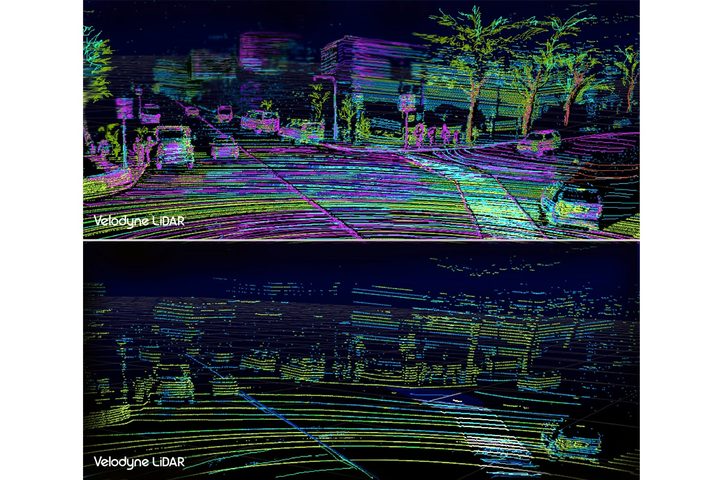
Image used with permission by copyright holder

As can be seen from the above image, the new VLS-128’s resolution is considerably better than its (already highly competent) predecessor. When you factor in faster scanning and better algorithms, it’s anywhere from three to 10 times better than existing technology. In terms of what this means for its use in the real world, Velodyne suggests that it will sideline other sensors, such as cameras and radars, that are used by current autonomous vehicles. While those other sensors will almost certainly stay a part of the next generation of self-driving cars, there’s a good chance that they will be relegated simply to acting as backup devices.

“We are ramping production up now, and we expect to start providing engineering samples to key customers by the end of the year,” Gopalan said. “Production will be fully ramped up in early 2018.”

Luke Dormehl
I'm a UK-based tech writer covering Cool Tech at Digital Trends. I've also written for Fast Company, Wired, the Guardian…
This new chip stacking technique could be the key to unlocking faster AI performance
Researchers solved the fragile chip stacking problem holding AI memory back, and the results are significant.
ai-chip-image

Every time you use ChatGPT or generate an image with AI, there is a memory chip working at extreme speed behind the scenes. However, that chip has a memory bottleneck problem, and a Korean research team may have just solved it.

Researchers at POSTECH (Pohang University of Science and Technology) developed a new way to stack more than 10 ultrathin semiconductor chips on top of each other, achieving a memory density roughly four times higher than the best commercial chips available today (via TechXplore).

Read more
ChatGPT can now finish what you started, and that’s a much bigger deal than it sounds
Man using ChatGPT on a laptop

Just a few minutes after unveiling its new GPT-5.6 family — Sol, Terra, and Luna — OpenAI is back with another announcement. This time, it's introducing ChatGPT Work, a new AI agent designed to do more than answer questions. Instead of helping with one task at a time, it can take on entire projects that span multiple apps, documents, and services.

If you've ever spent an afternoon jumping between different apps just to finish a single assignment, ChatGPT Work is trying to eliminate that back-and-forth. The idea is to describe the end goal and figure out the steps in between.

Read more
If you’ve grown tired of babysitting ChatGPT, the new GPT-5.6 models might be the fix
open ai logo on mac

OpenAI seems to have a new AI model waiting in the wings every few months, and today is no different. The company has officially unveiled the GPT-5.6 family, bringing three new models to ChatGPT, Codex, and its API. The big star of the show is GPT-5.6 Sol, but it's joined by Terra and Luna, which are designed to deliver strong performance at a lower cost.

The days of endless follow-up prompts may be numbered

Read more