  1. Home
  2. Emerging Tech
  3. Outdoors
  4. News

No batteries. No wires. No friction. These bike lights are powered by physics

Add as a preferred source on Google

When it comes to lights, cyclists typically have one of two options: Either a battery-powered light which needs replacing every so often or a dynamo-powered light which uses the spinning of your bike’s wheels to generate power, but which cause friction that can slow you down. A new Kickstarter campaign seems to offer a perfect third solution, however: Smart brake lights that work courtesy of a completely contactless dynamo-powered battery. The promise? Endless light without resistance — via so-called eddy currents, loops of electrical current induced within conductors thanks to a changing magnetic field.

To fit them, simply exchange your regular brake pads with the new brake lights. No batteries or cables required!

Recommended Videos

“When faced with Magnic Light for the first time, many believe that this is either a fake or a perpetual motion generator,” inventor Dirk Strothmann told Digital Trends. “Both aren’t true, but the underlying eddy current technology is so fascinating because the magnetic fields only appear when there is motion — in our case the rotating rim. By hiding a rotating magnet wheel inside a black box, the perpetual motion illusion is perfect. But in our case, this is more than a magic trick because this concept has several advantages over standard dynamos: an air gap between wheel and generator means no problems with dirt, rain or snow, and an encapsulated unit without external cables is better protected and feels like a battery light that is never empty.”
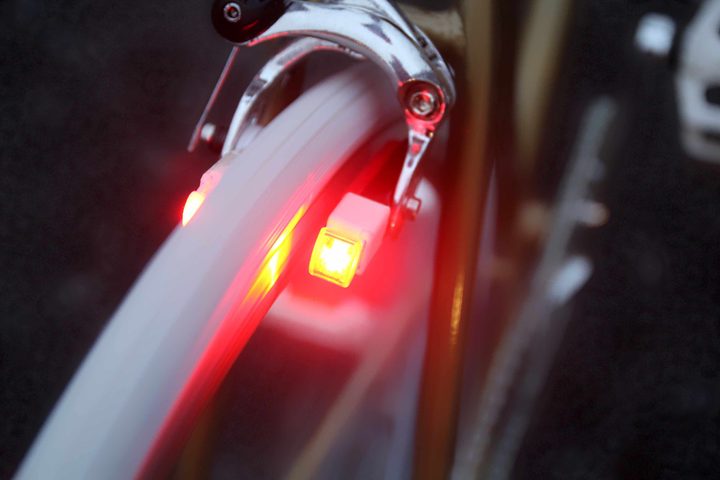
Magnic Microlights: Non-contact driven brake shoe bike light
Image used with permission by copyright holder

In addition to excellent illumination, Strothmann has also created smart versions of the brake lights which offer a turn signal that’s triggered via a quick double pump of the brake handle, alongside smartphone-controlled navigation signals and sensor-free speed tracking.

Strothmann is no stranger to Kickstarter. He has two successful Kickstarter campaigns he has delivered in the past, which means that people willing to stump up some pre-order cash aren’t doing so on an unproven entity. If you would like to get hold of some of his new lights, you can currently place an order on Kickstarter, where he is selling a set of both the smart new rear lights and also front lights for 99 euros (around $118). Other price options are also available — including a basic set of front and rear lights for a frankly ridiculous $1.20 (!!) for the first 1,000 people to sign up. Shipping is set to take place in November 2018.

Luke Dormehl
I'm a UK-based tech writer covering Cool Tech at Digital Trends. I've also written for Fast Company, Wired, the Guardian…
Anti-surveillance clothing is getting cheaper, but don’t expect an invisibility cloak
Affordable shirts now claim to confuse facial recognition, although their protection depends heavily on the camera and software watching you
Chart, Plot, Adult

Anti-surveillance clothing is starting to look less like an art-school experiment and more like something you could actually wear outside. Shirts designed to confuse facial recognition systems now cost about as much as ordinary streetwear, although buying one won’t make you disappear.

The Guardian reports that designers are using face-like prints, unusual cuts and infrared lights to interfere with computer vision. These techniques target specific weaknesses, so their success depends on what happens to be watching you.

Read more
This spinning drone hides in plain sight using a visual illusion
This drone doesn't turn invisible. It tricks your brain into thinking it has.
Phantom Twist

For decades, engineers have chased the dream of an invisible drone. The usual approaches have involved transparent materials, camouflage coatings, or complex optical systems that bend light around an object. Researchers at Northwestern University decided to take a completely different route. Instead of hiding the drone itself, they chose to fool the human eye.

The result is Phantom Twist, an experimental drone that spins so rapidly it almost disappears into the background. It's not technically invisible, but to anyone watching, it looks more like a faint blur than a flying machine.

Read more
This smart knitted fabric can flip switches, count your steps, and even change shape
Grandma's knitting just entered its Iron Man era
Representative Image

For most of us, knitting brings to mind sweaters, scarves, and perhaps an ambitious grandmother determined to make winter more fashionable. Researchers at Harvard University, however, have a far more futuristic vision. They've transformed ordinary knitted fabric into a programmable material capable of changing shape, acting as an electrical switch, sensing movement, and potentially forming the foundation of tomorrow's wearable technology.

The research, published in Advanced Functional Materials by scientists at the Harvard John A. Paulson School of Engineering and Applied Sciences (SEAS), demonstrates how machine-knitted textiles can "snap" between multiple stable shapes without relying on motors or rigid mechanical parts.

Read more