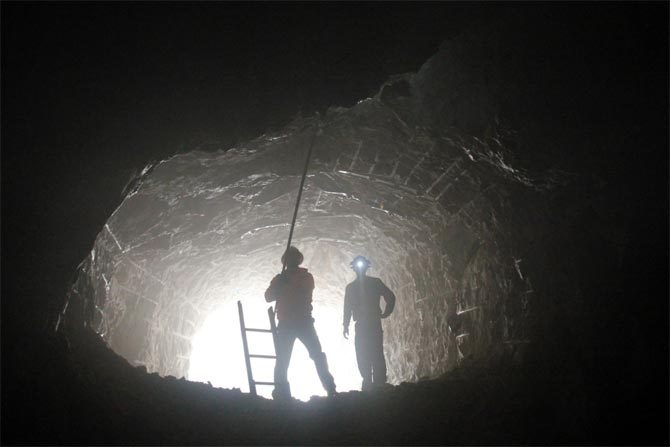
You may know Jeff Bezos best for sitting at the helm of Amazon, the e-commerce giant that is slowly but surely establishing full control over the entire world. But in a few millennia, we may know Bezos for something else — his role in building a 10,000-year clock. The executive has invested $42 million in this project, and it’s now being built inside a mountain in West Texas.
Installation has begun—500 ft tall, all mechanical, powered by day/night thermal cycles, synchronized at solar noon, a symbol for long-term thinking—the #10000YearClock is coming together thx to the genius of Danny Hillis, Zander Rose & the whole Clock team! Enjoy the video. pic.twitter.com/FYIyaUIbdJ
— Jeff Bezos (@JeffBezos) February 20, 2018
Standing 500 feet tall and deriving its power from the Earth’s thermal cycles, the 10 millenium clock is meant as a “symbol for long-term thinking,” Bezos said in a tweet. And while installation of the impressive piece of hardware has only just begun, the concept is actually quite well-established. In fact, the project was initially conceptualized by Danny Hillis (the founder of Thinking Machines Corporation) in 1989, nearly three decades ago.
As Bezos wrote in a blog post, “[Hillis] wanted to build a clock that ticks once a year, where the century hand advances once every 100 years, and the cuckoo comes out on the millennium. The vision was, and still is, to build a clock that will keep time for the next 10,000 years.” For the last six or so years, Bezos has been involved in the project, and considering that building a clock within a remote mountain is a “big task,” it’s quite lucky that one of the world’s wealthiest individuals is now involved.
“As I see it, humans are now technologically advanced enough that we can create not only extraordinary wonders but also civilization-scale problems,” Bezos continued in his blog post. “We’re likely to need more long-term thinking.”
Thus far, there have been a few prototypes of the enormous clock built, but this version — which Hillis is designing and Bezos is funding — will be the first that will be functional on a full scale. For the last few years, the team has been making the parts of the machine and drilling into the mountain in order to begin laying the groundwork. And now, installation of the hardware has actually begun.
Theoretically, once the clock is finished, curious visitors will be able to check out the landmark, though you’ll have to really want to see it. As the website notes: “The nearest airport is several hours away by car,” and you’ll then have to traverse a foot trail around 2,000 feet above the valley floor. But seeing as you have at least 10,000 years to see this clock in action, there’s really no rush.