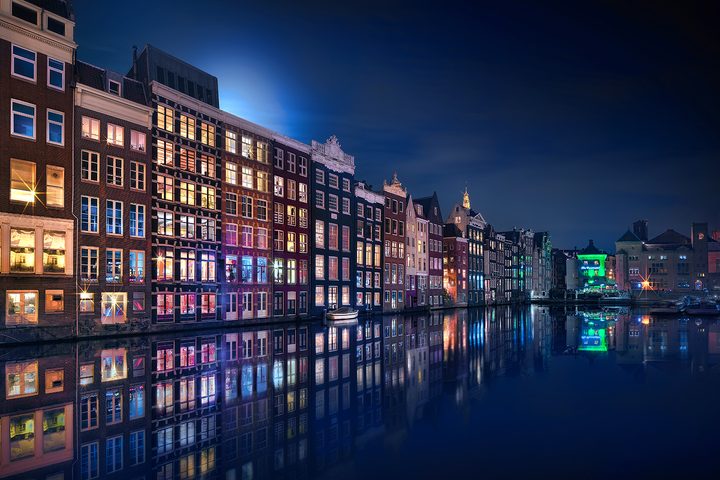
If you want to understand how far-reaching the effects of smart city technologies can stretch, look no further than the Netherlands. As a country with roughly 26 percent of its land below sea level, the Netherlands is used to supporting and maintaining major technical engineering projects. Today, it’s learning how to use data to take the country into a sustainable future.
And in Amsterdam, its largest city, you’ll find the most prominent examples of smart city initiatives in the country. With over 800,000 people, the city has historically enjoyed a reputation as a center of commerce and culture. It’s an enviable combination that you can see reflected in its smart city efforts, which have been well underway for a decade.
To build a smart city, start with data

Cities across the globe are installing technology to gather data in the hopes of saving money, becoming cleaner, reducing traffic, and improving urban life. In Digital Trends’ Smart Cities series, we’ll examine how smart cities deal with everything from energy management, to disaster preparedness, to public safety, and what it all means for you.
Amsterdam started its smart city initiatives when it used data analytics to improve urban life, using information to develop more integrated services and a more sustainable community. It has taken almost 10 years, starting with an inventory of the information the municipality already had. It turned out the mid-sized city had 32 different departments that created a staggering 12,000 different databases.
Since the initial assessment, the city has been working to leverage and integrate the daunting diversity of information, launching nearly 100 pilot projects in the process. Its efforts have earned numerous accolades, including a million-dollar Capital of Innovation award from the European Commission in 2016. Amsterdam has also appeared in the top 10 of the most advanced cities worldwide in the IESE Cities in Motion Index from the University of Navarra in Spain. Furthermore, the Netherlands is ranked by KPMG as the country best prepared for the future of mobility.
“We are very much in favor of learning by doing,” explained Florien van der Windt, a manager with the Netherlands Ministry of Infrastructure and the Environment. She also believes that to be successful, any project needs to be a cooperative arrangement between government, infrastructure companies, and technology innovators.
Amsterdam’s pilot projects have been wide ranging and ambitious. A trash collection initiative, for example, was aimed at reducing the waste and pollution caused by repetitive, inefficient truck pickup routes (which also generates excessive congestion on narrow streets shared with buses, cars, pedestrians, and most famously in the country, bicycles). Like in most cities, garbage and recyclables in Amsterdam are picked up separately, which is wasteful in itself. So AEB Amsterdam, which runs the largest garbage incineration waste-to-energy system in the world, decided to look for ways to improve sustainability. It created a pilot project to have residents separate trash into four different streams (biowaste, plastic, glass, and paper) using different colored bags. The color-coded system allowed trucks to pick up both trash and recyclables at the same time.
Other pilot programs have also changed city systems, and consequently citizen behavior. Amsterdam was one of the first cities, for example, to replace street parking meters with pay-by-smartphone apps.
Still, other projects look to further leverage the ubiquity of smartphones. The Amsterdam Institute for Advanced Metropolitan Solutions, which began with a $50 million investment, initiated a so-called Beautiful Noise project. The idea is to collect and instantly analyze what the organization calls “ambient geo-social data”–the information generated by visitors and residents on sites like Twitter and Instagram about what’s going on in the city. The Beautiful Noise program would then use the data to send out alerts about transit delays or long lines at venues such as the Rijksmuseum.
A country-wide effort
Similar data-based smart city initiatives have spread across the country.
To the south, in Eindhoven, a city of 227,000 people, the municipality has been working on several projects using what it calls a “triple helix” model of collaboration between government, businesses, and institutions of higher learning. The goal is to improve the quality of life in the city. For example, in a real-world experiment, the city has outfitted a popular street known for its nightlife, Stratumseind, with Wi-Fi on lamp posts, a welter of video cameras, and over 60 microphones. The goal is to detect early warning signs of aggressive behavior and alert the police before it turns into dangerous or illegal behavior. The local government has also experimented with changing the lighting on the street to affect the mood of the crowds and even used odors, such as the scent of oranges, to try to create a more relaxed atmosphere.
Indeed, safety is one of the primary motivations for smart city projects.
It’s not just Amsterdam. Similar data-based smart city initiatives have spread across the country.
In Woensdrecht, a town of just 22,000 inhabitants, a six-mile bike route to neighboring Bergen op Zoom was a dangerous path to take in the dark winter months. So, the city installed 65 smart street lights–LEDs that would turn on automatically when a car or bike was approaching and then turn off when there was no traffic. It’s made it safer for children to travel between the two towns in the dark after school.
For small communities, such smart lights represent a significant investment, but the lights last longer than traditional incandescent ones and require considerably less electricity. They also can be used to accommodate additional technologies in the future, such as connected cameras and microphones.
Sustainder, a Dutch company that makes smart lamps, says not only can such intelligent lights include infrared and ambient light sensors to turn on and off automatically, but they can also be equipped with accelerometers to automatically alert a local department of transportation whenever a lamp post is hit by a vehicle. Other possible features include air quality sensors, Wi-Fi mesh network transceivers, and future 5G transmission points.
It’s all part of urban integration, which even includes new perspectives on housing. A professor at the Eindhoven University of Technology, Theo Salet, is working on what may be the first-ever 3D-printed concrete houses, for example. Looking like something out of an episode of The Flintstones, such homes could be more sustainable and energy efficient than traditional houses. Meanwhile, Elphi Nelissen, another professor at the university, is working on the “Brainport” smart neighborhood. It is designed to include 1,500 homes to house approximately 3,000 residents.
Elsewhere, in the eastern Dutch city of Enschede, sensors around town pick up visitors’ Wi-Fi signals and track their location. The idea is not to follow citizens, but rather to learn about how people travel around the city, where they spend the most time, and how often they return. The anonymized information has already been used in projects like the Data SkyLine, a visual dashboard representation of information around town intended to spark new ideas and solutions to urban challenges. It has led to initiatives such as a traffic app that rewards users for walking, biking, or using public transportation to get to work rather than a car.
The lesson from the Netherlands: Expect gradual transitions rather than radical changes.
In Utrecht, a city of about 300,000 people in the center of the country, the government has invested more than $90 million over the last four years in about 80 projects. The spending has spawned intelligent utilities around town including smart garbage receptacles, smart street lights, burglary prediction, and a social media monitoring room. It’s also enabled the wireless sensing of illegally parked cars and the automatic issuance of parking tickets, something that some residents may not be happy about, but saves the city and ultimately the tax payers money.
Smart initiatives are not a one-time investment
One major lesson that smart city projects in the Netherlands have taught businesses and municipal governments is that smart initiatives need to keep evolving. Just as new solutions come along, societal behavior and a city’s needs change.
In Amsterdam, for example, the city has used GPS data from TomTom to help manage traffic. It initially based its traffic management on models that were created with 2011 data. However, the city had to update the system in 2016 because by then, Amsterdam had 25 percent fewer cars and 100 percent more scooters than it did back in 2011.
According to a study by the MIT Sloan Management Review, the numerous smart city projects in the Netherlands have another important lesson to teach other countries and cities: Expect gradual transitions rather than radical changes. And start by integrating the information you already have to create practical solutions.
“And don’t just focus on mobility, but also on livability,” van der Windt said.